
Civ 7 How to Play
★ Start Here: How to Play | Early Game
★ See the Best Leaders and Civs
★ Tech, Civics, Buildings, Units, & Wonders
★ Economic, Military, Science, Culture Victories
★Recommended Guides: Treasure Fleets
┗ Map Types | Trade Routes | Migrants
Learn how to play Civilization VII (Civ 7) with this guide if you are a new player to the series and genre. See a step-by-step walkthrough of what to do in your first turns and learn the basics to help you start your first game.
List of Contents
Gameplay Overview
Turn-Based 4X Grand Strategy Game
Civilization VII is a 4x grand strategy game where you'll play as a leader of a civilization. You explore lands, exploit resources, expand your control, and exterminate enemies across the world to achieve a selected victory that represents domination over other civilizations.
The game is played in a series of turns where you will perform actions such as constructing buildings in your cities, moving units across the map, researching technologies, interacting with other civilizations, and so on.
Goal of the Game
Victory Conditions
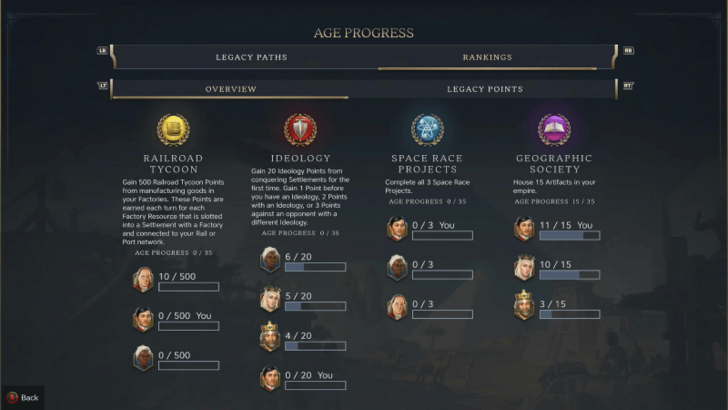
The goal in Civ 7 is to be the first player to achieve one of four victory conditions after three ages with each victory type pushing you to focus on the progress of a specific aspect of your civilization.
Victory Types
| Victory Type | Focus |
|---|---|
| Military | ・Capturing enemy settlements ・Building up armies ・Going into combat and wars |
| Economic | ・Trading with other civilizations ・Acquiring different and unique resources |
| Science | ・Advancing through the technology tree ・Creating rich and specialized cities |
| Cultural | ・Constructing Wonders ・Creating and spreading religion ・Researching and acquirng artifacts |
Aside from these, you can also win games by eliminating all of your opponents by destroying or capturing all of their capitals, or if no one was able to reach a specific victory after a set number of turns, the winner will be determined by points that depend on your overall performance.
Choosing a Victory Can Be Delayed
You don't have to decide immediately which victory you will go for at the start of the game. This decision can be delayed as several factors such as map position, enemy behavior, available resources, and others can affect how easy or difficult a victory condition may be.
Leader and Civilization Choice
It Doesn't Really Matter
If this is your first game of Civilization, it's best to choose whichever leader and civilization appeals to you thematically, as regardless of how you approach it, this will be a learning game where you will make a lot of mistakes. Embracing the chaos and shenanigans is one of the biggest appeals of the game series.
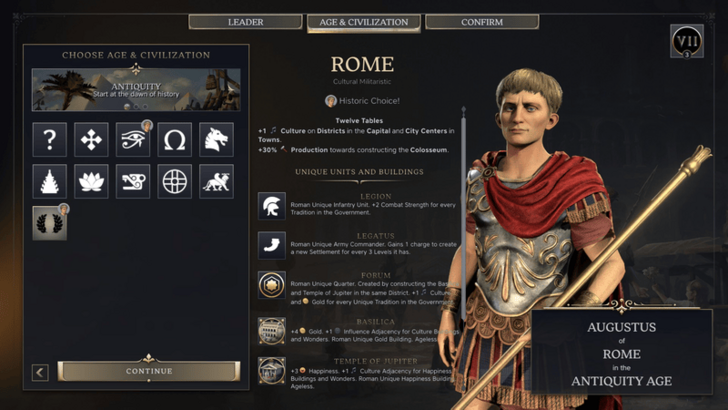
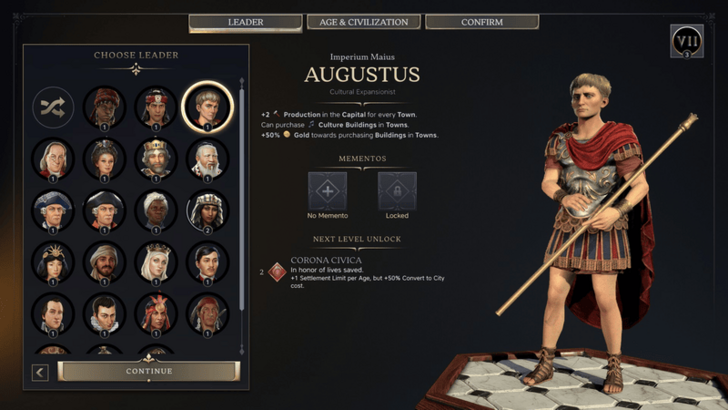
Best Beginner Civ and Leader: Rome - Augustus
| Civilization | Leader |
|---|---|
 |
 Augustus Augustus |
Rome is the ultimate beginner-friendly powerhouse, blending Culture, expansion, and military might with ease. While Augustus makes Rome one of the best beginner-friendly Civs thanks to his straightforward and powerful bonuses.
First Game Settings
- Governor Difficulty
- Quick Game Speed
- Continents Plus Map Type
- Small Map Size
This doesn't really matter either, but for a learning game, it can be slightly better to keep things quick and simple, so you can get through it faster and immediately start the next game where you can apply everything you have learned.
The Map
Civ is Played on a Hex Grid
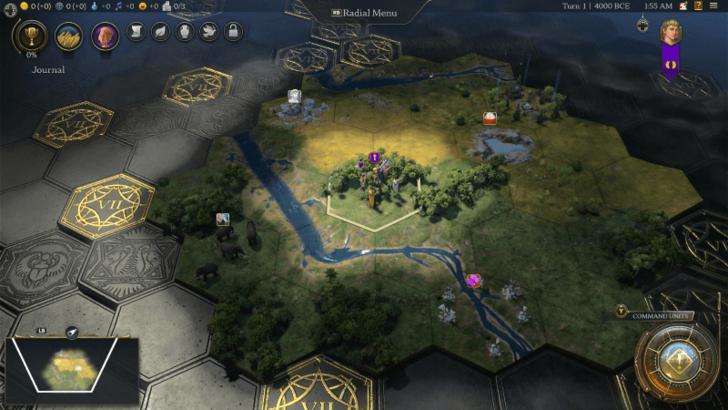
At the start of a game, the first thing you'll be greeted with is a bunch of tiles and icons. Civilization is played on a hex grid with each hex representing one tile and each tile having different characteristics such as terrain type, yields, and resources. By highlighting a tile, you'll be able to see these characteristics.
Yields and Resource Icons
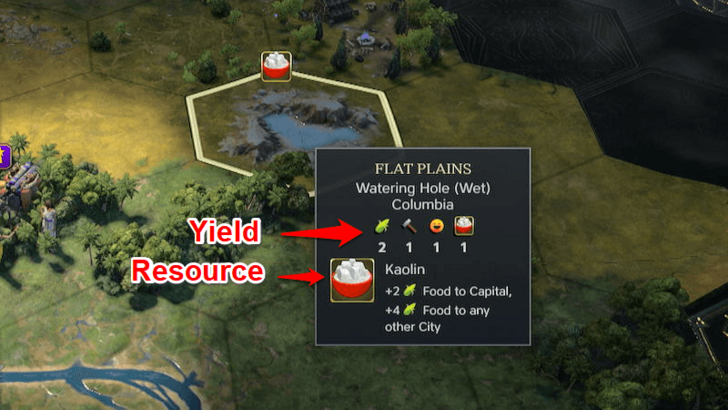
An important aspect of Civilization games is resources and yields. A huge part of the game is building up your cities to acquire and produce as many resources and yields as you can which in turn will be used to perform actions. To put it simply, the more resources and yields you have, the more you can do and the faster you can do things.
You can acquire the resources and yields on the map by improving the tile they are on which will be explained in a later section.
Note that the collection and use of some yields are restricted to their settlements, while some are pooled and shared to the entire civilization. You can tell which yields are pooled and shared from the ones that appear on the upper left side of the screen.
List of Yields
| Yield | Use |
|---|---|
 Food Food |
Used to grow your population. |
 Production Production |
Used to produce units and construct buildings |
 Gold Gold |
Used to purchase various things |
 Influence Influence |
Used to interact with other civilizations and independent people |
 Science Science |
Used to research technologies |
 Culture Culture |
Used to research civics |
 Happiness Happiness |
Used to prevent penalties and incidents |
Tick Decoration Options for a Better View of Yields
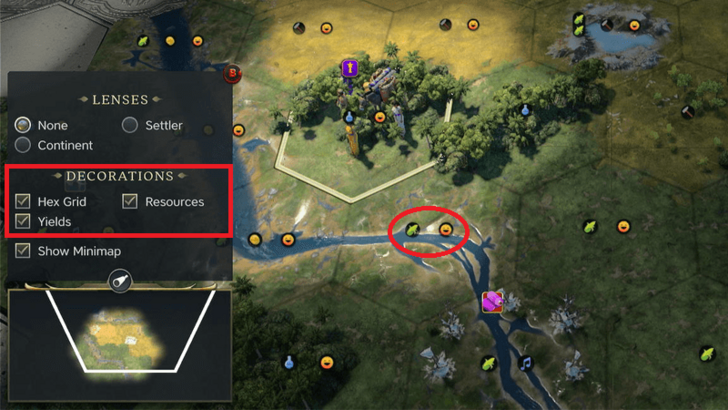
Note that you can turn on and off several options in lenses and decorations to get your preferred view of the map.
The First Turns
| What to Do in the First Turns |
|---|
|
|
Found Your Capital
Settle Near Tiles With High Yields and Fresh Water
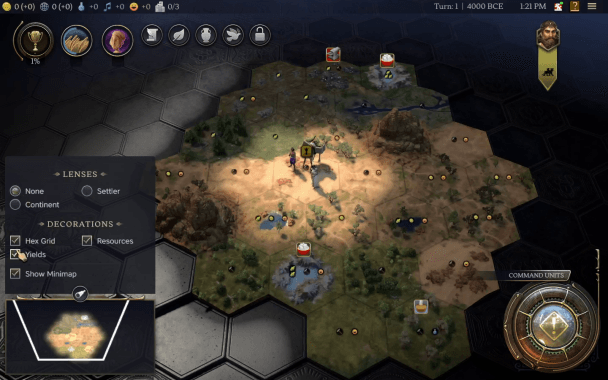
The best way to judge whether or not you should establish your capital in a tile is if the area has an above-average yield of food and resources. You need a lot of food to grow your settlements, especially in the Age of Antiquity.
It is also best to build your capital on freshwater tiles or near bodies of water like rivers. They will enable strong buildings to be built later on and grant your settlement a Happiness bonus.
However, don't take too many turns looking for the perfect tile when establishing your capital as you might end up behind your opponents early on. Use up to 1 or 2 turns max to move to a different tile if you happen to end up on a bad tile.
Produce Scouts and Explore
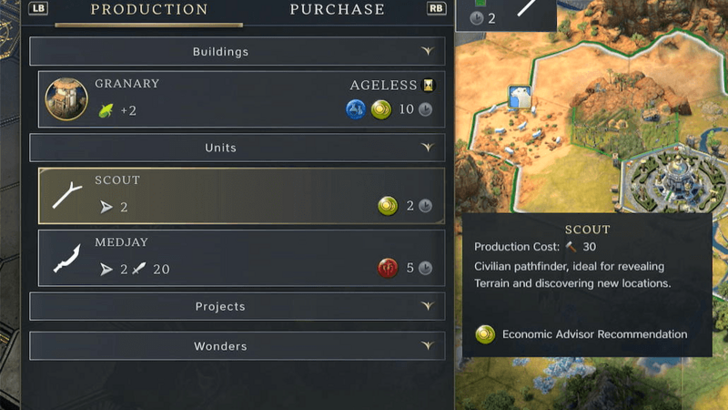
Scouts are almost always the first thing you should produce as nothing is more important than finding out what's around you. It's best to produce at least two scouts immediately to explore two different directions.
Note that the number beside the clock icon indicates how long the scout will take to be produced which is based on the settlement's production yield (hammer icon).
| What to Look Out for When Exploring |
|---|
|
|
Discoveries
 |
 |
 |
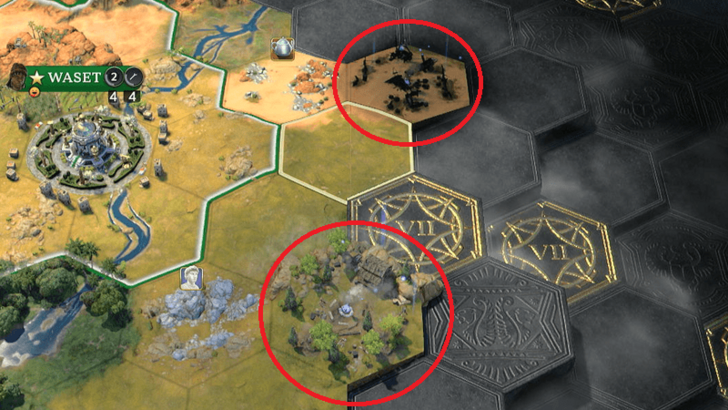
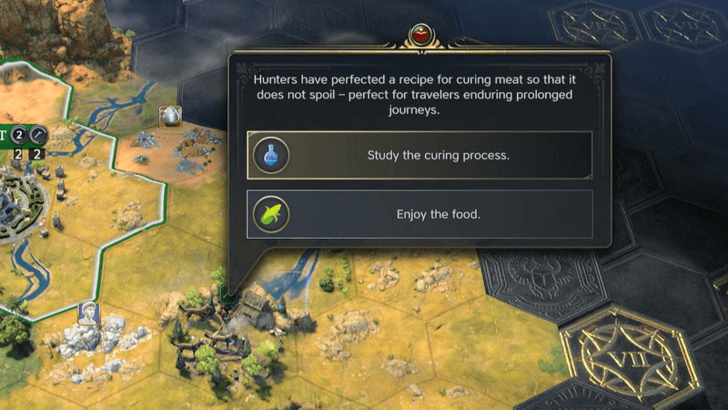
Discoveries are randomly generated bonuses that can be found scattered across the map. They are indicated by purple glowing light. Once your scout enters these tiles, you will get to choose from 2 possible bonuses to help speed up your civilization's progress and growth.
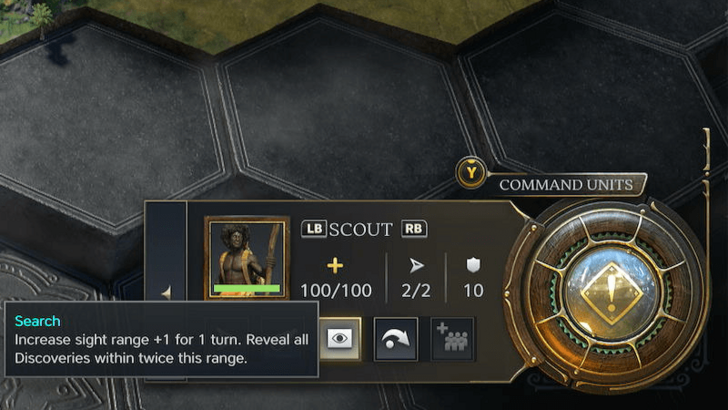
Your Scouts have the Search ability that helps them find these discoveries faster, so make sure to utilize that as much as you can.
Independent People
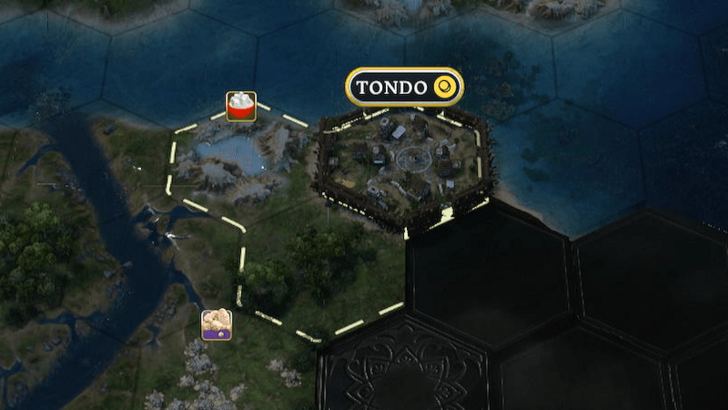
Independent people represent minor groups that are not vying for victory. However, their settlement can still grow both in size and strength, so meeting them early, knowing their location, and deciding what to do with them is crucial as your opponents are sure to do the same.
Generally, there are 3 things you can do with independent people, befriend them to gain bonuses, attack them to gain their settlement, or ignore them which will free them up for other civilizations to control. If you choose to ignore them, they will eventually become hostile to you as well, targeting and attacking your units and settlements.
Interacting with Independent People
Spots to Establish New Settlements
| Indicators of a Good Place to Settle | |
|---|---|
 Beside or near a Natural WonderBetween a group of tiles with lots of resourcesOn a coast for ocean access Beside or near a Natural WonderBetween a group of tiles with lots of resourcesOn a coast for ocean access |
|
| Related Guides | |
| Where to Settle | When to Build More Settlements |
Real estate can become scarce really quickly especially if you're playing on a small map, or you happen to have aggressive opponents in the area. Expanding your civilization by establishing more settlements is a crucial part of the game. So as soon as you find a good spot, produce a settler and establish a settlement on it as soon as possible.
Other Civilizations
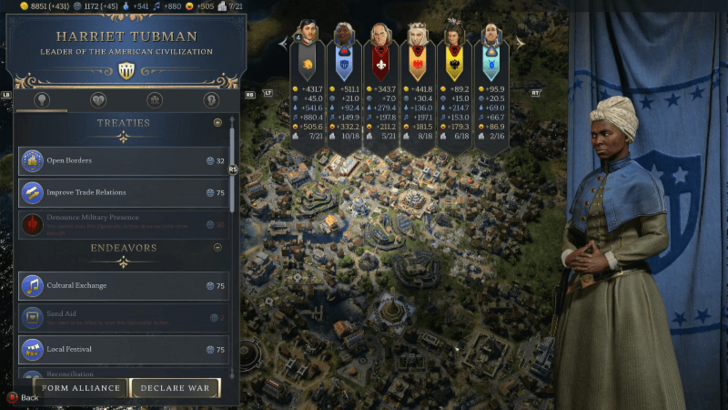
Depending on how you want to play, you might also want to meet your opponents early which you can do by exploring the map and looking for them. Once you do, interaction options will become available, but they will cost Influence. Some of these options will allow you to gain benefits from your opponents, but they can do the same to you, so this is only advisable if you're going to focus on gaining Influence as declining offers from opponents may cost Influence as well.
Grow Your City
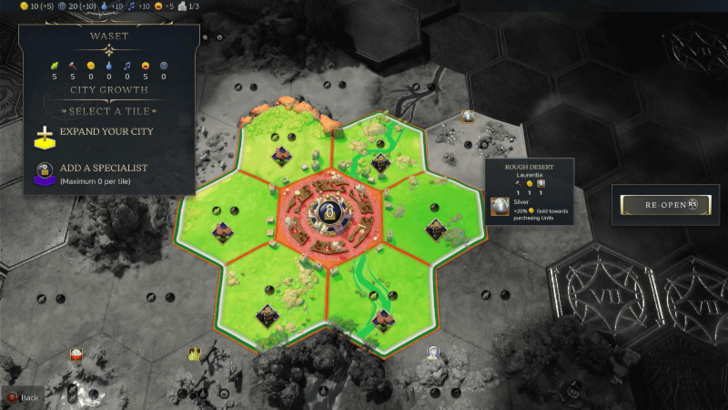
After several turns, as long as your city has a food source, your population will grow which will allow you to improve a tile creating a rural district. Performing this action will allow you to harvest the yields on the tile and acquire any resource if there is one. In addition, improving a tile will expand the borders of your city increasing your improvement options the next time your population grows.
The general goal when performing this action is to improve tiles that provide a lot yields and a resource and expand your border towards resources on the map so you can grab them at a later turn.
Research Tech and Civics
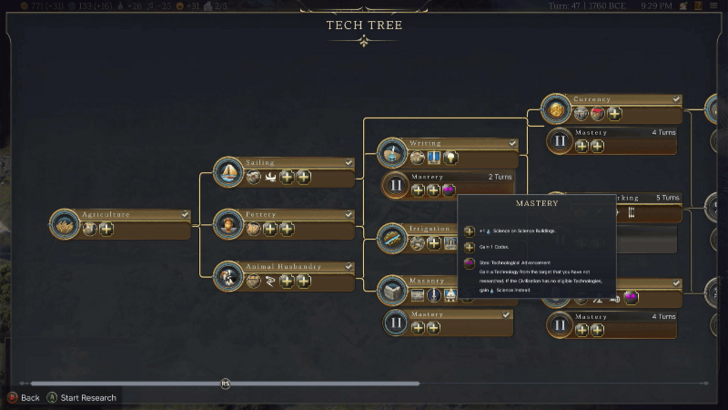
After several turns, you will be able to research a technology, and a bit later a civic. These are advancements that unlock various things such as buildings to construct, units to produce, passive abilities, new mechanics and so on that will help progress your civilization further.
The best choice here is the one where you will benefit immediately. For instance, if someone keeps attacking you, research a technology that unlocks stronger units. If you want to interact with independent people, research something that will provide Influence bonuses.
| Related Guides | |
|---|---|
| Technologies | Civics |
Recommendations are Available
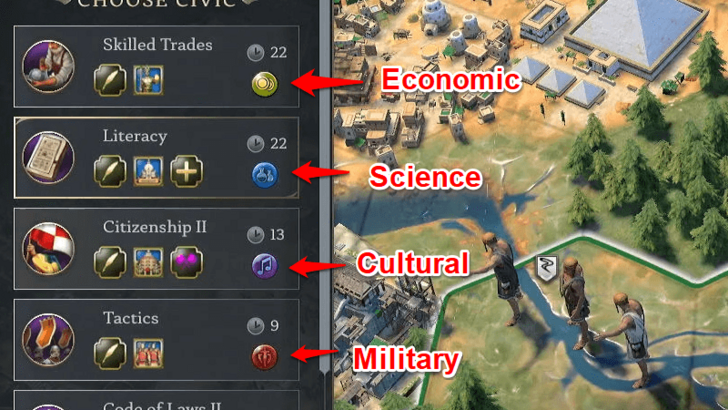
If you don't want to read through every single technology and civic, the game has a built-in recommendation system that will tell you which tech or civic is the best choice to improve a particular aspect of your civilization.
Construct Buildings
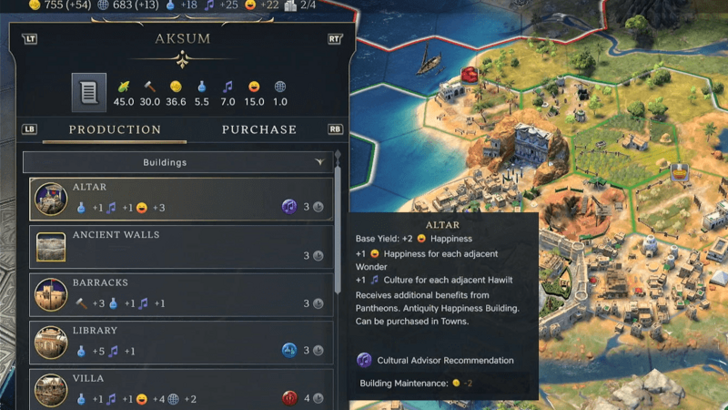
After producing your scouts, you can now produce buildings. These are structures that, like rural districts, as explained earlier, will take over a tile. But instead of harvesting the tile's default yields and adding to it, buildings will replace a tile's yield and destroy any resources on it. So they are best built on tiles with poor yields and no resources.
Similar to units like the Scout, buildings utilize the production (hammer icon) of a settlement. The higher the production, the faster it will be built. And when constructed, it will create an urban district. Urban districts can contain up to two buildings.
Another thing to note is that a lot of buildings have adjacency bonuses that will give them bonus yields depending on what the tiles surrounding them hold. So make sure to plan your cities well to get the most from building bonuses.
| Related Guides | ||
|---|---|---|
| Best Build Order | List of Buildings | How to Use Urban Districts |
Establishing a New Settlement
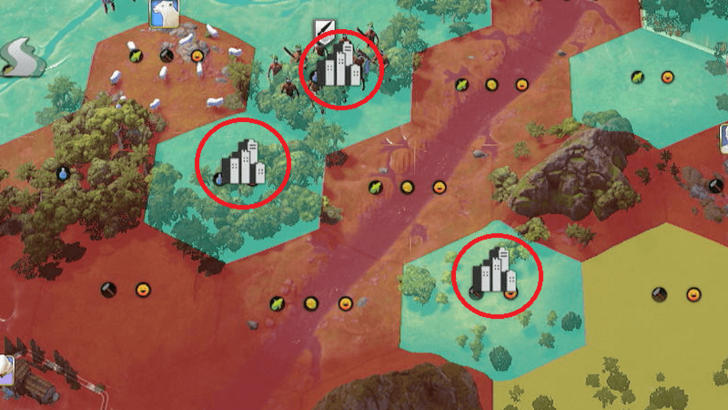
Once you have found a perfect spot for a new settlement, you can produce a Settler to establish a new settlement by sending them to your decided tile and activating their ability. If you're still unsure where to establish a new settlement, selecting your Settler will show recommended spots with a city icon.
Once established, a settlement will start as a town which is different from a city which is what your capital is. Towns have more restrictions on what they can produce or build and can perform fewer actions versus a city. However, you can turn towns into a city by paying gold.
| Related Guides | |
|---|---|
| Towns Explained | Should You Convert a Town Into a City? |
Choosing a Victory
Legacy Paths
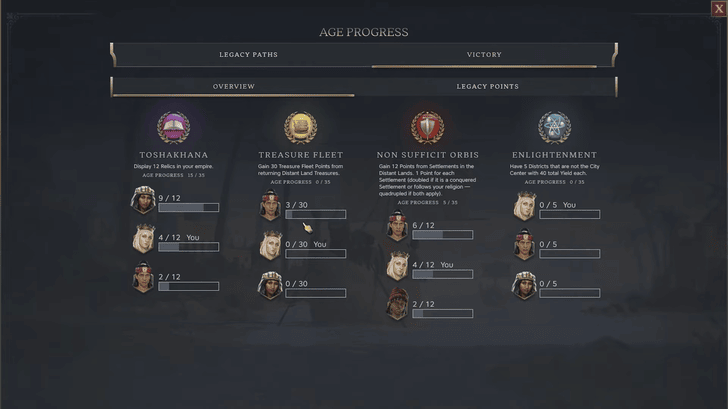
Once you have gotten used to the gameplay loop and progressed through the game, you will eventually need to choose a victory to go for.
Progress for each victory can be tracked with the legacy paths. This can be viewed from the Age Progress screen (the trophy icon on the upper left side of the screen), and will not only show how far along you are with each victory condition, but what you actually need to do to progress. Each legacy path has several tasks that you need to perform per age which involves different new mechanics.
Note that you are not locked into a victory at any point during the game and can progress through any, all, or no legacy paths.
| Related Guides | |
|---|---|
| Legacy Paths Explained | Victory Conditions |
The Three Ages
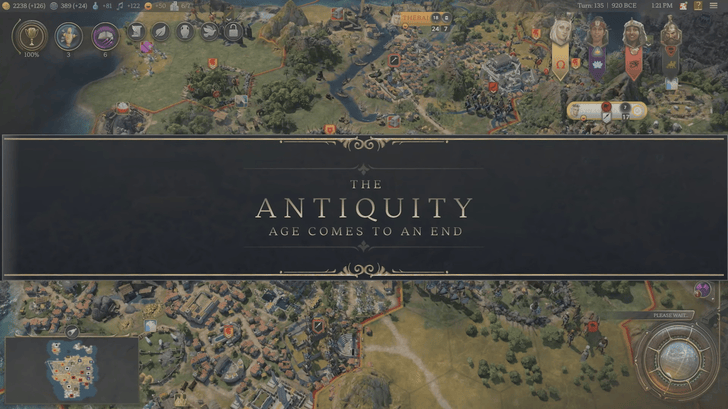
Civilization VII is played in 3 ages, Antiquity, Exploration, and Modern. Each age has a different set of quests for each legacy path and different new mechanics to learn and play around with. The game ends during the Modern age when a player has achieved one of the 4 victory types by completing the respective legacy path.
| Related Guides | |
|---|---|
| The New Ages Explained | What to Do Before and After Age Change |
Civilization (VII) Related Guides
All Recommended Guides
Comment



Author

Civ 7 How to Play

Rankings
- We could not find the message board you were looking for.
Gaming News




![Nova Roma Review [Early Access] | Newer, Better, and More Confusing](https://img.game8.co/4455512/2cbf8926e9a1c72a3ff056088f801ef4.png/thumb)
Popular Games

Genshin Impact Walkthrough & Guides Wiki
Umamusume: Pretty Derby Walkthrough & Guides Wiki
Crimson Desert Walkthrough & Guides Wiki
Monster Hunter Stories 3: Twisted Reflection Walkthrough & Guides Wiki
Honkai: Star Rail Walkthrough & Guides Wiki
Pokemon Pokopia Walkthrough & Guides Wiki
The Seven Deadly Sins: Origin Walkthrough & Guides Wiki
Wuthering Waves Walkthrough & Guides Wiki
Zenless Zone Zero Walkthrough & Guides Wiki
Arknights: Endfield Walkthrough & Guides Wiki









Recommended Games
Fire Emblem Heroes (FEH) Walkthrough & Guides Wiki
Diablo 4: Vessel of Hatred Walkthrough & Guides Wiki
Cyberpunk 2077: Ultimate Edition Walkthrough & Guides Wiki
Yu-Gi-Oh! Master Duel Walkthrough & Guides Wiki
Super Smash Bros. Ultimate Walkthrough & Guides Wiki
Pokemon Brilliant Diamond and Shining Pearl (BDSP) Walkthrough & Guides Wiki
Elden Ring Shadow of the Erdtree Walkthrough & Guides Wiki
Monster Hunter World Walkthrough & Guides Wiki
The Legend of Zelda: Tears of the Kingdom Walkthrough & Guides Wiki
Persona 3 Reload Walkthrough & Guides Wiki







All rights reserved
©2024 Take-Two Interactive Software, Inc. Sid Meier’s Civilization, Civilization, Civ, 2K, Firaxis Games, Take-Two Interactive Software and their respective logos are all trademarks of Take-Two Interactive Software, Inc. All other marks and trademarks are the property of their respective owners. All rights reserved.
The copyrights of videos of games used in our content and other intellectual property rights belong to the provider of the game.
The contents we provide on this site were created personally by members of the Game8 editorial department.
We refuse the right to reuse or repost content taken without our permission such as data or images to other sites.