
| Skate Story | |||
|---|---|---|---|
| Release Date | Gameplay & Story | Pre-Order & DLC | Review |
Skate Story Review Overview
What is Skate Story?
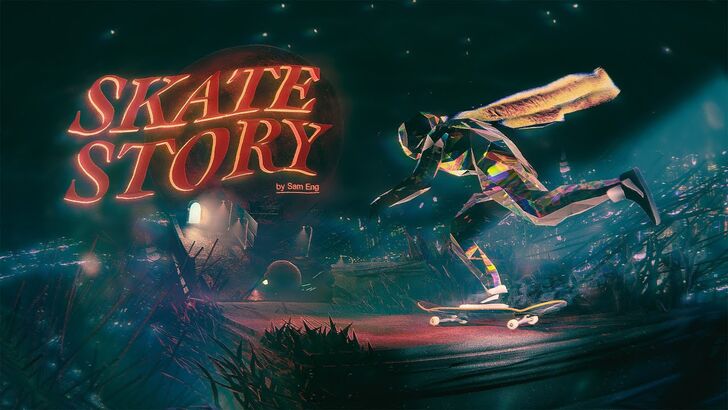
Skate Story is an indie skateboarding adventure where players control a glass-skinned demon on a quest to eat the seven moons. The game combines linear, fast-paced skating levels with open sandbox areas for exploration, teaching new tricks as players progress.
Skate Story features:
⚫︎ Nine Chapters
⚫︎ Boss Encounters
⚫︎ Combo System
⚫︎ Gift Shop Customization
⚫︎ Souls Currency System
For more gameplay details, read everything we know about Skate Story's gameplay and story.
| Digital Storefronts | ||||||||
|---|---|---|---|---|---|---|---|---|
 Steam Steam |
 PlayStation PlayStation |
 Switch 2 Switch 2 |
||||||
| $19.99 | $25.99 | |||||||
Skate Story Pros & Cons
| Pros | Cons |
|---|---|
 Gameplay That Rewards Skill and Experimentation Varied Level Design with Boss Encounters and Challenges Indie-Pop Soundtrack that Perfectly Matches the Game's Vibe Stunning Vaporwave-Inspired Visuals Gameplay That Rewards Skill and Experimentation Varied Level Design with Boss Encounters and Challenges Indie-Pop Soundtrack that Perfectly Matches the Game's Vibe Stunning Vaporwave-Inspired Visuals |
Minor bugs can break progression Limited Skateboard Customization and No Mechanical Variety Story is Hard to Follow |
Skate Story Story - 7/10
The story is imaginative and packed with quirky characters, offering humor, absurdity, and some surprisingly reflective moments. However, its comedic and fragmented delivery can make it hard to follow at times, which keeps it from reaching a higher score.
Skate Story Gameplay - 8/10
Gameplay is smooth, expressive, and highly rewarding, with a loop that teaches tricks progressively and encourages experimentation. While it’s fun and accessible, some players may wish for more skateboard variety or deeper mechanical complexity.
Skate Story Visuals - 8/10
The visuals are stunning, with a vaporwave-inspired aesthetic that perfectly complements the game’s tone and soundtrack. Minor visual quirks and occasional disorienting effects keep it from being perfect.
Skate Story Audio - 10/10
The soundtrack by Blood Cultures is absolutely perfect. Every track enhances the flow of skating, the pacing of levels, and the overall atmosphere of the game. The music captures the surreal, vaporwave-inspired aesthetic flawlessly, leaving nothing to be desired—it’s a complete audio experience.
Skate Story Value for Money - 9/10
For $19.99, this game feels like a steal. Nine chapters packed with inventive levels, boss encounters, and challenges that reward exploration make it feel substantial. You get more than your money’s worth without feeling like anything was padded or filler. However, the lack of post-epilogue free roam and limited access to boss-timed challenges slightly diminishes replayability. Minor bugs that occasionally break progression also take away a bit from the experience, keeping the score just shy of perfect.
Skate Story Overall Score - 84/100
Skate Story nails what it sets out to do: fun, expressive skateboarding wrapped in a quirky, surreal world. The way the narrative is told and small polish gaps in audiovisuals keep it from being perfect, but overall it’s a captivating ride that’s impossible not to enjoy.
Skate Story Review: Absurd And Brilliant Skating Through Neon Hell
Shattered Neon Dreams
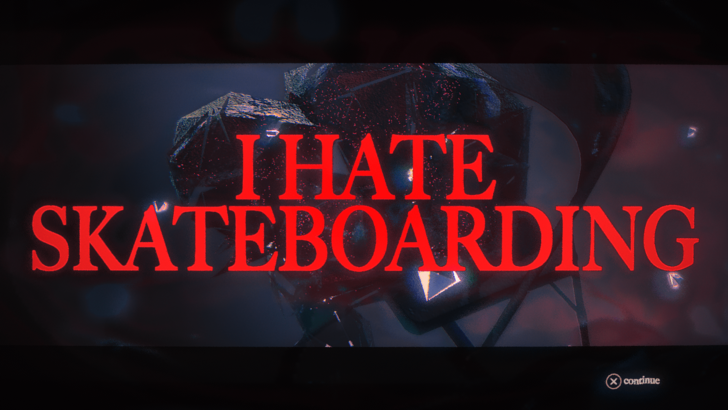
Skateboarding has always been a little bit of everything, hasn’t it? For some people, it’s a symbol of rebellion—scraped knees, scratched decks, and that sense of doing something you’re absolutely not supposed to. For others, it’s a form of art, a rhythm, a culture, a community. But no matter which angle you’re coming from, one thing’s for sure, skateboarding has grown big enough, loud enough, and iconic enough that the gaming industry has been trying to bottle its magic for decades.
The first skateboarding game—a thing called 720—rolled onto the Atari way before my time. Primitive by today’s standards, sure, but it planted a seed. Then, a couple of decades later, everything changed. The genre didn’t just grow, it boomed, largely thanks to Tony Hawk’s unstoppable takeover of the early 2000s. For many players, including me, that era wasn’t just about mastering tricks—it was about discovering a world, a style, a strange sense of belonging through pixels and polygonal half-pipes.
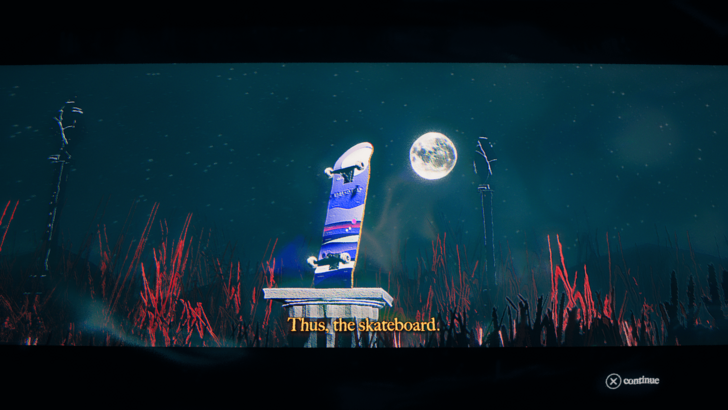
I’ve always been fascinated with the idea of skateboarding. The movement, the vibe, the feeling of balancing danger and freedom on a slab of wood with wheels. And with the rise of the "skater girl" aesthetic during the 2010s, I wanted nothing more than to grab a board and just… glide. Carve. Cruise. Unfortunately, in real life, I could only skateboard as far as my imagination (and my questionable sense of balance) would take me. So I did what any dreamer with fragile ankles would do—I turned to skateboarding games.
Which brings us here. To Skate Story. And the question that started this whole journey, is this just another skateboarding game… or is it something entirely different?
Demon in Glass Shoes
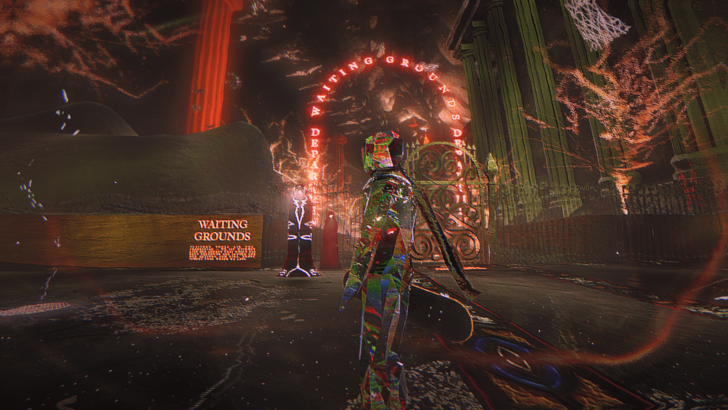
To answer the question above, no. It’s no OlliOlli, but it doesn’t need to be. Instead, it leans so hard into being its own strange, shimmering creature that it loops around into something genuinely unique. In this world, you step—quite literally—into the glass shoes of a demon who is so hungry he could eat the moon. And not metaphorically, either. He’s actually going to eat the moon. That’s the mission.
Well… it would be the mission, if underworld officials didn’t immediately step in and interrupt his celestial snack. But rules are rules (even in hell), and it turns out our demon skateboarder has a contract with the devil himself that complicates things. Before he knows it, he’s tossed into something like a lyceum—part philosophical prison, part cosmic lecture hall—where a resident philosopher becomes the first obstacle in his very literal hunger games.
Through a bit of persuasion and a lot of reasoning, our demon convinces the philosopher that his lunar appetite is a grand philosophical mission. The gates open, he’s released, and he proceeds to eat the first moon. Goal accomplished… or so we think. Because after a nap—yes, even moon-eaters need naps—he wakes up to realize that one moon isn’t nearly enough. To truly satisfy this cosmic craving, and fulfill the contract with the demon, he needs to eat all seven moons.
The storytelling here leans heavily into the bizarre. There are deeper themes, ideas that lead with meaning, purpose, creation, desire—but they’re told through a comedic lens that makes everything feel more absurdist than profound. And honestly? That’s part of its charm. Even its late-game twist doesn’t shock as much as it elicits a kind of "huh, yeah, that tracks" reaction. Not bad, just… fittingly odd.
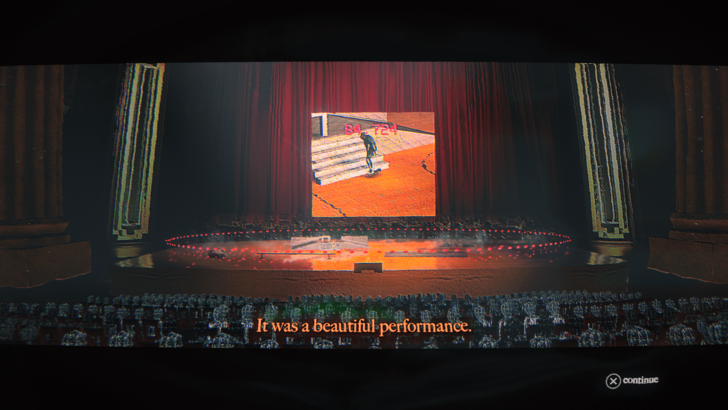
Still, while the narrative is intriguing, I’ll admit I struggled to follow its point at times. Not because it’s complex, but because of how it’s delivered—scattered, dreamy, fragmented, like philosophical graffiti spray-painted on a half-pipe. It’s interesting, it’s weird, and it’s memorable, but it’s not always the easiest thing to hold onto while you’re trying not to miss your next ollie.
Learning to Fall, Learning to Fly
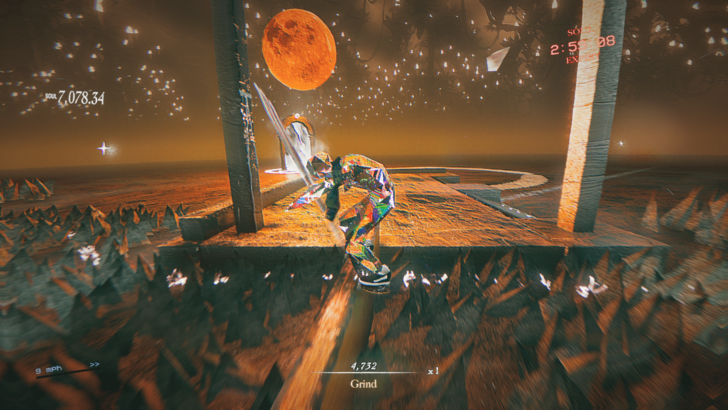
The first thing that struck me about Skate Story’s gameplay was how invisible its loop feels. You know how some games practically tap you on the shoulder and whisper, "Hey, you’re doing the same thing again"? Not this one. The pacing is so smooth, so fluid, that you don’t even notice you’ve settled into a rhythm until you're several chapters deep and wondering where the time went.
The game is divided into nine chapters, each broken into levels that fall into one of two styles. Some are high-speed, linear path—pure momentum, pure flow, the kind of sections where your reflexes take over and you’re just skating. Others are more open, sandbox-style areas where you’re free to explore, experiment, and piece together the movement at your own pace. It’s a deliberate contrast, one mode teaches you to react, the other teaches you to understand.
Every chapter layers something new onto your deck. Early on, you’re mastering basics like the pop shuvit, but before long you’re flipping into more advanced tricks like the varial flip, or working in movement techniques like powerslides and reverts. Eventually, some areas require you to consecutively perform different tricks or actions to unlock certain paths or progress the level, adding another layer of challenge and engagement. Each addition isn’t just a button press—it’s another fragment of expression, another little nudge toward feeling like you’re actually riding this shimmering glass skateboard through a neon underworld.
And this is where the heart of Skate Story really lives. Yes, some players might argue that the skateboarding here is "basic" compared to more grounded, simulation-heavy games. That it isn’t trying to compete with the big, technical skate sims. Let me tell you why that doesn't matter, and why its approach ends up being so captivating.
Riding Through Hell’s Layers
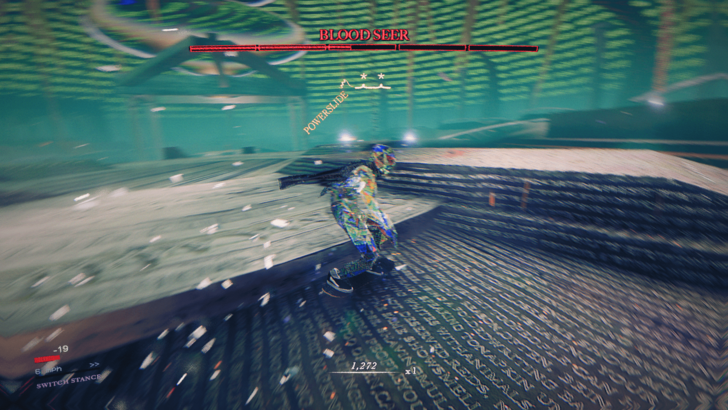
I’ll start with the obvious, gameplay is where Skate Story absolutely shines. Like I mentioned earlier, the game teaches you new tricks chapter by chapter—but if you’re the kind of player who loves tinkering and testing things out, you can often discover techniques early just by experimenting. The game doesn’t punish curiosity, it rewards it. And honestly, that freedom ends up being one of the most satisfying parts of the journey.
Each chapter represents a different layer of hell, and every level inside it holds its own moon. That’s your goal, find the moon, reach the moon, eat the moon, all while everyone around you does everything they can to stop you. Some chapters are straightforward—almost like you’re chasing down a frightened celestial orb. Others become more complicated as underworld security patrols tighten up, obstacles multiply, and your route becomes less about speed and more about precision.
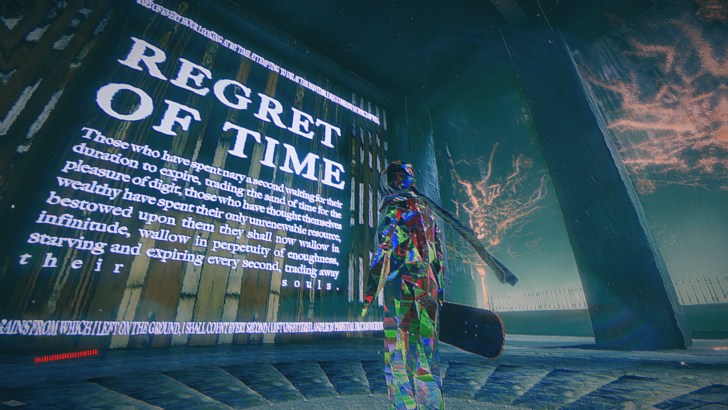
Every layer also has its own "gatekeeper" of sorts. Sometimes it’s someone literally holding the key or blocking the path to the moon. Other times it’s a citizen of hell who needs help—and by helping them, you help yourself get closer to your cosmic feast. It gives each chapter a sense of personality, almost like every layer has its own little community with its own problems, rules, and weird underworld bureaucracy.
Boss Fights Don’t Want You Dead, They Want You Shattered
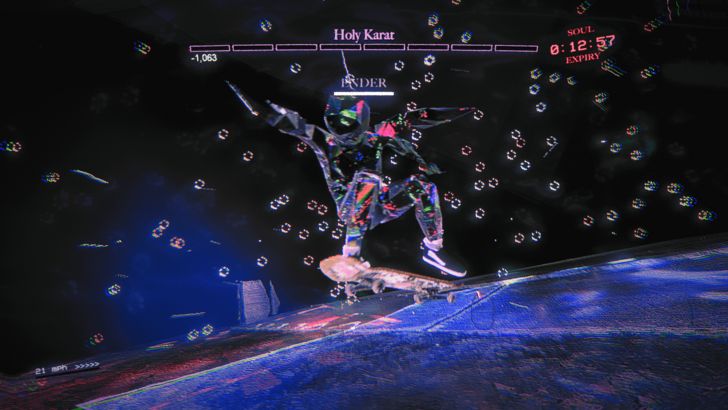
Boss fights arrive at the end of each chapter, and technically speaking, the boss is always the moon itself. (Well, except for the last two chapters, those are different, and I’ll leave those surprises untouched.)
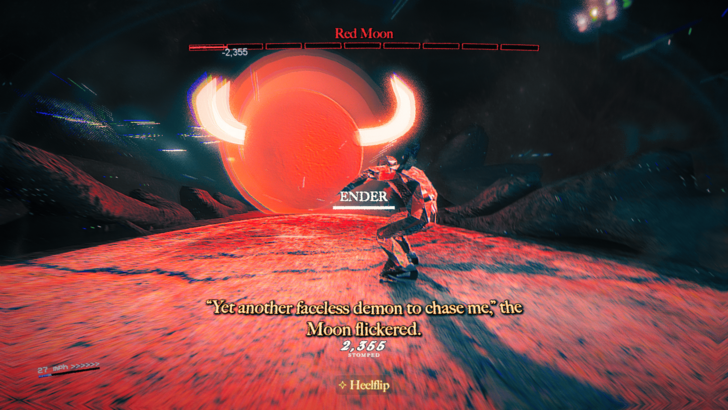
And when I say boss fight, don’t think combat. Think rhythm, timing, execution. You don’t deal damage by punching or slashing—you deal damage by stomping your tricks directly onto the moon’s projected form. If you mess up, you don’t take damage. You shatter. That’s the only way to die, a single mistake, and your glass body cracks into a thousand tiny regrets.
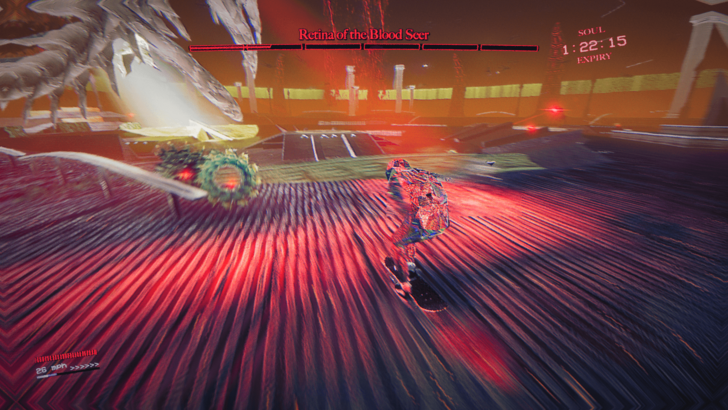
As the game goes on, these battles become increasingly gimmicky (in a good way). The moons start moving more erratically, weaving through obstacle-filled arenas that test your line of sight and reaction time. In some fights, you get teleported farther and farther away the more you damage the target, turning the whole encounter into a chase against distance and timing.
Combos are essential here. Mix four different tricks in a row, land a stomp on the last one, and you deal significantly more damage. It’s like the game wants you to perform—not just succeed, but succeed stylishly.
Souls, Shops, and the Limits of Your Board
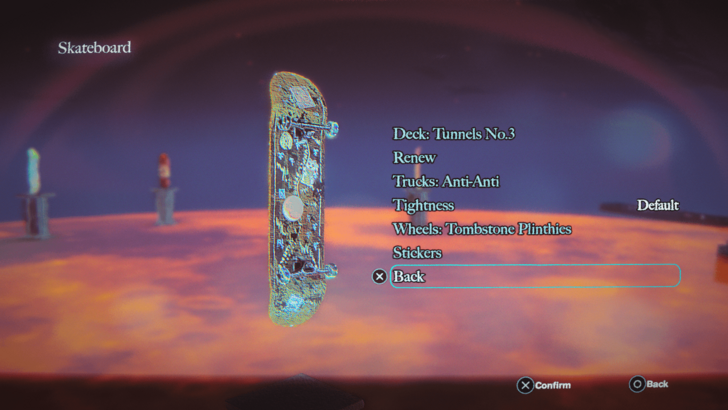
Outside the main path, you earn souls—from defeating bosses, completing challenges in sandbox areas, and even just from skating around and landing tricks. Souls serve as currency for the gift shop, where you can buy decks, wheels, trucks, and stickers. And… that’s the extent of customization.
I get it. Realistically, a skateboard is a skateboard. Most performance comes down to the skater, not the equipment. But I still found myself wishing for something more—not necessarily in terms of player power, but in terms of variety.
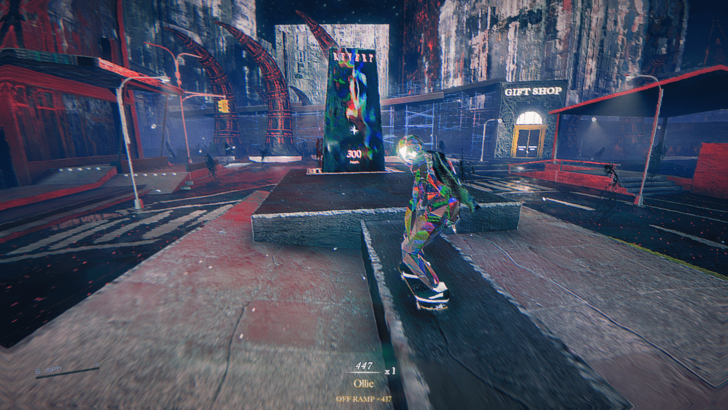
Maybe a longboard would’ve helped with the linear tunnel levels, where you’re hitting breakneck speeds and praying your turns stay sharp. Maybe a penny board could’ve existed as your "starter" deck before you move up. Or even some kind of demonic perk system that tweaks base trick damage or enhances an ability based on the board’s background, nothing game changing, just a little something to tailor your run.
But that’s just me daydreaming. The heart of Skate Story is clearly about skill, about expression, about the thrill of piecing your movements together. The game wants you to feel chill, not min-max. And honestly, that philosophy works.
On the technical side, there are still a few bugs that can break the flow. For instance, in one of the levels, when it’s time to progress to the boss fight, the game sends you back to the previous scene. Rebooting fixes it, but it’s still a little jarring.
But, when all of these elements come together—the tricks, the speed, the boss fights, the obstacles—each level becomes this hypnotic blend of motion and sound, which brings me to the next part of the experience.
Music That Feels Like Motion
Oh my god, this game’s soundtrack is solid gold. Truly. While I can admit that having voice acting—especially for the narrator—might’ve elevated some of the storytelling beats, there’s also the very real risk that a poorly chosen voice could’ve broken the game’s entire vibe. Skate Story survives beautifully without it, and honestly, maybe it’s better this way. The silence in the dialogue makes more room for the music to breathe, to take over, to define the emotional rhythm of your run.
Because if you’ve ever listened to Cigarettes After Sex, blackbear circa 2015, or any vaporwave-adjacent artist who drenches their sound in dreamy haze, you already know the energy Skate Story channels. Actually—scratch that. Just pause for a moment and put on Blood Cultures while reading this.
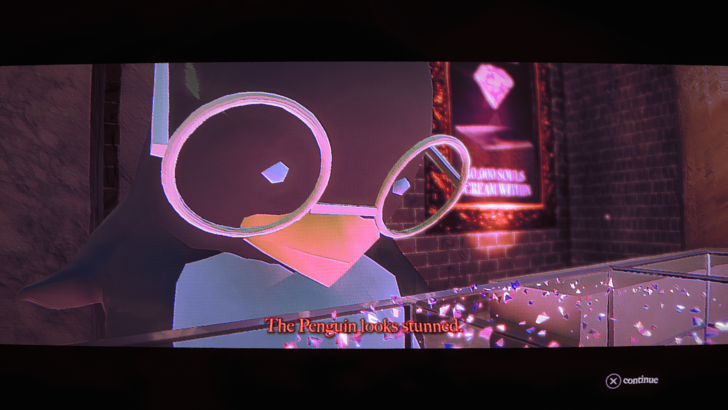
The experimental indie-pop isn’t just "fitting." It’s the perfect match for Sam Eng’s vision. It feels less like a collaboration and more like two artists operating on the same wavelength, meeting in the exact middle of haunting, dreamy melancholy and slick, stylish motion. It’s correct. It’s "this is the only choice, and any other decision would have been a mistake"-level correct. Every track feels like cruising under neon streetlights at 2 a.m. with no destination except the next wave of emotion. That’s the vibe. That’s the exact, shimmering, introspective headspace the game wants you in.
And remember how I mentioned earlier that a chunk of my fascination with skateboarding came from the culture around it? The feeling of it? Back in the early 2010s, when the skater girl aesthetic blew up online and everyone was curating mood boards with grainy filters and melancholic synths—I lived in that world. I had playlists built entirely to imagine what real skateboarders listened to as they cruised through empty parking lots and abandoned malls.
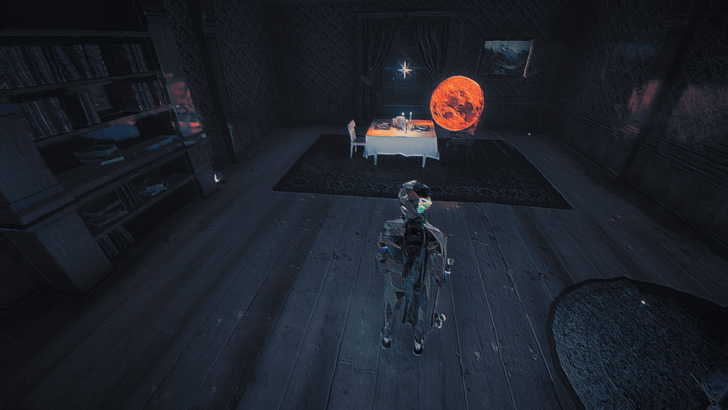
Skate Story’s OST sounds exactly like that. It brought me back to that era instantly, effortlessly, and then introduced me to a new artist I’m now adding to those same playlists. There’s something magical about a game that nails not just a genre, but an entire feeling, and this soundtrack is that magic.
Speaking of things that feel unmistakably early 2010s—well, that leads me right into my next point.
Visuals That Glow, Glide, and Bleed Style
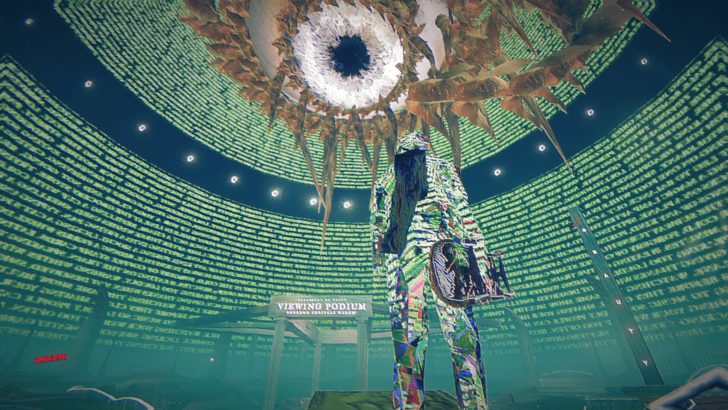
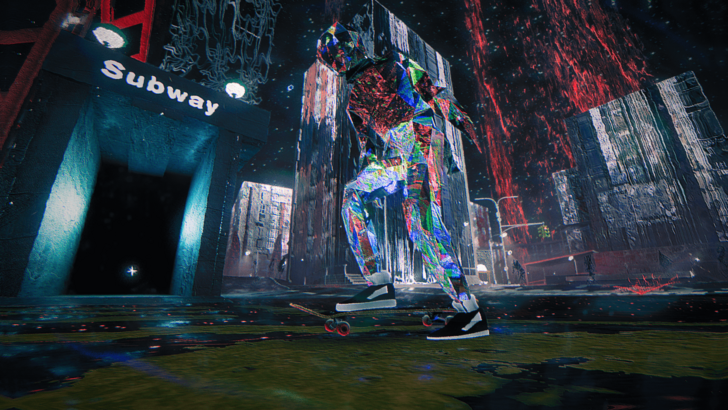
The visuals in Skate Story are stunning—not in the "pretty lighting and clean textures" way most games chase, but in that unmistakable, vaporwave-adjacent, neon-soaked fever dream that feels ripped straight out of a 2010’s Tumblr mood board… which itself was desperately trying to reimagine the aesthetics of the ‘80s. It’s not authentically retro, and it’s not trying to be. Instead, it’s this hyper-stylized reinterpretation of a reinterpretation—a nostalgic echo of an era filtered through two different decades of yearning.
It’s the 2010’s idea of what the ’80s felt like. Not what they looked like. What the vibe was.
And Skate Story leans into that vibe so confidently that every environment ends up feeling like a lucid dream somebody dipped in holographic paint. Colors warp. Shapes shimmer. The entire world looks like light refracted through broken glass—which, considering you literally are a demon made of glass, feels poetically intentional.
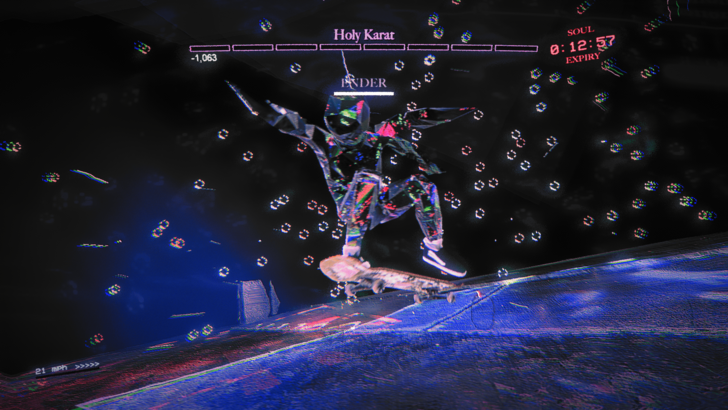
In motion, it’s almost like an LCD acid trip (not that I’d know—my knowledge is entirely pop culture osmosis). Trails of color stretch behind you as you kickflip through impossible tunnels. Moons glow like forbidden candy. Shadows ripple in ways that are more emotional than realistic. It’s surreal without feeling disorienting, abstract without losing clarity, and expressive without drowning you in visual noise.
Skate Story doesn’t just look good. It looks like a memory you can’t quite place. And all of it melts beautifully into the soundtrack I just gushed about.
Ghosts, Pigeons, and Lunar Philosophies
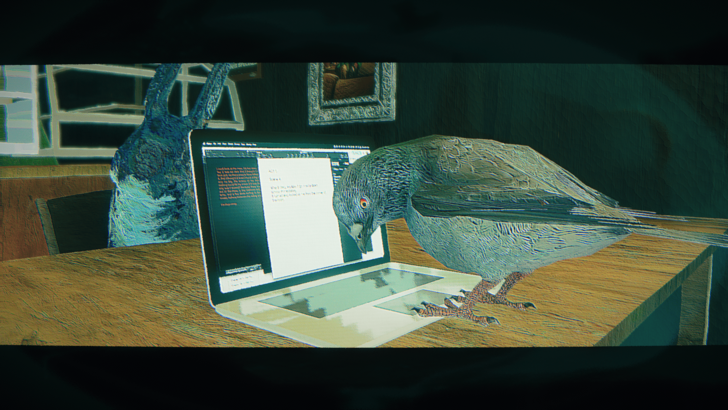
If you’re the type who likes to mind your own business and speed through levels without poking at the corners, this game’s story isn’t going to meet you halfway. Most of its narrative lives in the environment—scribbles on monuments, dead folks’ leftover musings, and the kind of offhand worldbuilding you only catch if you stop skating long enough to actually look.
And honestly? By the time I reached the end, this game had me feeling some type of way. I just haven’t fully pinned down which type yet. The storytelling starts off with this comedic, sarcastic, almost absurdist charm—like everyone you meet is cracking jokes just to stay sane—but then it swerves. Hard. Suddenly the humor morphs into something more reflective.
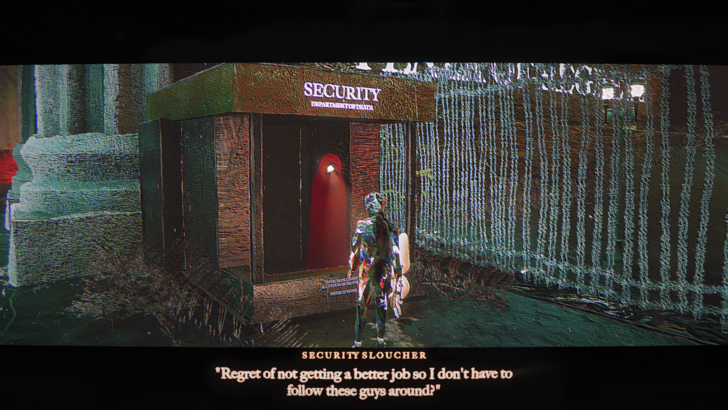
The characters are definitely goofy, but there’s something painfully relatable beneath the jokes. There’s a pigeon with a chronic writer’s block who’s doomed to revise their work until the end of time (felt a little too called out there). Skeletons ramble about the lives they lived or wish they lived. Some spirits refuse to end their lunch breaks. Others can’t drink coffee anymore but cling to the idea of drinking coffee. It’s silly, but it’s also… kind of heartbreaking?
The world is way more than a backdrop. It’s a whole ecosystem of regrets, coping mechanisms, unfinished business, and tiny joys. The lore isn’t shoved in your face—it’s quietly waiting for you to tune in.
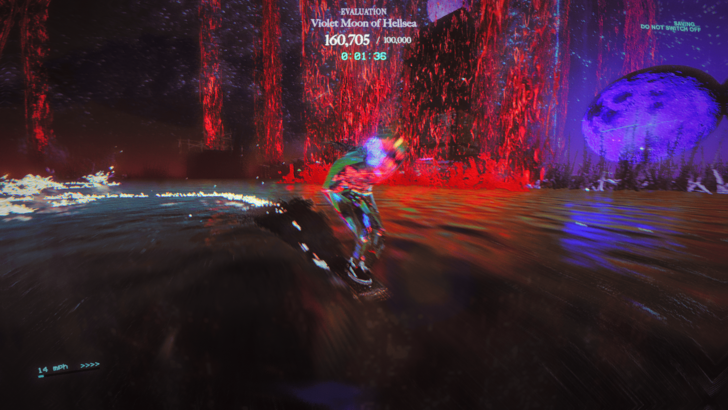
While many might argue that Skate Story isn’t as mechanically complex as other skateboarding games, I’d counter that this is exactly what the game set out to deliver. Across every front—from tricks to level design to pacing—it succeeds in creating an experience that’s approachable, expressive, and deeply satisfying without overcomplicating the core loop.
Is Skate Story Worth It?
It’s A Glass-Shattering Good Time
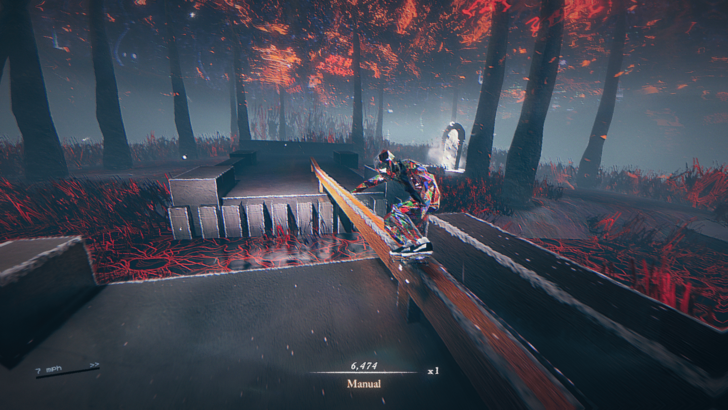
Skate Story isn’t just another skateboarding game, it’s a carefully crafted, absurdly charming experience that blends fluid, expressive gameplay with a surreal world, a killer soundtrack, and a story that lingers long after the last moon is eaten. For $19.99, you’re getting nine chapters of inventive skating, boss fights that challenge your timing and creativity, and a world brimming with humor, oddball characters, and tiny philosophical touches.
It knows exactly what it wants to be, a game about skill, style, and sensation, wrapped in a shimmering neon dream. And in every one of those aspects, it succeeds. If you’ve ever wanted to feel like you’re skating through a cosmic acid trip, landing tricks on moons while grooving to perfect indie pop, this is the one to grab. Solid gameplay, unforgettable visuals, and an OST that refuses to leave your head make it an easy recommendation.
| Digital Storefronts | ||||||||
|---|---|---|---|---|---|---|---|---|
| Steam |
PlayStation |
Switch 2 |
||||||
| $19.99 | $25.99 | |||||||
Skate Story FAQ
Are There Any Other Modes Besides Playing the Story?
Right now, Skate Story only features the main story mode. There aren’t any separate free-roam modes or mini-games yet. However, given how well the game has been received, many players are hoping the developer will add post-epilogue free-roam or additional timed boss challenges to increase replayability.
Game8 Reviews
You may also like...
 |
Tony Hawk's Pro Skater 3+4 Review Simulation, Sports |
 |
Drag x Drive Review Sports, Simulation |
 |
Everybody's Golf: Hot Shots Review Sports, Party |
 |
JDM: Japanese Drift Master Review Racing, Simulation, Adventure |
 |
F1 25 Review Sim Racing |
Skate Story Product Information
 |
|
| Title | SKATE STORY |
|---|---|
| Release Date | December 8, 2025 |
| Developer | Sam Eng |
| Publisher | Devolver Digital |
| Supported Platforms | PC (Steam), PS5, Switch 2 |
| Genre | Skateboarding, Adventure, Sports |
| Number of Players | 1 |
| ESRB Rating | E |
| Official Website | Skate Story Website |