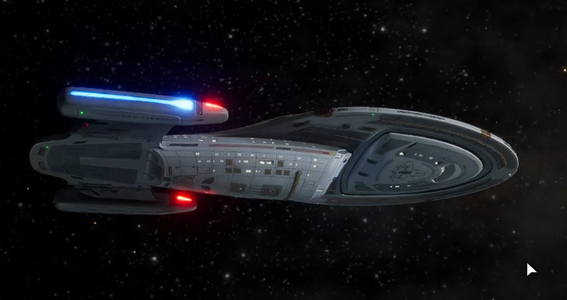

| Star Trek: Voyager - Across the Unknown | |||
|---|---|---|---|
| Release Date | Gameplay & Story | Pre-Order & DLC | Review |
Star Trek: Voyager - Across the Unknown is a strategy simulation game where you control and crew your own ship across the cosmos. Read our review to see what it did well, what it didn’t do well, and if it’s worth your money.
← Return to Star Trek: Voyager - Across the Unknown main article
Overview
What is Star Trek: Voyager - Across the Unknown?
Star Trek: Voyager - Across the Unknown is a strategy simulation game set in the utopian, sci-fi future of Star Trek and its spanning universe of aliens, spaceships, and space exploration. Given command of the Voyager, the newest starship to Starfleet’s ever-expanding flotilla, players are thrust into a sci-fi saga filled with dangerous engagements, difficult choices, and extraterrestrial missions meant to test their resolve and decision-making skills.
Star Trek: Voyager - Across the Unknown features:
⚫︎ Node-based exploration
⚫︎ Resource management simulation gameplay
⚫︎ Real-time starship combat simulation
⚫︎ Three difficulty levels for new and experienced captains
⚫︎ Branching storyline with real and immediate consequences
| Digital Storefronts (Standard Edition) | |||||||
|---|---|---|---|---|---|---|---|
 Steam Steam |
 PS PS |
 Xbox Xbox |
 Switch 2 Switch 2 |
||||
| $39.99 | |||||||
For more gameplay details, read everything we know about Star Trek: Voyager - Across the Unknown's gameplay and story.
Star Trek: Voyager - Across the Unknown Review: The Final Frontier Needs Another Pass
FTL was a cornerstone for my current taste in video games, and I’m confident that I’m not the only one who can proudly admit to that. Not only did it hook me to the harsh reality of space travel and the logistical nightmares that can entail, but it also showed me that actions have consequences, and that moral choices aren’t exempt from having dire repercussions.
It’s been a while since I’ve played FTL, but I can never mistake the feeling of accomplishment and satisfaction it gives me when my long-term planning pans out and saves me in the end. It’s this feeling that resonated with me once more when I played Star Trek: Voyager - Across the Unknown. With every new room added to my starship and every passed skill check while on manned excursions, I could feel the tingle of a well-laid plan put to action.
That’s pretty much the best of what you can expect from this game, and, as you’ll come to see, that’s both a good thing and a bad thing. It put all of its eggs in two baskets: strategic resource allocation and story. Everything else got shafted, making the whole experience less fun than it could’ve been.
That’s far from damning, though. There’s much to discover and much to explore. Set all thrusters to full and, on my mark…engage.
Marooned in the Delta Quadrant
Let’s begin this dissection of Star Trek: Voyager - Across the Unknown (henceforth referred to as Across the Unknown) with one of its stronger aspects: story. Star Trek didn’t amass such a huge following over the decades by telling an awful story. No, it painted a different kind of sci-fi, one rife with exploration, diplomacy, and soap opera levels of drama and meme potential. That’s pretty much its main draw, and Across the Unknown benefited heavily from this pedigree because its universe was already fleshed out when it came to be.
That’s not to say that its story and narrative don’t come with their own merit, though, as Across the Unknown isn’t your typical Star Trek episode. First off, it doesn’t have characters we know and love, instead opting to tell a relatively new story from the point of view of a somewhat obscure character from the IP’s annals.
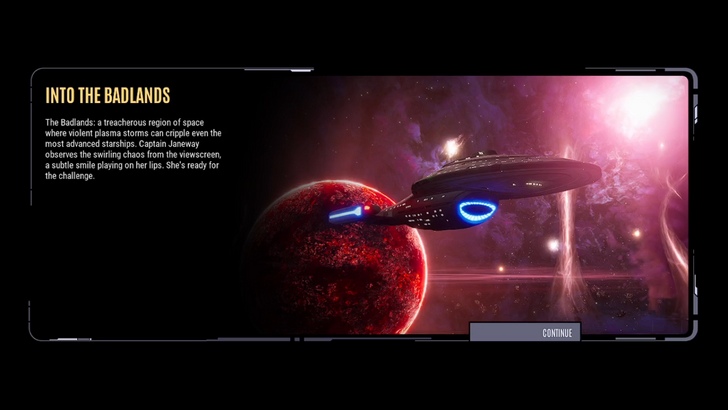
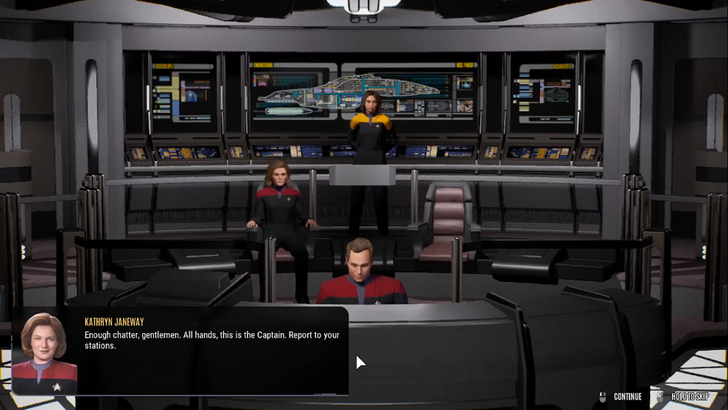
As a newish player to the game of life, I’m not as huge a Trekkie as many people out there, but I know an obvious pick when I see one. Captain James T. Kirk would’ve been what people expected, or perhaps even Jean-Luc Picard, but no. Across the Unknown tells the tale of Captain Katherine Janeway and her crew aboard the Voyager as they try to find their way home after being marooned in the faraway Delta Quadrant.
Captain Janeway isn’t a new character, having been the protagonist of the IP’s serial run from 1995 to 2001, but she isn’t a clear choice, and the game is all the more refreshing for it. Apart from the curious choice of cast, Across the Unknown also oozes that pure Star Trek flavor fans have come to love.
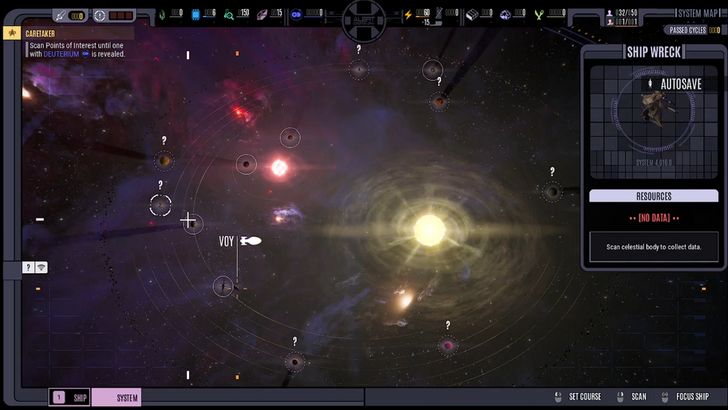
Expecting exploration, diplomacy, and moral integrity as core values for the main cast and crew? You got it. Looking for high-stakes, boots-on-the-ground excursions with redshirts dying left and right? This game’s got you. What if you just wanted to blast another starship out of the sky? Well, you can do that. Not very Starfleet of you, though.
No Trekkie would find themselves out of place when playing this game because it’s pretty much an interactive episode of Star Trek, down to the moral dilemmas. The downside is that it’s hard for non-Trekkies to get as deep into the narrative as the obvious target demographic, but the game’s story can nonetheless be appreciated by everyone.
Rebuilding the USS Voyager
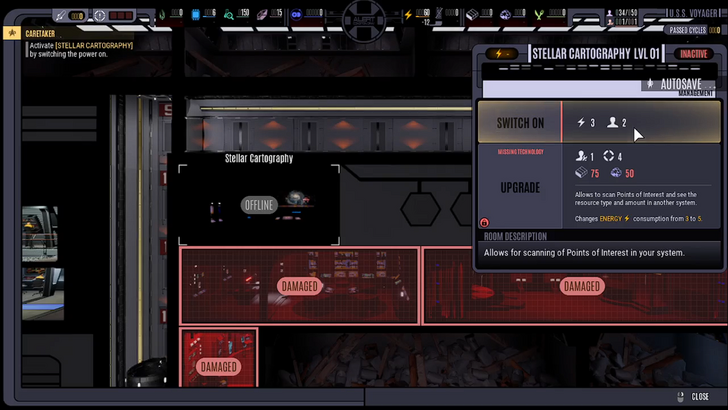
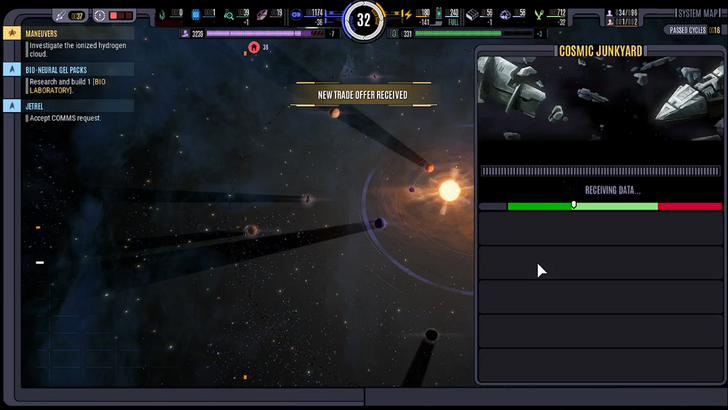
Now for gameplay. Across the Unknown splits cleanly into two halves: a strategic resource-management layer and a combat layer. The former does the heavy lifting, so let’s start there.
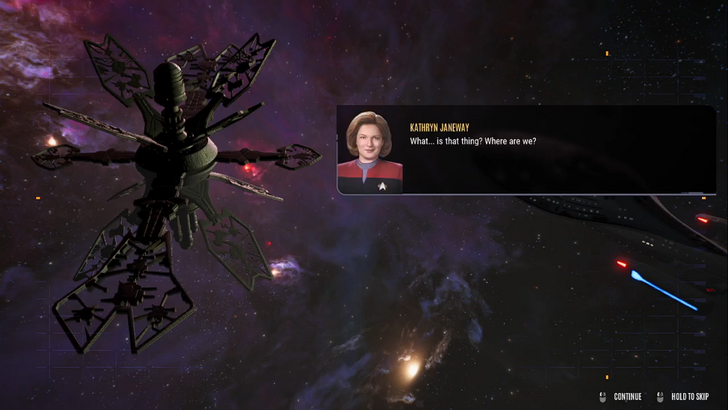
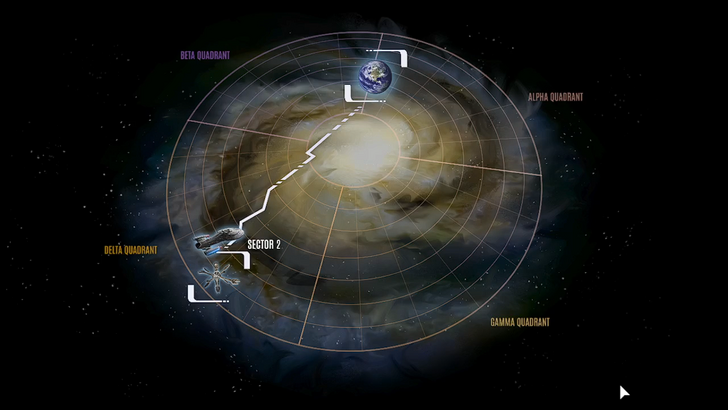
The inciting incident is no secret: the USS Voyager is flung thousands of light-years into the uncharted Delta Quadrant. Stranded, battered, and very far from home, Captain Janeway’s crew must uncover what happened and find a way back.
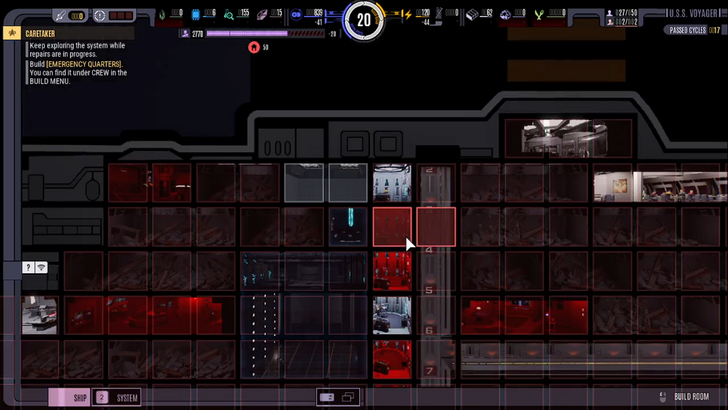
That disaster leaves Voyager in shambles, and your primary job is rebuilding it. You’ll repair hull breaches, clear debris, restore systems, and reconstruct infrastructure through a grid-based, room-building system reminiscent of XCOM: Enemy Unknown and Fallout Shelter. Every structure requires specific resources like Deuterium, Food, specialized materials, as well as Work Teams to complete construction over several Cycles.
Cycles function as the game’s unit of time, similar to Civilization’s turns. Nearly every strategic action—construction, upkeep, research, production—consumes Cycles. While projects tick forward, you can scan anomalies, launch away missions, travel to new sectors, or simply advance time manually. Each Cycle resolves ongoing tasks: tech completes, facilities come online, crew recovers, trades appear, and the next round of allocation begins.
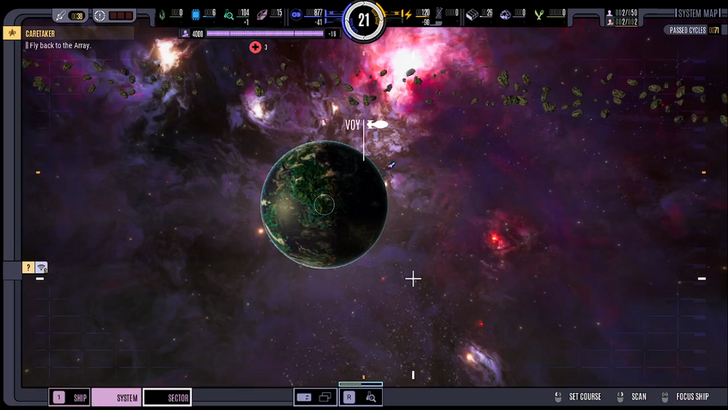
The system runs deeper than it first appears. New facilities need crew to staff them, energy to power them, and physical space aboard the ship. You can upgrade output, storage, or function through research and resource investment, or demolish blocked rooms to reclaim materials and expand. Like XCOM, you’re building outward from a central hub, reclaiming and repurposing damaged space, just at starship scale.
It’s robust enough to stand alone as a starship colony sim. Fortunately, it doesn’t stop there. Because once Voyager is stable enough to breathe, the away missions begin—and that’s where the other half of the game earns its stripes.
Exploring Diverse Worlds on Away Missions
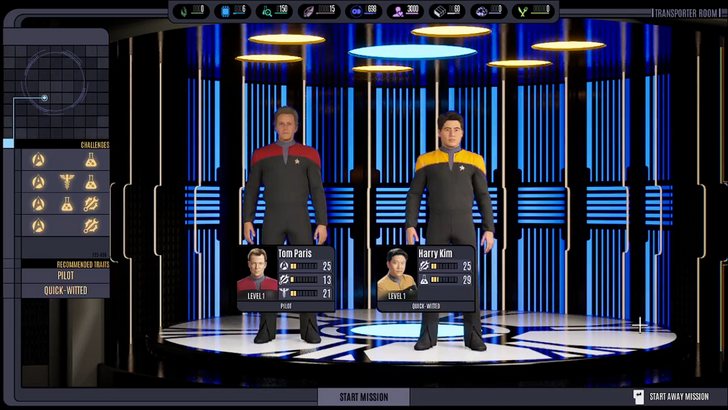
Resource gathering in space is good and all, but it’s not Star Trek if the entire ship’s most important crew members all inexplicably choose to go on a ground mission together. It’s strategically unsound, but that’s just how Star Trek does its stories historically, and Across the Unknown is nothing if not respectful to its source material.
While on away missions, which are text-based adventures meant to represent planetside exploration, players can draft their own trio of crew members to head out, each with their own specialized skill, unique trait, and varying figures for their stats. Just before embarking, the away missions selection screen indicates what skills and traits are helpful for the upcoming section, and once you’ve settled on a team, it’s time to beam them down.
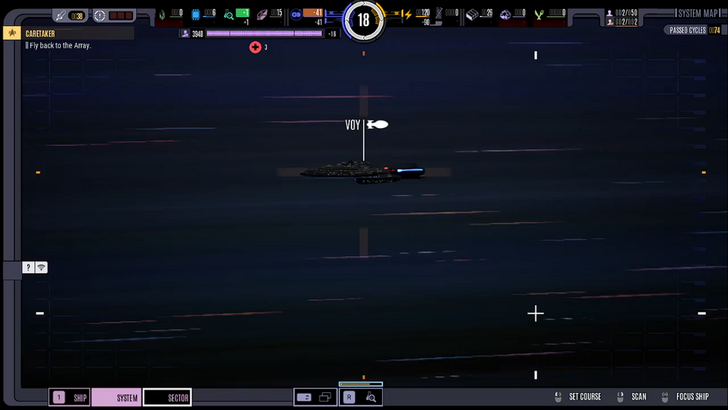
What follows is a deceptively intricate chain of skill checks built around the specific crew you deploy. Each away mission is divided into distinct scenarios, and every scenario presents a unique problem with its own skill requirement and narrative twist.
You’ll assign one or more crew members to handle each situation, weighing their abilities against a listed difficulty rating. If a crew member has the relevant skill, you can select them, and their stats are tested against that difficulty to determine the odds of success.
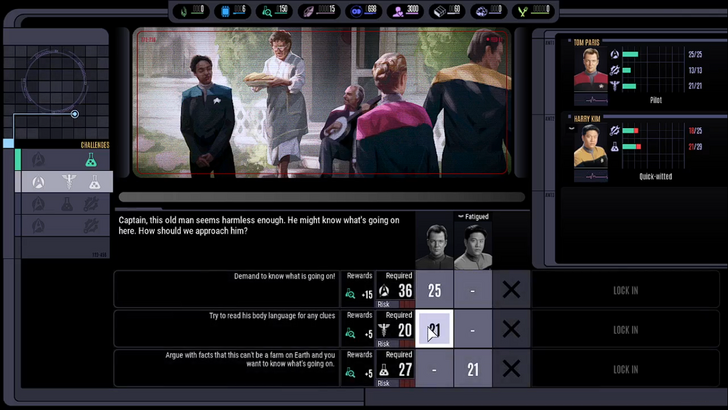
Whether the outcome is good or bad, the scenario will resolve, often rewarding you with resources or penalizing you for failing. Once used on a scenario, a crew member is exhausted and will have reduced effectiveness for the next scenario, stacking until they pass a scenario without being selected.
It’s quite an elegant system that forces you to make strategic choices, and not just pick the biggest number each time. A good example that comes to mind was when It’s great, makes for great compositions, and the unique traits pack just enough creativity to be a glowing addition to the Away Team’s kit, sometimes even opening up entirely new options by existing.
Gameplay is a back-and-forth of ship-wide planning and away-team excursions, following the beat of a proper Star Trek episode. Here’s where it starts to fall apart, though, because for all its greatness in all the mechanics I’ve explained so far, the game pretty much gives up when it comes to the combat.
The Worst Space Combat Since the Holdo Maneuver
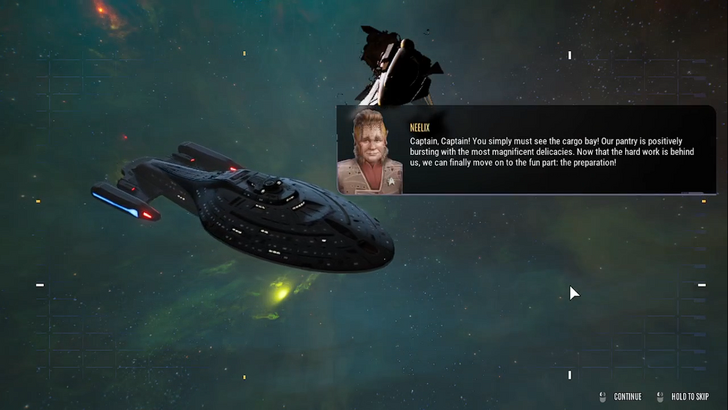
Dangerous Star Wars reference aside, this game’s combat really does pale in comparison to the rest of its gameplay. I actively do not look forward to having to fire up my ship’s guns, which I guess is in spirit with Starfleet’s diplomacy-first approach to altercations. It’s not fun to play, though, and I attribute that mostly to how poorly-explained it is while also being mostly automatic.
Combat in this game is a proper showdown between ships in 3D space. Things like heading and directional attacks matter, and targeting specific parts of enemy ships can have various debilitating effects on their combat potential.
This is very similar to how FTL manages its battles, just in 3D and on an admittedly much larger scale. Unfortunately, it’s only fun on paper, and the comparison to FTL only works on a surface level, as all that targeting and strategizing is pretty much made simple by the game’s orders system.
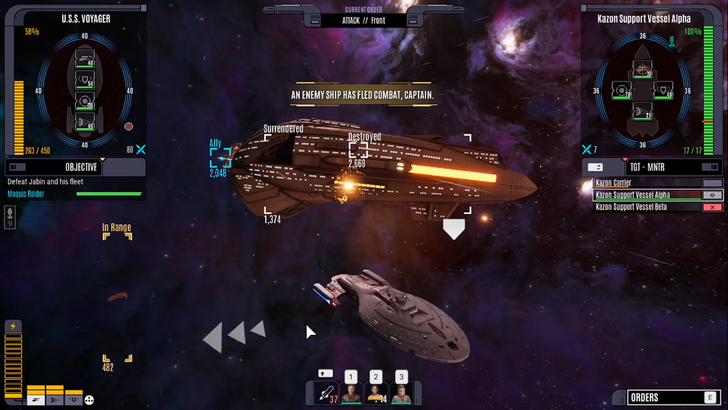
You don’t control your ship, at least not as directly as you think. You don’t pick its direction, heading, or position in space. Instead, you give orders to be defensive, offensive, or to repair broken sections through a list. Clicking the order puts it into play, and the ship will act accordingly. If you choose an offensive action, the HUD will ask for a target room or system, and the ship will modify its trajectory to better target the room you select.
All of this operates on an RTS system with pause, so you can send out your orders, unpause, and watch the magic happen. Well, that’s a bit generous, considering it’s just shooting and circling half the time.
You at least get active abilities from the three crew members you choose to lead at the start of each combat. These mechanics combine to make a slightly confusing, unengaging combat scenario that somehow makes ship battles look boring. This is the game’s worst aspect, and I wish they never bothered to add it in.
Your Choices as Captain Matter More Than You Think
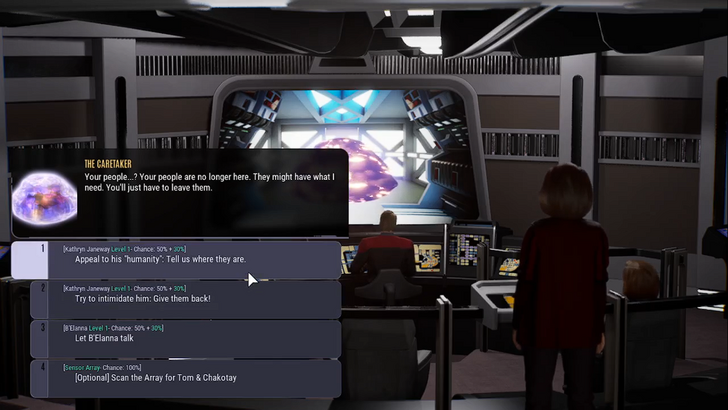
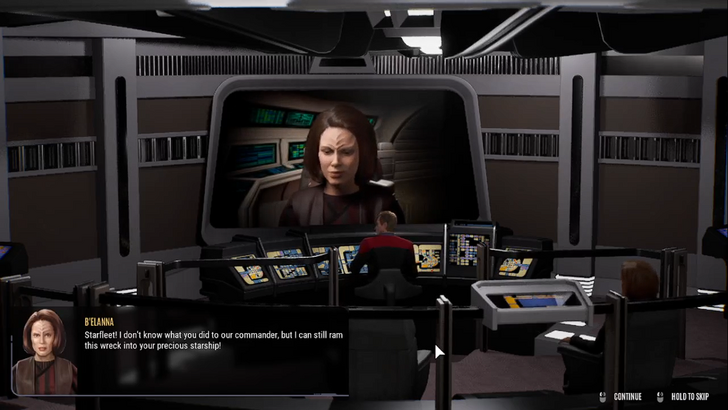
Moving over to a game mechanic that the devs actually thought about, we have the game’s dialogue system. Snarky, era-appropriate dialogue aside, you can sometimes be forced to choose between lesser evils or varying degrees of questionable behavior. If you thought this was a Bethesda-style Karma system where accumulated bad behavior eventually sours into a mob of NPCs after your head, you’d be mistaken. No, consequences in this game are immediate, serious, and disastrous.
Take my absolute greed for upgrades, rendering my ship dead in the water, for example. You choose which planets you visit and in what order you visit them, with the limiting factor being your fuel stores. I went for upgrade materials first, never leapfrogging to other planets for fuel. Before long, I was adrift in enemy space, operating at half capacity, with a starving crew losing loyalty by the parsec.
Making the right choice could be the difference between earning the resources you need for an important upgrade or not, and could even cost you crew if it goes poorly enough. You’ve got to use your real-life discernment to make the choice, too, because there’s no illusion of choice here. The Choose-Your-Own-Adventure style of branching outcomes is in full swing for this game, so you'd best think hard and think fast when those choices hit.
Mostly Looks Great, Mostly Sounds Alright
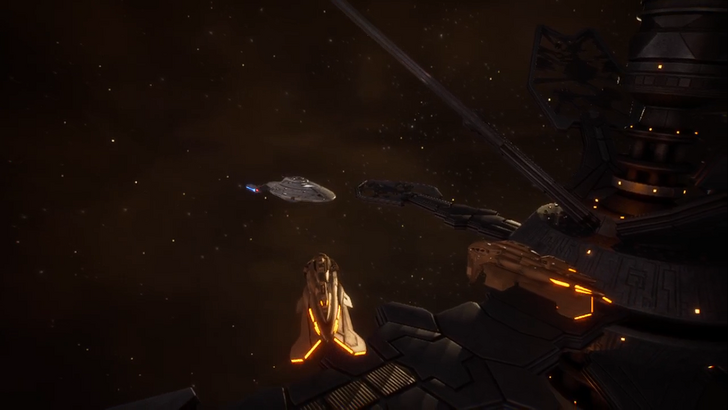
Changing topic to the game’s sights and sounds now, both are mixed bags, with one being more affected by poor quality than the other. Across the Unknown looks great as long as things aren’t moving. The crew portrait and art accompanying the chapter intros look great and are perfect for the setting. The UI is a masterwork that requires study in its elegance and efficiency. The static backdrops for space encounters and the sector map itself are all beautiful and require praise.
That all falls away when something has to move, because this game grooves like a cutscene from an ancient cutscene whenever a cinematic plays. Weird, clunky movements, minimal expression through body language. If you think that’s bad, it’s nothing compared to the voice-acting, though.
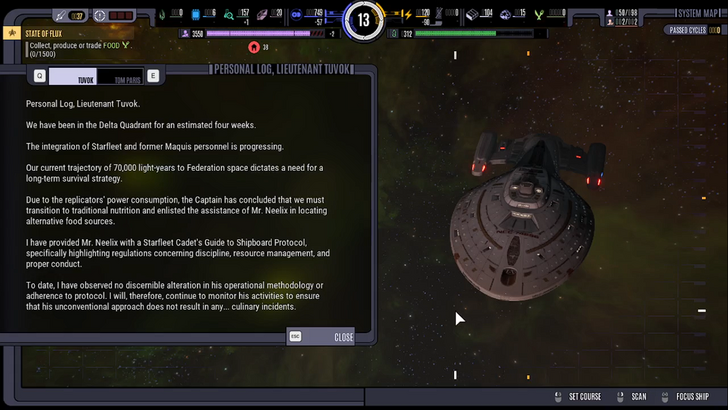
The game’s voice-acting falls through in many ways, the most notable of which is in consistency. VA’s only recorded in-combat blurbs and their voice logs at the start of each chapter. There’s a lot of conversation to be had between all of that, but the game doesn’t entertain those with voice acting.
The quality of the voice acting itself is a little suspect. Most deliveries are passable but not great, while some are just downright heinous. I’m all for hiring voice actors over screen actors for projects like these, but I think I’m better off hiring anyone but the VA behind Lieutenant Paris. At least the music’s above average, otherwise this game would’ve sunk lower than its audio quality control. Altogether, though, the audio makes this game sound cheaper than it actually is.
The Final Frontier Needs Servicing
And that’s pretty much it for our in-depth dissection of Across the Unknown’s gameplay, story, and overall design. It’s a dead ringer for FTL in many ways, but consistent quality is certainly not something these games have in common. Across the Unknown has a notable divide in game design quality between its two halves, and has entire sections of its existence that need redoing, like its audio and animation.
When one half is amazing, and another is forgettable and bordering on awful, one can only hope that some updates and overhauls are in short order. An early access release may have been the right move, but past 1.0, I don’t see how something like the voice acting can be saved.
Just keep your eyes on what the game does well, appreciate its faithfulness to the source material, and expect nothing more than the bare minimum for everything else, and you can expect this title to live long and prosper in your library.
Is Star Trek: Voyager - Across the Unknown Worth It?
Pricey for a AA, but It Can Be
Coming in at $29.99, Star Trek: Voyager - Across the Unknown is a tad more expensive than your run-of-the-mill AA title. Then again, this isn’t your run-of-the-mill AA title; it’s Star Trek, and for some, that’s more than enough.
In terms of gameplay, only half of it is worth bothering with, even if you need to pay full price, so maybe waiting for a sale is more prudent than buying it outright. Regardless, the strategic layer alone carries much of this game’s value as a product, so if that’s all you need, then this might be the game for you.
Star Trek: Voyager - Across the Unknown FAQ
What Languages is Star Trek: Voyager - Across the Unknown Available in?
While the game’s demo will only be available in English, Star Trek: Voyager - Across the Unknown will have German, French, Spanish, Italian, Polish, Russian and Chinese localizations on release.
Game8 Reviews