



| Digimon Story: Time Stranger | ||||
|---|---|---|---|---|
| Release Date | Gameplay & Story | DLC & Pre-Order | Demo Review | Full Review |
Digimon Story: Time Stranger Review Overview
What is Digimon Story: Time Stranger?
Digimon Story: Time Stranger is an upcoming RPG published by Bandai Namco Entertainment and developed by Media.Vision, the developers of Digimon Story: Cyber Sleuth (2015) and Digimon Story: Cyber Sleuth - Hacker's Memory (2017). Released on October 3, 2025 for PC, PlayStation 5, and Xbox Series X|S, it will be the seventh installment in the Digimon Story series.
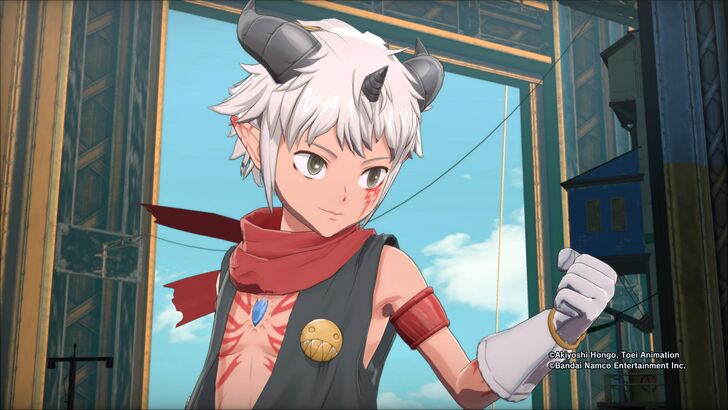
Time Stranger follows a male or female protagonist (Dan Yuki or Kanan Yuki), an agent of the secret organization ADAMAS, which investigates anomalous phenomena. After encountering a mysterious Digimon in Shinjuku, they are caught in an explosion and wake up eight years in the past. They are now tasked with uncovering the mystery behind the impending collapse of the world while exploring the interplay between the past and future, the human and digital worlds, and the relationships between humans and Digimon.
Players can assemble a diverse roster of Digimon and nurture them into powerful allies for turn-based battles. They can collect, train, and customize these creatures, with deeper customization options providing "limitless ways to approach the challenges of battle." Digimon can evolve into stronger forms as they grow in experience and meet specific criteria, such as achieving certain stat thresholds. The bond players share with their Digimon also plays a crucial role in their evolution and overall strength.
Digimon Story: Time Stranger features:
⚫︎ Over 450 Digimon to Collect
⚫︎ Turn-Based JRPG Combat
⚫︎ New Cross Art Mechanic
⚫︎ 16 Digimon Personality Types
⚫︎ Plenty of QoL Improvements From Previous Games
⚫︎ Agent Skills and Rank Progression
For more gameplay details, read everything we know about Digimon Story: Time Stranger's gameplay and story.
| Digital Storefronts | ||||||||
|---|---|---|---|---|---|---|---|---|
 Steam Steam |
 PlayStation PlayStation |
 Xbox Xbox |
||||||
| $69.99 | ||||||||
Digimon Story: Time Stranger Pros & Cons
| Pros | Cons |
|---|---|
 Deep and Rewarding Combat System Central Town is at the Center of My Heart Quality-of-Life Improvements Make Gameplay Smoother Digivolving and De-Digivolving is Just Fun Deep and Rewarding Combat System Central Town is at the Center of My Heart Quality-of-Life Improvements Make Gameplay Smoother Digivolving and De-Digivolving is Just Fun |
Lack of Newer Digimon in the Base Game Sound Mixing Issues Story is Full of Anime Tropes |
Digimon Story: Time Stranger Story - 8/10
The story in Digimon Story: Time Stranger is strong, even if it doesn’t quite hit the darker, more mature themes that Digimon Survive pulled off so well. The pacing is steady, and even though some beats are a little too anime tropey, it really finds its footing once the time travel elements kick in. The cast of characters, both human and Digimon, are easy to like, and the Digital World of Iliad is hands down my favorite Digimon server so far. The choice of having a silent protagonist might not sit well with everyone, since it can make certain moments feel less impactful than they could have been, but, really, that’s a sickness within JRPGs as a genre.
Digimon Story: Time Stranger Gameplay - 10/10
What I like best about Digimon Story: Time Stranger is the way freely Digivolving and De-Digivolving Digimon opens up endless team possibilities. This is because the combat pushes you to actually think about elemental matchups and attribute advantages instead of just brute-forcing through battles. I found myself using Digimon I never thought I’d touch just because the game pushed me to think outside my usual comfort zone, and that made victories feel all the sweeter.
Digimon Story: Time Stranger Visuals - 9/10
The digital world of Iliad looks and feels amazing thanks to all the small background details, like Digimon just doing their own thing as you pass by. I also really like how the game makes the size of Digimon stand out, with bigger ones actually looking massive next to your character. The designs themselves are stylish, and flashy attack animations make battles fun to watch. This, however, doesn’t make it a technically demanding game. The choice to lock it at 30fps even on the PS5 feels odd in 2025. It didn’t bother me personally—I’ve played worse—but it’s still worth pointing out.
Digimon Story: Time Stranger Audio - 9/10
I have to eat the words I wrote about Masafumi Takada’s soundtrack in my demo review. What felt underwhelming in the demo really goes full force here in the full game, with tracks that hit harder the more you hear them. I also appreciate how you can swap out background music in places like the DigiFarm or standard battles, which lets you keep the vibe fresh. The addition of English voice acting, even for Digimon themselves, is a huge plus. It’s not something new; Digimon World 2 had Digimon shouting attacks back in 2001, but it’s great to see it come back here. My only gripe, though, is the sound mixing. You can hear it being uneven, especially with headphones on. Music often drowns out dialogue in cutscenes, but lowering its volume in the game's settings makes it lose some of its impact during exploration and battles.
Digimon Story: Time Stranger Value for Money - 9/10
Digimon Story: Time Stranger feels like a complete package, with enough depth in its combat and monster collecting to keep you busy for dozens of hours, whether you’re chasing every last Digimon or just sticking to the main story. The quality-of-life changes, especially, go a long way in smoothing out the experience compared to past entries. Still, the absence of more recent Digimon makes the game feel a bit dated. The current roster is great and all, but it’s hard not to feel let down that some Digimon are notably absent or are being held back for DLC on top of the full $70 price tag.
Digimon Story: Time Stranger Overall Score - 90/100
Digimon Story: Time Stranger manages to be one of the best entries in the series, even if it isn’t perfect. Its streamlined systems, large roster of 450 Digimon, and meaningful quality-of-life updates make it a smoother and more engaging experience than past titles. Its main story is good, though I did wish it pushed its more mature themes further. Nevertheless, what’s here is still a JRPG that’s deeply rewarding and worldbuilding that, just like the anime, feels larger than life.
Digimon Story: Time Stranger Review: Digivolved Into a Champion
The Best Digimon Game (So Far)
I can’t pretend I was ever going to be neutral about this one. I’ve been a Digimon fan long before I ever touched a Pokémon game, and that alone already colors how I look at something like Digimon Story: Time Stranger. My first real exposure to the series was on the PlayStation 1, playing Digimon World and Digimon World 2 as a kid. Those games weren’t easy to love; if you’d played these games before, you’d know that they demanded so much from players. Looking back now, though, I think those frustrations shaped me into the kind of player I am. I learned how to stick with games even when they weren’t always giving me the best rides. I’ve played most of the Digimon games that have come out since then, some better than others, but it’s hard to deny that the series has always been either hit or miss.
Digimon Story: Time Stranger feels different. For me, it’s the best Digimon game we’ve had so far, even if that might not sound like the biggest achievement on paper. Digimon has had its fair share of good games, and even some great ones, but they’ve almost always come with drawbacks that made them hard to recommend outside of a niche crowd. That’s been the biggest challenge for Digimon games in general. The Cyber Sleuth titles are probably the closest the series got to alleviating this issue, but even that had the misfortune of being a PS Vita era JRPG (i.e., tied to pacing and design choices that can baffle modern audiences). I’d still call them great, but they aren’t admittedly easy to sell to someone who doesn’t already like this type of game.
Having spent years playing through nearly every Digimon release, I can confidently say this is the strongest title the franchise has ever produced. Crucially, it transcends being just "good for a Digimon game," which is a limiting compliment I've had to offer too often in the past. This is a great JRPG, dare I say one of the better ones released this year.
The Digital World of Iliad is Amazing
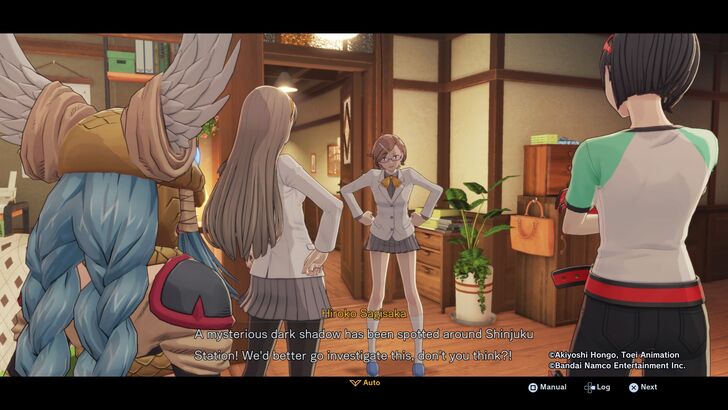
If you played the demo that came out before launch, you can carry over your save and continue right where you left off. Either way, Digimon Story: Time Stranger begins with your character, an agent of ADAMAS, a secret group tasked with investigating strange anomalies across time and space. Things get moving quickly when you’re sent to investigate one such event, only to end up face-to-face with Inori Misono, a girl who somehow knows who you are even though you can’t remember her at all. Her connection to the Digimon Aegiomon sets the stage for most of what follows.
Without giving too much away, the two of them are central to stopping what’s known as the Shinjuku Inferno, a disaster that reduced the city to rubble. And this catastrophe is also the reason your character was thrown back in time, eight years into the past, and as you’d expect with any story about time travel, paradoxes and contradictions end up twisting the plot in different directions. I appreciated how the story leaned into this without overexplaining it, letting you just go along for the ride.
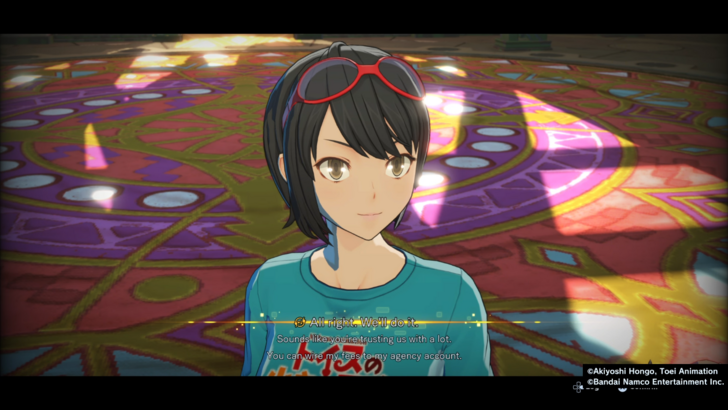
That’s the backbone of the narrative, and it gives all of the game’s characters a clear purpose. Everyone is essentially trying to understand what caused the Shinjuku Inferno and how to prevent it from happening again. Your own role in all this is a bit more complicated because, like past Digimon Story entries, you play as a silent, blank protagonist.
I know this can be divisive; some players feel like a quiet lead undercuts emotional scenes, and I don’t think that’s unfair criticism. Considering this game has been anticipated for nearly a decade, it’s not strange to want a lead with a stronger voice and presence.
Personally, I wasn’t bothered much by this. Silent protagonists are common in JRPGs, and it works fine here. If anything, it opens the door for sillier or nonessential dialogue options, which adds some levity when things get too heavy.

However, because of this, it sometimes feels like you’re not really the main character. Sure, you’re the one doing most of the heavy lifting, all things considered, and you have a unique connection to the anomalies, but the real focus of the story belongs to Inori and Aegiomon. Their growth together, both as tamer and digimon, and as individuals with their own insecurities and hopes, is what drives the entire narrative. It does veer into melodrama at times, but that’s part of what gives it the feel of a Digimon anime. It captures the bonds and emotional arcs the series has always been known for.
Without going into spoilers, I also liked that the game drops hints about bigger concepts, like the Digital World of Shambala, which long-time fans will recognize as an exciting detail. At the same time, I sometimes wished the writing pushed further into its darker themes, closer to what Digimon Survive attempted. That’s more of a personal preference, though, since Time Stranger is clearly aiming to keep the feel of the Cyber Sleuth games.
Digimon Are Literally Massive
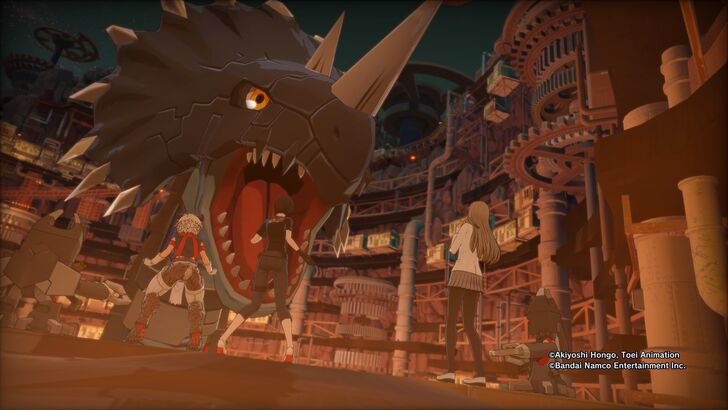
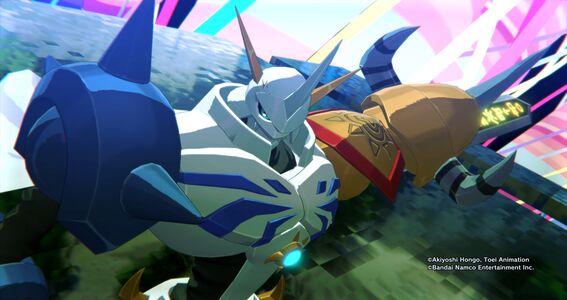
The Digimon themselves are the real stars here. Much of the story unfolds in the Digital World of Iliad, and the way Digimon are portrayed makes them feel alive in a way past Digimon Story games didn’t always manage. The Titans are especially impressive. Their size and scale reminded me of that scene from the 2000 Digimon: The Movie where Greymon fought Parrotmon in the middle of the city, towering over buildings like kaiju. That sense of scale carries over into Time Stranger, and it makes the stakes of the story feel more immediate whenever these colossal beings appear.
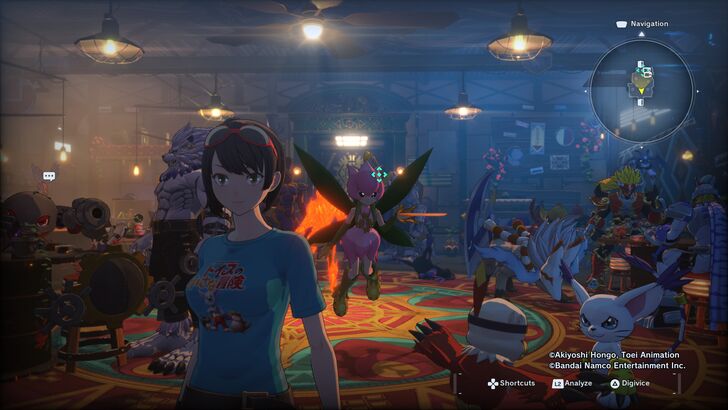
On the other side of things, there are smaller, more lived-in details that bring the world to life. Central Town is the best example. In the demo we only got a small taste of it, but in the full game it expands into something that feels like a real hub. Digimon don’t just stand around waiting for you; they go about their day, running shops, chatting, or flying overhead. There’s even a bar tucked away in a corner.
The town itself has a rough, patchwork look, like it was built piece by piece by Digimon who needed a place to settle. It doesn’t look sterile or overly polished. It feels like a space that grew naturally, which makes it far more interesting than the flat, single-colored Digital Spaces we’ve seen in past titles.
Turn-Based Combat That’s More About Team Comps
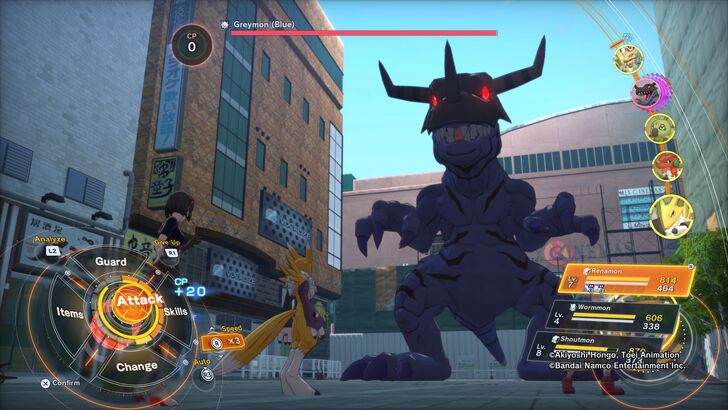
When people talk about Digimon games, they usually split a lot of them into two categories. The World games are on the monster-raising side, closer to its tamagotchi-like roots, where you’re responsible for training and taking care of your Digimon, down to things like feeding them and even dealing with their bathroom needs. The Story games, on the other hand, are firmly rooted in turn-based RPG design. That’s been the case since Digimon World: DS on the Nintendo DS, which, despite its localized title, was very much the first "Story" game. Time Stranger continues this tradition, but with a lot more polish and improvements that make it feel more in line with something like Persona or Shin Megami Tensei.
The battle system is straightforward on the surface. You always have three Digimon in your active party, with another three waiting in reserve. Aegiomon is with you most of the time, but you’ll also occasionally have guest Digimon joining your team. These guests can’t be controlled and usually can tank damage if your AI opponents are dumb enough to target them.
The real strategy, though, comes from exploiting enemy weaknesses. There are two layers here. First are the standard elements—fire, water, wood, and so on—which determine what types of attacks will do the most or least damage. On top of that is the attribute triangle: Vaccine beats Virus, Virus beats Data, and Data beats Vaccine. If you ignore these systems, your damage output plummets, and fights become a slog.
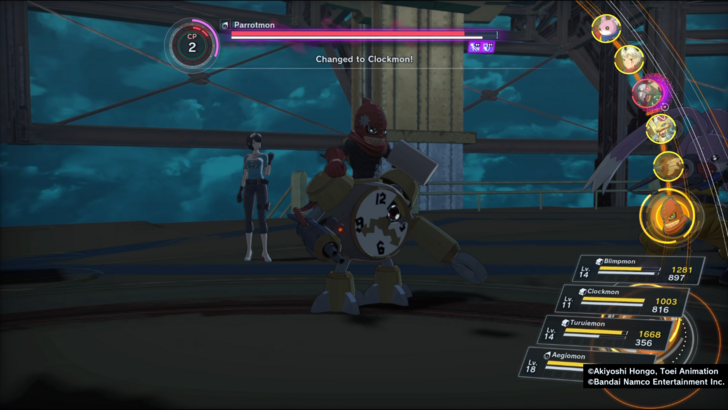
Because of this, you can’t just brute force your way through dungeons with the same team of Digimon. You need to think ahead and adjust your lineup based on what you’re going up against. I actually liked this because it forced me to experiment with Digimon I wouldn’t normally use.
For example, my plan going in was to eventually evolve my team into Apollomon and Dianamon, two of my favorite Digimon from Digimon World: Dawn and Dusk (which are also Digimon Story games). But midway through the game, I had to shelve that plan to cover weaknesses in my team. That’s how I ended up relying on Clockmon and Kiwimoon, Digimon I’d never given much attention to before. They weren’t my first choice design-wise, but they got the job done at the time, and that’s what mattered.
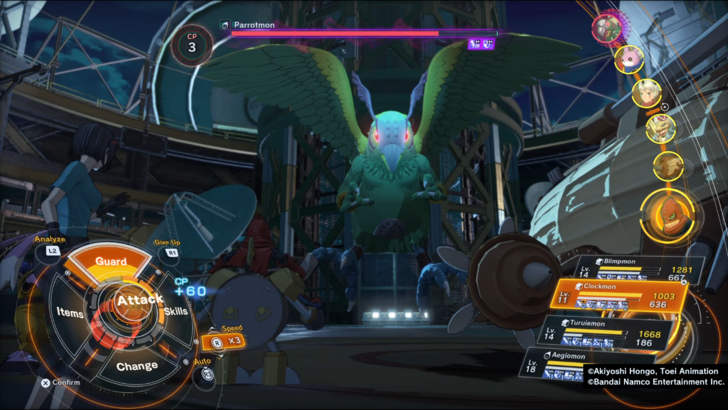
The need to adapt becomes especially clear in boss battles. These fights are tough. Bosses are often damage sponges, and if you walk in underleveled or with the wrong attributes, they can take your team out fast. One early wall for me was Parrotmon at the top of Central Tower, a fight that was shown before release. It wasn’t impossible, especially halfway through, but the first time I fought it, my team was almost entirely at a disadvantage against its Vaccine typing and resistance to electric attacks. Coming back with a properly balanced team made all the difference.
There are systems in place to keep things from becoming overwhelming. You can use items once per turn without losing a Digimon’s action, which can save you in a pinch. For those who want more of a challenge, New Game+ unlocks Mega and Mega+ difficulty. On Mega+, you can’t use items at all, which means you need to think ahead and build teams with support skills instead of relying on healing items.
There are also new mechanics layered on top of the base system. Cross Arts, for example, are special abilities you can trigger by spending Cross Points, which build up each time your Digimon does an action. They can be powerful attacks that hit all enemies or buffs that strengthen your whole team. You can only equip one type of Cross Art at a time, but you can use it as many times as you want as long as you have the points.
On top of that, attachment skills (which work like Pokémon’s TMs) let you teach Digimon moves they wouldn’t normally learn. These can patch up weaknesses, give access to healing or debuff skills, or just expand your options in combat. Unlike Pokémon, there are no restrictions on who can learn what, so you’re free to experiment.
SHINKA!!!
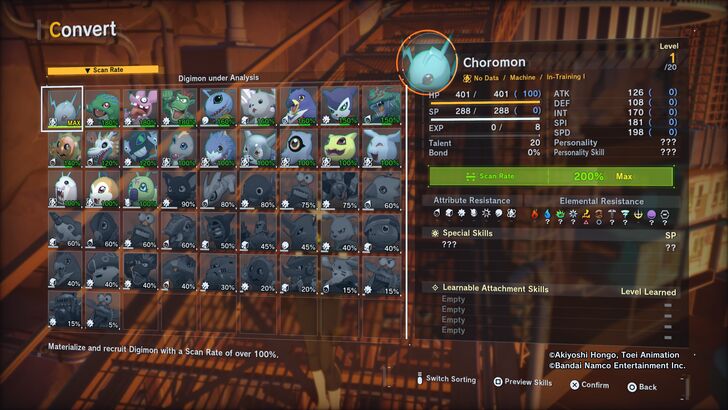
The added difficulty in Digimon Story: Time Stranger is one of the reasons why you’ll find yourself constantly rotating your roster of Digimon. You’ll rarely stick with the same group for long. Outside of the starter Digimon you choose, most of your roster comes from encounters out in the field. Every Digimon you face gets automatically scanned for a percentage based on their evolution stage. Collect enough scans to hit 100%, and you can convert that data into a new ally. If you’re patient enough to reach 200%, you’ll unlock bonus stats and a higher level cap when they finally join your team.
Because scanning is tied to encounters, you’ll end up collecting a lot of Digimon just by moving through the game, duplicates included. Grinding in the same area often means your storage quickly fills with multiple copies of the same Digimon. You don’t have to convert them, but since 200% is the cap, letting them sit there feels like a waste.
The game gives you a couple of options for handling this overflow. You can be a heartless monster and use them as fodder to give experience to other Digimon, or you can branch them into entirely different digivolution paths.
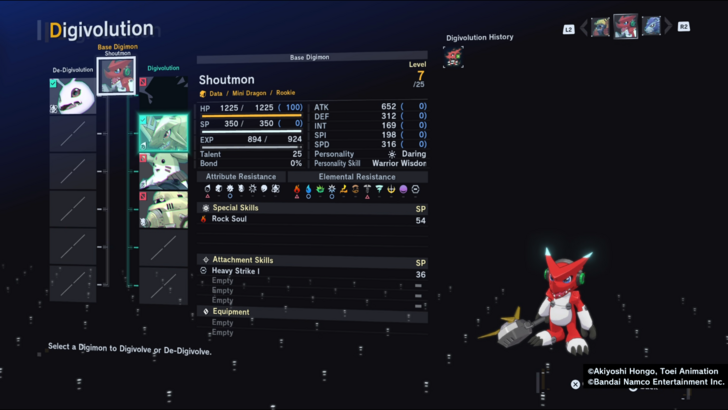
What makes this system interesting is that Digivolution in Digimon isn’t linear the way it is in something like Pokémon. It’s more of a branching tree, where a single Rookie Digimon might evolve into multiple different Champions, Ultimates, or even Megas, depending on which path you take. Koromon, for example, can turn into Agumon, Guilmon, Dracomon, or Shoutmon. From there, Agumon might digivolve into Greymon, GeoGreymon, or even Numemon, who in turn could de-digivolve back into Betamon and then take an entirely new line into water types like Seadramon or Coelamon. The options keep expanding the more you explore the evolution tree, and you’re rarely locked into one outcome.
Because of this, digivolution and de-digivolution happen constantly. They’re not permanent forms. You might change a Digimon simply to fill a gap in your team, or because you’re chasing a new entry in the Field Guide, the series’ version of a Pokédex.
However, there’s also a mechanical reason to evolve and revert frequently. Every time you do it, your Digimon’s stat grows stronger, especially once they’ve reached certain level thresholds. Some higher-level digivolutions even require specific stats, so training and evolving in cycles becomes part of the natural grind.

However, plenty of evolutions are locked behind stat requirements, so unless you’re investing into the right stats, you won’t always be able to reach the forms you want. This is where the new Personalities come in. These influence how Digimon gain stats as they level up, similar to natures in Pokémon. Unlike Pokémon, though, these can be changed. Depending on how you respond to a Digimon’s messages, their Personality shifts, letting you nudge their growth in certain directions. I didn’t pay much attention to this during my first run, but it’s clear from the get-go that people who enjoy min-maxing will get a lot of mileage out of it.
Stat growth also ties into the DigiFarm, a familiar system for anyone who’s played past Digimon games. Here, you place Digimon in different areas and let them passively gain experience or train specific stats with Training Sets. Training takes real-time hours, which makes it something you can manage in the background while continuing with the main game. If you want, you can spend in-game money to speed it up, but honestly, the money is usually better spent elsewhere. Costumes, for example, are cool. They don’t affect gameplay, but, hey, who doesn’t want to see their agent wearing a Tales of Arise t-shirt?
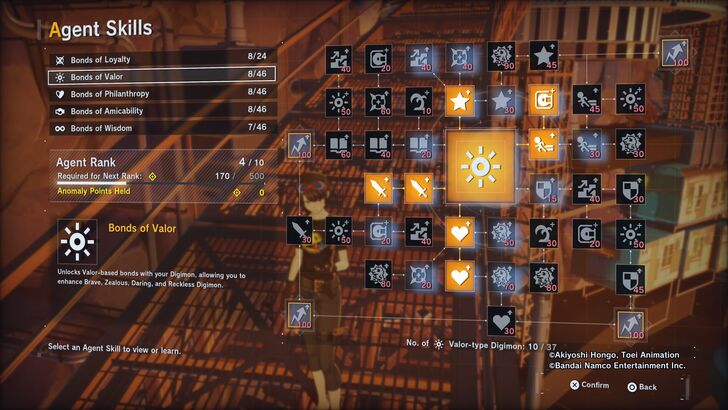
There are also side quests that have you running back and forth for a small reward, but what you really want from them are the Anomaly Points. You spend these on a skill grid to get useful Agent Skills, like Cross Arts, and stat boosts for your Digimon based on their Personality.
Spending AP also raises your Agent Rank, which is a must for digivolving your partners. It's annoying that so much of the AP is tucked away in these optional missions. Still, the main story gives you enough to keep you on par with the usual enemies, so you're not totally underpowered. Bosses, though, are another thing entirely.
Is Digimon Story: Time Stranger Worth It?
Yes! Bias Aside, It’s One of the Better JRPGs of 2025

Digimon Story: Time Stranger is not the best JRPG I’ve ever played, but it’s one of the strongest to come of 2025. There’s a lot here that deserves recognition, both in terms of what it adds to the series and what it refines from past entries. Even though Kazumasa Habu isn’t part of the franchise anymore, you can still feel the impact of the groundwork he helped establish in the way this game carries itself. It’s a $70 release, which has become the standard price nowadays, but despite some minor gripes, this earns that price tag. The mechanics are deep enough to reward min-maxers who want to squeeze out every possible stat advantage, while monster-collecting fans like myself will find hours slipping away just trying to fill out the DigiFarm and box slots with all 450 Digimon in the roster.
What also helps is how many quality-of-life features the game builds into its design. Enemy encounters are no longer random, and many quests often have you immediately teleport if you don’t prefer backtracking. You can even manage your Digimon directly from the menu instead of heading to a DigiLab, which might not sound like much, but it really makes the overall pace of the game feel more modern. Because of all this, the game is leaner than earlier entries. My playthrough clocked in at about 40 hours with a decent amount of side content, whereas Cyber Sleuth often stretched closer to 50 or 60 hours. A lot of that difference is probably just the removal of padding, but it does make Time Stranger feel brisker.
I do, however, wish that the game added more of the newer Digimon to have come out in recent years. The inclusion of Agumon and Gabumon’s Bonds evolutions from Last Evolution Kizuna was a nice touch, but I wish the developers went further. Characters like Gammamon from Ghost Game or Pteromon from Liberator would’ve been nice. Adding Gekkomon from Beatbreak, which releases this October 5th, would’ve been perfect. Heck, I wish they added Herissmon from the now-defunct gacha game Re:Arise. The selection is good, don’t get me wrong, but I do hope to see some of these new faces make their way into the game one way or another.
Regardless, what Time Stranger achieves here is impressive. For years, Digimon games have lived in the shadow of Pokémon, always being compared and rarely seen as equals. With Pokémon Legends: Z-A releasing later this month, the comparisons are inevitable, and as a fan of both franchises, I’m glad to finally say that Digimon stands shoulder to shoulder with its rival.
| Digital Storefronts | ||||||||
|---|---|---|---|---|---|---|---|---|
| Steam |
PlayStation |
Xbox |
||||||
| $69.99 | ||||||||
Digimon Story: Time Stranger FAQ
How to Beat Parrotmon in Digimon Story: Time Stranger?
It is advisable to come into this boss fight with teams of Data-type Digimon. Since Aegiomon and Minervamon are both Vaccine-type Digimon, they will do little damage to Parrotmon. Therefore, Aegiomon's primary role here will simply be to tank damage and heal others. Your objective is only to do enough damage to trigger the second half of the fight, which makes the rest of the encounter considerably easier.
How Long to Beat Digimon Story: Time Stranger?
The main story takes about 30-40 hours to finish, depending on difficulty and the amount of content players do alongside it, but players who explore every nook and cranny can easily double that playtime.
Game8 Reviews

Digimon Story: Time Stranger Similar Games



Digimon Story: Time Stranger Product Information
|
|
| Title | DIGIMON STORY: TIME STRANGER |
|---|---|
| Release Date | October 3, 2025 |
| Developer | Media.Vision Inc. |
| Publisher | Bandai Namco Entertainment |
| Supported Platforms | PC (via Steam) PlayStation 5 Xbox Series X|S |
| Genre | Monster-Taming, JRPG |
| Number of Players | 1 |
| ESRB Rating | ESRB Teen IMDA 16 |
| Official Website | Digimon Story: Time Stranger Official Website |









honestly pretty good audio would be considered a 10 if the soundtracks were not behind a paywall and the OG voice actors came in for the Digimon. I have to fight the story score though due to it being expansive, what i mean is what you do defines the the final fight scenes, if you complete all the royal knights side quest you get an awesome cut scene that adds to the final fight and that is just one example. i will admit the digi farm did feel like a downgrade from the last two games.