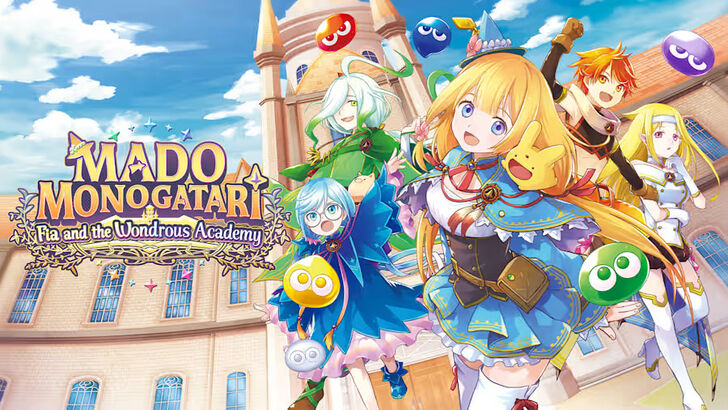
MADO MONOGATARI: Fia and the Wondrous Academy is the latest game in the said dungeon-crawler RPG! Read our review to see what it did well, what it didn't do well, and if it's worth buying.
MADO MONOGATARI: Fia and the Wondrous Academy Review Overview
What is MADO MONOGATARI: Fia and the Wondrous Academy?
MADO MONOGATARI: Fia and the Wondrous Academy is a dungeon-crawling RPG released in Japan on November 28, 2024, and worldwide a year later, on July 29, 2025. It revives the long-dormant Mado Monogatari series—a franchise of first-person, grid-based dungeon crawlers from the late ‘80s and early ‘90s—for the first time since Sorcery Saga: Curse of the Great Curry God in 2013.
At the Ancient Magic Academy, a storied institution where the legendary Great Mage once trained, players take on the role of Fia, a young girl who travels from her hometown and gains admission through sheer luck. Her goal is to rise through the ranks of the Academy and ultimately become a Great Mage herself.
MADO MONOGATARI: Fia and the Wondrous Academy features:
⚫︎ Randomly Generated Dungeons
⚫︎ Real-Time Turn-Based Combat
⚫︎ Progression Through Skill Trees
⚫︎ Magic Artes and Great Magic Artes
⚫︎ Light School Life Sim Elemets
 Nintendo Nintendo |
 PlayStation PlayStation |
||||
| Price | $49.99 | ||||
|---|---|---|---|---|---|
MADO MONOGATARI: Fia and the Wondrous Academy Pros & Cons

| Pros | Cons |
|---|---|
 A Cast of Lovably Annoying Goofs Great Character Portraits and Full Art Illustrations Strong Voice Performances A Cast of Lovably Annoying Goofs Great Character Portraits and Full Art Illustrations Strong Voice Performances |
Repetitive Dungeon and Enemy Designs Lightweight Mechanics May Disappoint Hardcore RPG Fans Story is a Bit Too Simple |
MADO MONOGATARI: Fia and the Wondrous Academy Overall Score - 66/100
Mado Monogatari: Fia and the Wondrous Academy might offer a first outing for Fia that's more charming than it is challenging, but it sails on the whimsy and luck of its lovable weirdos. The combat’s got just enough going on it to stay fun all throughout, and the characters themselves just ooze personality. It’s a light game, sometimes too light, but it’s also weirdly committed to its own nonsense. It’s impossible to be annoyed when everyone involved is so utterly dedicated to the bit.
MADO MONOGATARI: Fia and the Wondrous Academy Story - 7/10
The story here leans heavily into anime nonsense, but that ends up being one of the game’s many strengths. Fia’s luck and her disaster-class of misfits keep things lively, if rarely grounded. There’s a certain whimsy to how problems are solved, sometimes through the power of friendship or Fia and Carby just stumbling through the solution, and the game fully embraces that tone. Still, it’s a rather simple story that relies too much on tropes, and it doesn’t have a lot of drama in it. Regardless, it’s lighthearted and genuinely funny at times, and that’s enough, perhaps.
MADO MONOGATARI: Fia and the Wondrous Academy Gameplay - 7/10
The dungeon crawling in Fia and the Wondrous Academy is enjoyable enough, with combat adding just enough spice to keep each floor engaging without overstaying its welcome. The real meat lies in managing your resources and tweaking your party, which gives the game’s mechanics some an illusion of depth. Outside the dungeons, the school life sim offers a nice change of pace and keeps things from feeling too samey. However, it’s pretty light fare for a JRPG. It's fun nonetheless, but it feels like a diet soda version of games you’ve probably already played before.
MADO MONOGATARI: Fia and the Wondrous Academy Visuals - 6/10
Character portraits do a lot of the heavy lifting here, with expressive art that gives the cast more personality than the stiff 3D models ever could. The story segments pop with occasional full illustrations that add just the right amount of flair, especially when the dialogue leans into the absurd. Unfortunately, the visual creativity doesn’t extend to the dungeons or enemies, where reused assets and palette swaps start showing up far too early. It’s still adorable where it counts, but a little more variety wouldn’t have hurt.
MADO MONOGATARI: Fia and the Wondrous Academy Audio - 7/10
The voice acting does a great job carrying the cast’s eccentricities, with each performance dialed in just enough to sell the weirdness without going full parody. Sound effects are clean and punchy, and they help keep battles feeling crisp. The music, though, mostly plays it safe. Outside of the catchy opening and a few battle tracks, the rest of the soundtrack fades into the background more than it probably should. It’s still solid, but you can’t help but wish the rest of the game had the same playful flair opener teased.
MADO MONOGATARI: Fia and the Wondrous Academy Value for Money - 6/10
There’s a lot of heart packed into Fia and the Wondrous Academy’s 30-hour runtime, and the game rarely wastes your time. But at a $50 price point, it’s a tougher sell when stacked against more polished or content-rich RPGs. It feels more like a solid mid-tier title. If you’re here for the vibes and the characters, there’s enough meat on the bone to justify the purchase, but it won’t shake the feeling that it probably should’ve launched with a smaller ask or just denser systems.Still, for fans of this dungeon crawler series or just anime nonsense in general, there’s something to be said for what is here, even if it doesn’t always go the distance.
MADO MONOGATARI: Fia and the Wondrous Academy Review: A Cotton Candy JRPG
The words "Madou Monogatari" used to mean very little to me. It was just one of those old Japanese PC games people would bring up in classic JRPG forums, usually alongside other offbeat dungeon crawlers. I remember seeing the titles shared in spreadsheet rec lists and fan translation threads, always with some variation of "you should play this if you like Shin Megami Tensei." I never did. Maybe I was too young, maybe because they were Japanese-only, or maybe I just didn’t know how to appreciate the weirdness and adorableness of the said series. Whatever the reason, I never really gave Mado Monogatari the time of day.
But now, with Mado Monogatari: Fia and the Wondrous Academy on the verge of its Western release—its first in a decade, no less—I decided to finally find out what I’ve been ignoring all these years. Originally a Compile creation in the early ‘90s, the Mado Monogatari franchise eventually splintered into what would become the Puyo Puyo puzzle series, while its dungeon-crawling RPG roots faded into the background. It didn’t help that most of these games never officially saw the light of day outside of Japan. The first real chance Western players got at the series came with Sorcery Saga: Curse of the Great Curry God back in 2013.
I’ve clocked just over 30 hours into Fia and the Wondrous Academy, and I sort of get it. The appeal, the warmth, the gentle pace; they’re all there. It’s old school in some ways, sure’ turn-based battles and dungeon crawling never went out of style here. However, it also makes a case for why that old magic still works.
Fia is a Force to be Reckoned With
The story here doesn’t waste time pretending to be anything it’s not. It opens with Fia, a girl who dreams of becoming a Great Mage just like her grandmother before her. She’s made the long journey to the Ancient Magic Academy entirely on foot—a supposed "tradition" in the loosest sense of the word, since there are easier travel methods. Unfortunately for Fia, she arrives only to find that the entrance exam ended days ago. But just when she have built up the resolve to try again next year (almost immediately, in fact), the school’s principal appears and deems her journey itself to be the exam. She passed, it turns out, through sheer dumb luck.
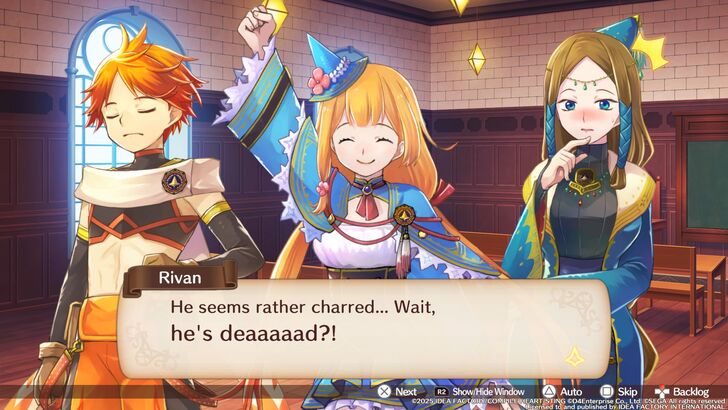
That logic, loose as it may be, sets the tone for the rest of the game’s story. Fia stumbles through one problem after another with a level of coincidental success that borders on slapstick. It’s not high drama; honestly, it’s a little too anime for my taste, the kind that leans heavily on the power of friendship. Basically, what I’m trying to say here is that if you’re looking for a story with foreshadowed twists that will have you pondering society at large, you won’t find it here. However, if you’re willing to embrace the absurdity of a world where the universe bends over backwards for a cheerful dunce, you’re in for a good time.
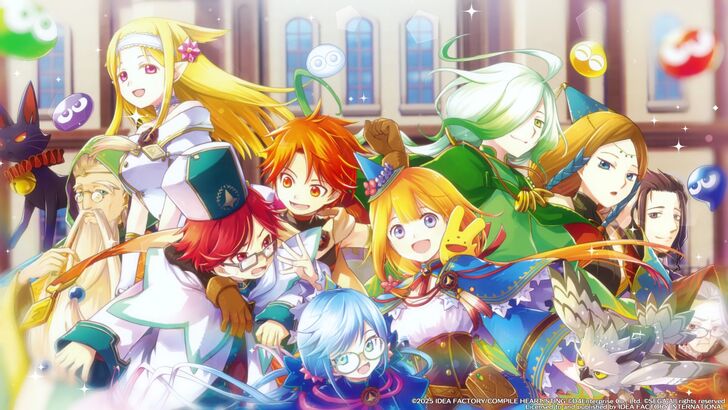
Much of the game’s whimsy comes from its ensemble of disaster-prone misfits. Fia herself is a lovable klutz, frequently being led astray by her sidekick Carby the Carbuncle who has an anarchic streak of his own. Will, an aspiring Hero™, is so single-minded in his quest to be one that any situation with a bit more nuance causes him to freeze up entirely. Leena, the classic tsundere, manages to sabotage her own good intentions nearly every time she opens her mouth. Totto mostly sees casual conversations as a means to do business. And Eska just wants to be eaten by Fia. Yes, really, and somehow that manages to make sense in context. Kind of.
As absurd as all that sounds, the writing here is very much committed to the joke. Each chapter usually spotlights one member of the group, drawing out a short backstory or personal motivation, but it never lingers too long before veering back into the madness of it all. And whenever all five are together, the results are predictably catastrophic. Teachers look on in horror at the sight of all five, and there are even instances where the staff actively tries to get them expelled.
Of course, there’s more to the story than goofs and gaffs, and the game does try to sneak in a few emotional beats here and there. However, if you ask me, the appeal lies in its complete disinterest to take itself seriously. It’s happy in being weird and a little dumb. That might not sound like high praise, but after 30 hours of watching Fia trip her way through the curriculum and somehow come out ahead, I kind of get the appeal.
Fun Game with Some Diet Mechanics
When I booted up Fia and the Wondrous Academy, however, it was the gameplay that had me most excited. I mean, people before had been throwing around comparisons to early Shin Megami Tensei and Etrian Odyssey, two series I’ve spent a lot of time with, and that alone was enough to get me on board. I was more than ready to get lost in some punishing dungeon crawling.
That’s not quite what this game delivers, though. It has dungeons. It has a decent battle system. It even feels like those older games if you squint really, really hard. But this isn’t the artisanal small-batch RPG grindhouse I was expecting. It’s a diet soda version of the aforementioned games. It's not necessarily a bad thing, but it's not entirely a good thing either.
At the start, you choose a job class for Fia. Your options—Magic Knight, Wizard, Witch Thief, or Hermit Hunter—are basically color-coded templates for her companions, who each occupy one of these roles in your party. Each class changes Fia’s stat growth and gear options. Regardless of your choice, you can still swap classes whenever you want. Plus, you can only bring two other characters to your party, so it’s best to choose a class which works best with your lineup. Or, you know, just choose the characters you like.
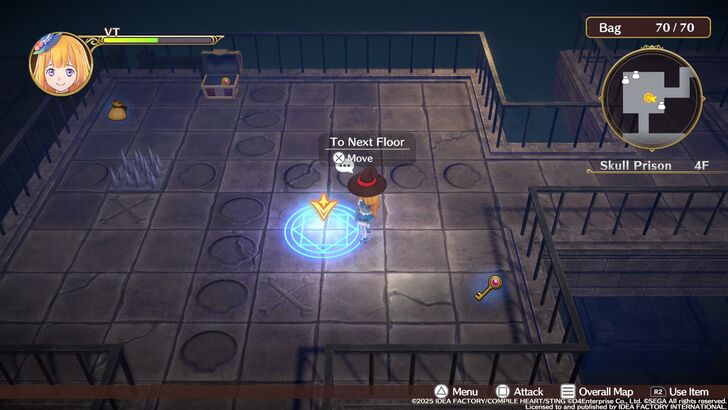
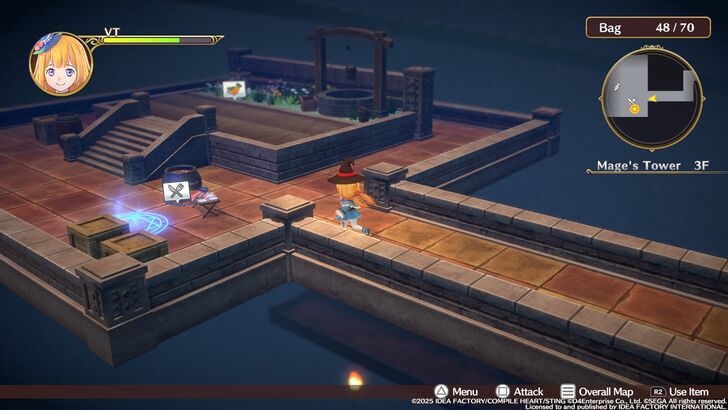
The meat of the game lies in its dungeon crawling. You’ll tackle multi-floor towers, some of which go as high or as deep as 50 floors, packed with enemies, treasure chests, and gimmicks upon gimmicks. The catch is that these dungeons aren’t especially complex. The layouts tend to blur together after a while, with corridors that look a little too similar and environmental hazards that start to feel like mild inconveniences. There are rotating floors and traps that chip away at your vitality—a stat that governs your ability to explore—but even those rarely force you to change how you approach things. The actual challenge here is more on resource management: keeping your vitality meter healthy, managing loot space, and figuring out when it’s time to retreat and offload your haul.
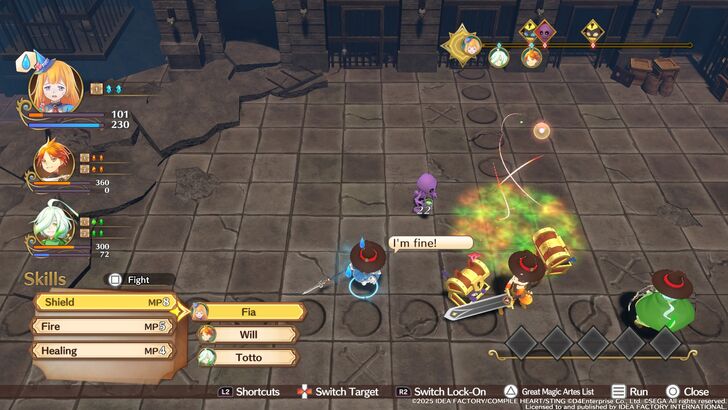
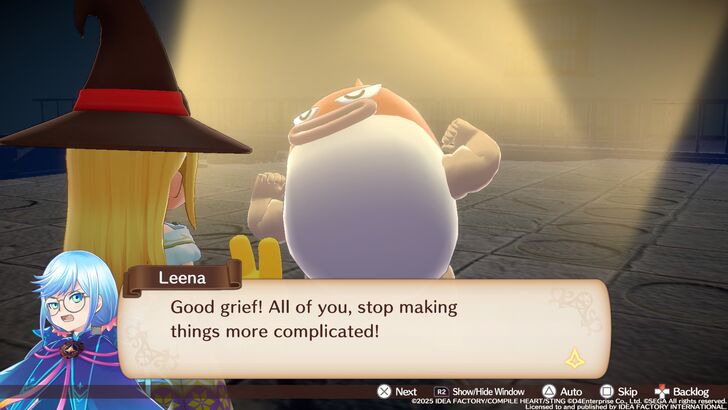
Combat happens in small-arena style battles whenever you bump into an enemy on the field. Here, you directly control Fia, while the rest of your party follows AI instructions based on how you’ve configured them ahead of time. It’s not as overly complex as the gambit system of Final Fantasy XII. I don’t even think it’s as detailed as the one in the Tales of series, but it will at least have you thinking ahead more than micro-managing the fight itself. Leena, for instance, is a great support unit who can both heal and throw up shields, so you’ll want to preserve her MP for emergencies. Will is the opposite, as he can pretty much go ham with his broadsword and fire magic. Each party member has their own quirks, and learning how to set their behavior is important to staying alive.
Every character can equip a variety of Magic Artes, most of which do elemental damage or have helpful effects. More importantly, when you use one, an Elemental Orb tied to that spell’s type is dropped. Collect enough of these during battle, and you can cash them in to unleash a Great Magic Arte that smacks all enemies on screen for a lot of damage. These became my go-to in regular battles, as they deal with monsters quickly.
The battle system runs on a timeline at the top right of the screen. It works a bit like the Active Time Battle systems seen in more recent turn-based Final Fantasy entries. You can attack anytime, but doing so delays your position on the timeline. Positioning also matters. You can move freely during combat to dodge incoming attacks or stay in range, and bosses in particular like to exploit this with large Area-of-Effect spells. Early fights are a breeze, but later chapters can become challenging, especially when enemies chain attacks to delete a party member before it is even your turn on the timeline. There were fights where I had to park Fia at the edge of the arena doing nothing but healing and shielding while the rest of the team whittled down a boss. I mean, it’s not difficult in the traditional sense, but it does require you to stay awake at the very least.
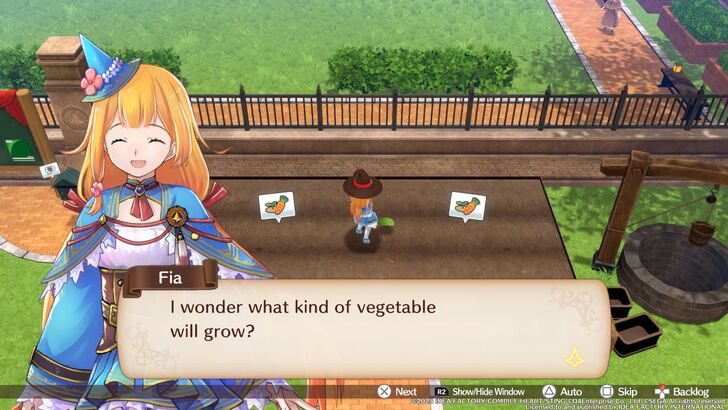
Once you step outside the dungeons, though, Fia and the Wondrous Academy tries its hand at a light school life sim, and while it won’t give Persona any sleepless nights, it does enough to shake up the gameplay loop. You can grow vegetables using seeds, then use those crops in cooking, which provides buffs for dungeon runs. You can also turn literally anything into fertilizer for a tree to get fruits in return. Crafting equipment via recipes unlocked through quests is also a thing, and you can fish in various spots for a side quest or just for the sake of it.
Side quests themselves are pretty light. Fetch this, find that, reach X floor of Y dungeon. It’s padding that could wear thin, but here it mostly acts as a way to pace your dungeon dives and remind you to take a breath.
Enemy and Dungeon Designs Need Some Variety
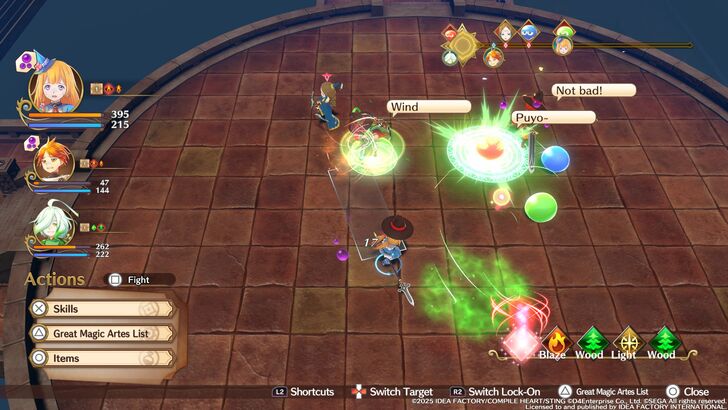
What starts to weigh the experience down, though, is how little visual variety the game offers over time. Enemy designs are one of the biggest offenders. A few hours into the game, and you’ll start noticing that you’re fighting the same ghosts and skeletons, and slimes over and over again, just tinted a different color. Recoloring is a time-honored RPG tradition, but it’s hard to ignore how often it’s leaned on.
Dungeons suffer a similar fate. While their floor layouts change and the traps rotate often enough to stay mechanically relevant, the environments themselves start to blur together fast. A hallway is a hallway, even if you put a crystal on the ground.
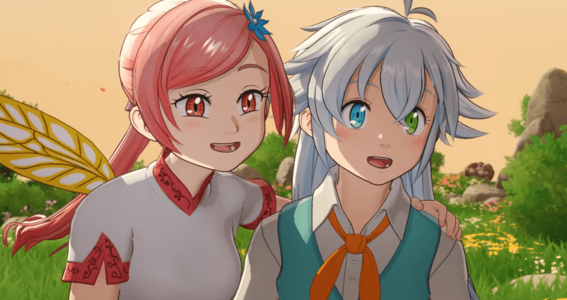
The game’s visuals, at least, give the main cast justice. Character portraits are expressive and well-drawn, often changing mid-conversation to match tone and expression. Even the more static 3D models, which don’t do much in the way of emoting, manage still to feel lively thanks to its character art and some well-timed animations. Occasionally, full illustrations pop up during key scenes, and they do a lot of heavy lifting in selling the emotional (or often comical) beats of the story.
Is MADO MONOGATARI: Fia and the Wondrous Academy Worth It?
Charm Alone Can’t Carry an Entire Game, Sadly

There’s a lot I ended up appreciating about Mado Monogatari: Fia and the Wondrous Academy, even if I’m not entirely sure who I’d recommend it to without caveats. It’s an oddly specific game: light on systems, full of anime nonsense, and committed to a bit that often had me laughing out loud. I found myself charmed more often than I expected by the way the characters bounce off each other. But it’s also a game that feels like it’s skating just above mediocrity and coasting on its charm where other RPGs this year are delivering depth.
Still, I want more of it. I want to see where Fia and her friends end up next. I want another round of Leena barely keeping her tsundere act together, or Will misunderstanding absolutely everything. What I don’t want is for this series to disappear again for a decade. For too long, Mado Monogatari has been a series trapped in the shadows of its own spin-off, forever tied to Puyo Puyo in the West, if even acknowledged at all. The Mado Monogatari series at least deserves to get its own spotlight and the devs their due credit.
Is this a game for everyone? Probably not. It’s anime through and through, both in aesthetic and in how it leans heavily on its tropes. Its systems are very light, sometimes frustratingly so, and there’s not much depth if you’re looking for something to min-max. $50 is a big ask for what is essentially a middling RPG released in a year where the genre is bursting at the seams. But if you go in with the right expectations, or just want a JRPG that doesn’t demand a spreadsheet, you might find yourself enjoying it more than you expect. At the very least, you’ll walk away humming the game’s opening tune and wondering what kind of shenanigans Fia will be up to in the next chapter.
| Nintendo |
PlayStation |
||||
| Price | $49.99 | ||||
|---|---|---|---|---|---|
MADO MONOGATARI: Fia and the Wondrous Academy FAQ
Who are Mado Monogatari: Fia and the Wondrous Academy’s Characters?
The main cast is composed of five eccentric students: Fia, Will, Leena, Totto, and Eska.
Game8 Reviews

MADO MONOGATARI: Fia and the Wondrous Academy Similar Games

MADO MONOGATARI: Fia and the Wondrous Academy Product Information
|
|
| Title | MADO MONOGATARI: FIA AND THE WONDROUS ACADEMY |
|---|---|
| Release Date | November 28, 2024 (Japan) July 29, 2025 (Worldwide) |
| Developer | Idea Factory Compile Heart Sting |
| Publisher | Idea Factory |
| Supported Platforms | PlayStation 5 PlayStation 4 Nintendo Switch |
| Genre | RPG |
| Number of Players | Single-Player (1) |
| ESRB Rating | ESRB E 10+ |
| Official Website | MADO MONOGATARI: Fia and the Wondrous Academy Website |