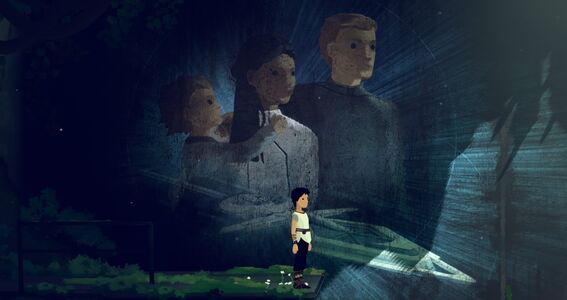





| The Wandering Village | |||
|---|---|---|---|
| Release Date | Gameplay & Story | Pre-Order & DLC | Review |
The Wandering Village is a city builder game where players start a village on the back of a giant creature in a world overrun by toxic plants. Read our review to see what it did well, what it didn't do well, and if it's worth buying.
The Wandering Village Review Overview
What is The Wandering Village?
The Wandering Village is a city builder meets survival simulator where your entire village rests on the back of a massive, lumbering creature called Onbu. Developed by Stray Fawn Studio, the game blends resource management, environmental planning, and long-term survival as you try to keep both your villagers and your host creature alive in a post-apocalyptic world.
The Wandering Village features:
⚫︎ Unique City Builder
⚫︎ Strong Focus on Survival Gameplay
⚫︎ Charming and Cozy 2.5D Visuals
⚫︎ Deep Management System
⚫︎ Light Post-Apocalyptic Narrative
For more gameplay details, read everything we know about The Wandering Village's gameplay and story.
| Digital Storefronts | |||||||
|---|---|---|---|---|---|---|---|
 Steam Steam |
 PlayStation PlayStation |
 Xbox Xbox |
 Switch Switch |
||||
| Price | $29.99 | ||||||
The Wandering Village Pros & Cons

| Pros | Cons |
|---|---|
 Good City Builder With Layered Systems Great Art Direction Addictive Loop Good City Builder With Layered Systems Great Art Direction Addictive Loop |
Early City Layout Is Punishing Resource Overlap For Villagers and Onbu Flat Narrative |
The Wandering Village Overall Score - 74/100
While The Wandering Village offers a unique blend of survival and city-building on the back of a living creature, it doesn’t fully escape the trappings of its genre. Its charming presentation, immersive systems, and original concept are strong pillars but some quality-of-life limitations, a flat narrative, and a few mechanical frustrations keep it from reaching greater heights. It’s a thoughtful, well-crafted game that asks for attention and care from the player, but it also expects you to work around design quirks that could’ve used more polish.
The Wandering Village Story - 6/10
The narrative is one of the game’s weakest aspects, not because it’s bad, but because it feels like an afterthought. There’s lore here, a post-apocalyptic mystery to uncover, and a world in decay, but it’s tucked away in snippets and flavor text. The protagonist isn’t a person, but a collective effort to survive, which is thematically consistent, but emotionally distant. The worldbuilding hints at something larger, but never commits. Still, it doesn’t hurt the experience too much, since the story isn’t the game’s focus.
The Wandering Village Gameplay - 8/10
The gameplay is the heart of The Wandering Village and where it shines brightest. Its management systems are layered and rewarding, with a gameplay loop that constantly pulls you forward. You’re always planning, adapting, and recalibrating, whether that’s researching new tech, optimizing crop rotations, or trying to keep Onbu alive. The mechanics are smartly interwoven, and even when they’re occasionally rigid, they serve a meaningful survival challenge.
The Wandering Village Visuals - 8/10
Visually, the game is a stunner. It doesn’t go for realism, instead, it leans into a soft, storybook art style full of life and detail. From Onbu’s sleepy head to your bustling mushroom farms, everything feels handcrafted and lively. Zooming in to admire villagers going about their day is a joy, and even the smallest animations carry a surprising amount of charm. That said, the lack of camera control (no rotation or free-look) is frustrating in a world you want to see more of. It’s a genre limitation, sure, but a limiting one all the same.
The Wandering Village Audio - 7/10
Audio in The Wandering Village is effective but it never quite elevates itself to something memorable. The music isn’t something you’ll rush to add to a playlist, but it works beautifully in context—tribal rhythms and ambient tones that rise and fall with the mood of the game. What really sells the soundscape is how dynamic it is as zooming in gives you micro-audio environments. As immersive as it is, it doesn’t leave a strong audio footprint.
The Wandering Village Value for Money - 8/10
At $29.99, The Wandering Village offers a solid return on investment. A single playthrough can easily stretch into dozens of hours, especially if you’re a methodical builder or enjoy perfecting your efficiency. The replayability isn’t endless but biomes vary, and each run carries enough random events and survival challenges to keep things fresh. While some systems could use refinement, there’s no filler here. Just a good, well-contained game that respects your time and your wallet.
The Wandering Village Review: Adorable Chaos

Rain is pouring outside, just as hard as it is on the screen in front of me. The wind is howling past my window, the occasional crack of thunder in the distance. But I’m wrapped in a warm blanket with only my villagers to worry about. Unfortunately for them, they don’t have a blanket. They don’t even have a roof anymore. The sudden storm just took out half their housing, the fields are flooded, and the giant creature they’re hitching a ride on has decided to take a nap in the middle of a toxic wasteland. Great.
Welcome to The Wandering Village, a city-builder-meets-survival sim where the last remnants of humanity cling to life atop the back of a massive wandering creature named Onbu. It’s part Ark of Charon, part Frostpunk, part Studio Ghibli fever dream. A game that looks like a warm mug of tea but plays more like a lukewarm panic attack. And that’s exactly my cup of tea. There’s something irresistible about games that pretend to be cozy, only to unravel your plans one drought, poison cloud, or fungal outbreak at a time.
In The Wandering Village, you’re tasked with managing a growing community of villagers who are trying to survive in a world ravaged by toxic spores. The twist? Your entire village is perched on the back of a lumbering beast, and as it roams across desolate biomes, your survival hinges on adapting to whatever the world throws at you—be it scarce resources, shifting climates, or whether Onbu feels like obeying your commands today.
It’s a game about balance between growth and sustainability, between the needs of your villagers and the health of your gigantic host. And it’s a game that demands respect—not just for the genre it stands among, but for the quiet brutality it hides under its hand-drawn charm. So, let’s wander into the review.
A Village in Motion

Let’s start with the game’s stronger suit, the Wandering Village is a damn good city builder. Not just in that usual "watch numbers go up" way—but in the way it makes you care. Every building you raise, every hut you hammer together, every herbalist you assign feels like a small act of defiance against a world that's already ended. There’s a quiet satisfaction in watching your little patch of civilization take root on the back of this gentle giant, stretching and growing like moss on stone.
At its core, the city-building systems are what you'd expect from the genre—you gather resources, construct buildings, assign jobs, and slowly automate your production chains. But the execution is clean and snappy. Your villagers are smart enough to figure things out most of the time, and the UI does a solid job of keeping you informed without overwhelming you. The game never loses track of its core idea, this isn't a static settlement. It's alive, precarious, constantly moving. You’re not just building a city—you’re building a city on a creature, and that changes everything.
The terrain is limited. Every patch of dirt matters. You're working with tight constraints, not just space, but time, weather, and the whims of Onbu. That limited map makes every decision feel heavier. Can you afford to drop a water extractor now, or should you focus on food? It’s a game that constantly asks you to weigh the long-term against the immediate, the individual against the collective.

There’s a bit of a learning curve to all this, of course. Early hours can feel overwhelming, especially if you’re not a city builder veteran. The resource flow isn’t instantly intuitive, and the production chains sometimes require more setup than you might anticipate. But to the game’s credit, it gives you just enough of a nudge to get you going—tips appear when you need them, the UI highlights potential issues, and trial-and-error never feels too punishing. Once you’ve internalized the basics, though? Oh, it’s over. You’re in. You’ll look up and realize three hours have passed and you’ve just been rearranging berry pickers and staring at the compost heap wondering if you need a second dung collector.
There’s a rhythm to the way you start recognizing biomes by the shade of green on the horizon, the way you time your scavenger parties before Onbu turns, the joy of seeing your villagers actually survive a toxic storm because this time you built enough air wells in advance. It becomes a quiet compulsion, this slow-motion crisis management.
Gears and Grime

If the village building is the heart of The Wandering Village, then the mechanics are its guts—messy, essential, occasionally weird, but overall impressively functional.
Everything you build serves a purpose. Your basic needs start simple: food, water, shelter. You construct farms to grow crops, air wells to capture moisture, huts for your villagers to sleep in. But before long, the systems start layering on top of one another. You’re no longer just harvesting beets, you’re deciding whether to feed those beets directly to your people, or process them into meals at the kitchen for a bigger hunger payoff. Do you need stone slabs more than wood planks? Is it worth rerouting a worker from food production just to speed up your research queue?
What The Wandering Village does well is make each of those decisions matter—and it does so without ever feeling clunky. Assigning workers is easy. Buildings are responsive. Resource chains, while layered, are visualized cleanly enough that even newcomers can get a grip on them within a few hours. Everything is interconnected, but never to the point of collapse. Unless, of course, you screw up. And believe me, you will screw up. That's half the fun.

The economy’s tight, and while it never feels unfair, it’s definitely unforgiving if you let things spiral. A lapse in water production during a dry biome can cascade into food shortages, health crises, even death. There’s no hand-holding once you’re in the thick of it. The systems expect you to adapt, not just to shifting resource flows, but to Onbu’s movement as well. A single biome shift can turn your food production upside down. Your farms won’t grow the same crops in the desert that they did in the mountains, and suddenly that well-oiled production line becomes a liability.
Some mechanics, though, feel a little rigid, especially when it comes to early-game placement of certain core structures. While buildings like the wood harvesters, stone miners, and berry gatherers are mercifully moveable, others like huts, the research station, your kitchens and compost heaps, are not.
It’s not game-breaking by any means, but it’s the kind of friction that adds a layer of regret to what should be a game about thoughtful optimization. A simple relocation mechanic, even for just a few of the more important buildings, could go a long way toward keeping the village flowing without the extra busywork.
Cozy Lies And Toxic Skies

The Wandering Village looks like the kind of game you’d play on a rainy afternoon with a cup of tea—all soft edges, painted art, warm tones, and a big ol’ gentle creature carrying your village on its back. It’s practically begging to be labeled as cozy.
And that’s the trap.
Because once you’re in, once you’ve built your first farm, cleared your first patch of forest, and think you’re getting the hang of it—the game kicks your legs out from under you. Suddenly you’re watching half your buildings get destroyed because of a storm. Then the next biome’s a scorched desert, now your food reserves are plummeting, and Onbu—sweet, sleepy Onbu—just wandered straight into a toxic spore cloud again because you couldn’t scrounge up the resources to build a horn tower in time.
It’s brutal. Not in a punishing, "you’ll die and start over" kind of way, but in a slow, suffocating one. A survival of erosion. You never quite lose, but you constantly feel like you’re about to. Even Normal difficulty doesn’t pull punches. There’s always a sense that one wrong move could spiral into a weeks-long recovery effort. Your villagers get sick. They get mad. They die. And you? You just try to hold it together.

This tension is what makes the survival side shine. It turns every resource into a lifeline. Food isn’t just sustenance—it’s morale, it’s leverage, it’s survival. Herbs aren’t just passive income for medicine, they’re your buffer against biomes that will make your people sick. Fuel is the difference between letting Onbu sleep in a poison swamp and coaxing him somewhere safe. It makes every decision feel weighty. Urgent. Alive.
And the best part? You’re not entirely in control.
Onbu isn’t a rideable mount you steer. He’s a character. He listens—sometimes. You can build trust, bribe him with food, send him gentle signals… but at the end of the day, he might just ignore you and walk headfirst into danger. That push-and-pull, that partial control, adds a delicious unpredictability to the survival loop. It’s not just about optimizing your village. It’s about coexisting with something bigger than you—literally and metaphorically.
So yeah. The game may look cozy. It may lull you in with its adorable animations and soft tribal soundtrack. But The Wandering Village is a survival game first, and it never lets you forget it.
A Story In The Background

There is a story in The Wandering Village, technically. Something about a world ravaged by toxic spores, a group of survivors trying to build a new life on the back of a gentle, wandering colossus, and the slow rediscovery of knowledge lost to the apocalypse. It’s not front and center, but it’s there—sprinkled through research unlocks, hinted at in dialogue snippets, and vaguely brushed over whenever a new building description appears. But let’s be honest, that’s not really why you’re here.
The narrative in The Wandering Village is more of a backdrop than a backbone. It exists to justify the gameplay, to explain why your people are squatting on this giant dinosaur-like creature and why they can’t just settle down somewhere more stable. It gives you a setting, a reason to keep moving, and a vague sense of a larger world. But it never pushes further than that. No big twists. No gripping arcs. Just the gentle drip of lore over time, if you go looking for it.
Characters? Also light. You’ll meet a few recurring villagers. Granny Wally and her overly practical husband, a researcher, maybe that bird guy. They each get a few lines here and there, mostly during tutorial beats or milestone events, but none of them really develop. They’re functionally just faces for your systems, a delivery method for explanations, not emotional depth.

And maybe that’s okay. Not every game needs a complex narrative or tear-jerking character arcs to succeed. In a survival city builder like this, story takes a backseat to systems. You’re not here to bond with characters, you’re here to make sure they don’t starve to death in a desert because Onbu fell asleep too close to a poison spore field. The tension comes from gameplay, not plot.
Still, it’s a little hard not to wish there was something more memorable about the story threads. Maybe a mystery to chase. Maybe more reactive world-building. Maybe just a few moments that let the characters show who they are beyond "grumpy old man" or "researcher lady." As it stands, the story is just… thin. Functional. Quiet. And very easy to forget once the next biome starts choking the life out of your village again.
Pain Points & Genre Quirks

Like I’ve said, The Wandering Village is a joy to play, until it isn’t. It’s got that familiar charm of city builders where each new structure feels like progress, and each completed production chain feels like a tiny win against the hostile world. But as with many games in the genre, it comes bundled with some of those classic quirks that, while traditional, can also feel downright archaic.
Take the "whole buildings can’t be moved" thing. Now, like I’ve said, certain utility buildings are thankfully flexible. You can move them as needed. Great. But the rest? Huts, kitchens, research stations, different types of extractors, god forbid Onbu-related buildings? Once they’re down, that’s it. They live there now. Want to reorient your housing district to free up some road space? Too bad. Accidentally placed your researcher in the middle of prime farmland? Well, enjoy wasting resources to demolish and rebuild it a few tiles over.
I get it. City builders value planning, you're supposed to commit to a layout, and mistakes are meant to teach you something. But a simple relocation tool—even one with a small resource cost—would’ve saved so much time and so many headaches. Sometimes I just want to clean up my messy village without bulldozing half my buildings, is that so much to ask?
And speaking of frustration: can we talk about resource sharing with Onbu?

It’s a sweet idea, giving and taking between your people and the giant beast you're living on. The symbiosis is part of the narrative and gameplay. But the execution? Sometimes it’s more of a hostile custody battle. You can stop your villagers from eating raw food—neat—but you can’t stop them from hoarding herbs meant for Onbu’s antidotes. In one run, my villagers happily depleted every last bit of herb while Onbu was lying in a toxic swamp coughing his lungs out. And then they had the nerve to get mad at me.
Let me rephrase that: they were literally sick and still managed to complain about the quality of life—while stealing medicine from a dying titan. I was sitting there like, "I will turn this entire village around, don’t test me."
A little more granularity here, like a shared resource restriction system, would go a long way in smoothing that out. Or at the very least, let me ration supplies in a meaningful way. I shouldn't have to babysit 80 villagers just to stop them from yeeting my Onbu’s meds into the nearest med tent.
Now, are these genre-breaking issues? Not at all. They’re the kind of friction city builder fans are probably used to—small quirks that you learn to work around. But it doesn’t mean they wouldn’t benefit from a little modern quality-of-life polish.
A World You Want to Watch (And Hear)

Let’s circle back to something I’ve said before: this game is adorable. Like, dangerously adorable. There’s a warmth to The Wandering Village’s art direction that’s almost disarming—soft colors, gentle animations, cozy textures that make you want to zoom in. There’s a real visual identity here, and it shines in every layer. Zoomed out, the village looks like a tiny living ecosystem stitched into Onbu’s spine—patches of farmland, rustic huts, strange contraptions. Zoom in, and you’ll spot villagers going about their day, harvesting crops, cooking meals, resting.
That said there is one little heartbreak, the camera angle. Or rather, the lack of camera freedom. You can zoom, sure, and pan around. But rotating the view? Forget it. You’re stuck with the standard angled perspective, which means you’ll never see the back of buildings, or what’s behind that adorable mushroom silo. I get it. It’s genre-standard. But I still found myself constantly trying to tilt the camera by instinct. The game's too cute not to peek behind things.
And the audio? The music does a quiet but crucial job. It doesn’t leap out at you, but it’s always there. Gentle, tribal-inspired melodies weaving in and out, the kind of tunes that sneak into your head until you catch yourself humming along. And when you zoom in on certain buildings, you’ll hear localized sound effects: hammers clinking, ropes pulling, water pooling. It’s not revolutionary sound design, but it’s immersive and deeply satisfying.
The whole vibe—visuals and audio—creates this strange, beautiful contrast. The world is sick. The struggle is real. But everything sounds and looks just lovely. And that contrast reinforces exactly what The Wandering Village is: a game about surviving in harmony with something bigger than you, in a world that wants you gone, all wrapped in a deceptively cute package.
Is The Wandering Village Worth It?
Charming, Challenging, And Worth Your Time

If you’ve made it this far, then you already know the answer. But let me spell it out anyway, The Wandering Village is a genuinely compelling blend of cozy aesthetics and high-stakes survival, and yes, it’s worth the $29.99 asking price. Just don’t be fooled by the art style. This isn’t your average laid-back builder where you can sip tea and casually automate your problems away. This is a game where your villagers will suffer, your plans will fail, and Onbu might accidentally poison himself because you ran out of herbs while trying to save your people.
Its strongest suit lies in the city-building and survival hybrid it manages to balance, sometimes gracefully, sometimes brutally. You’re not just expanding for the sake of growth. You’re adapting, reacting, constantly juggling between nurturing your people and caring for the giant creature beneath you. And once you fall into the rhythm of it all, it’s hard to stop. Just one more harvest. Just one more research unlock. Just one more decision at a crossroads.
Yes, there are pain points. Some quality-of-life tools are sorely missing, and resource management between villagers and Onbu can feel clunky at times. The story doesn’t leave much of a footprint, and certain genre quirks can be frustrating. But none of those issues ever really undercut what the game does well.
For the price, the package is generous. You’ll get dozens of hours out of a single playthrough, with replay value tucked into the game’s dynamic biomes, survival unpredictability, and gradual tech unlocks. Whether you’re a fan of city builders, survival sims, or just want to raise a nomadic village on the back of a big ol’ dinosaur-dog, there’s something here for you. So yes, The Wandering Village is absolutely worth it. It’s not perfect. But it’s unique, memorable, and quietly ambitious.
| Digital Storefronts | |||||||
|---|---|---|---|---|---|---|---|
| Steam |
PlayStation |
Xbox |
Switch |
||||
| Price | $29.99 | ||||||
The Wandering Village FAQ
What Are the Priorities for Research in The Wandering Village?
It depends on your playstyle. Focus on food and resource upgrades early if you want stability, but if you're aiming to explore or prioritize Onbu care, lean into those tech trees instead. Just don’t ignore decontaminators for too long.
How Do You Keep Your Villagers Happy and Healthy?
Balance is key. You’ll need steady food production, proper housing, and regular medical care. It’s also important to watch air toxicity and weather conditions—these can wreck your setup if ignored.
Game8 Reviews

You may also like...
 |
Ark of Charon Review Strategy, Simulation |
 |
Empire of the Ants Review Simulation, Strategy |
 |
Manor Lords Review Strategy, City-builder |
 |
Builders of Egypt Review Simulation |
 |
Victoria 3: Sphere of Influence Review Strategy Simulation |
The Wandering Village Product Information
 |
|
| Title | THE WANDERING VILLAGE |
|---|---|
| Release Date | July 17, 2025 |
| Developer | Stray Fawn Studio |
| Publisher | Stray Fawn Publishing, WhisperGames |
| Supported Platforms | PC, Switch, PS4, PS4, Xbox Series X|S |
| Genre | City Builder, Simulation |
| Number of Players | 1 |
| ESRB Rating | E |
| Official Website | The Wandering Village Website |