
Marisa of Liartop Mountain Review Overview
What is Marisa of Liartop Mountain?
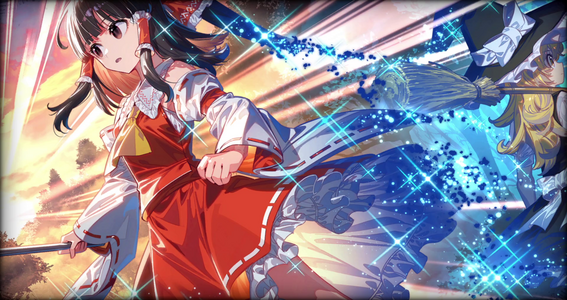
Step into a literary wonderland as Reimu to search for her best friend in Marisa of Liartop Mountain. This adventure RPG, inspired by classic tabletop gamebooks, unfolds through dice rolls and fork-in-the-road decisions that shape a branching narrative and multiple endings. Four familiar heroines also lend their guidance—but the choice of whose voice to follow is yours.
Marisa of Liartop Mountain features:
⚫︎ Play as Reimu being played by the Scarlet Devil Mansion cast
⚫︎ Tabletop RPG mechanics
⚫︎ Custom dice
⚫︎ Reroll mechanics
⚫︎ Fully voiced narration
| Platform | Price |
|---|---|
 Steam Steam |
$14.99 |
 Nintendo Shop Nintendo Shop |
$14.99 |
Marisa of Liartop Mountain Pros & Cons

| Pros | Cons |
|---|---|
 Easy-to-Digest Tabletop Mechanics Incredibly Immersive Voice Acting Limited Cast Allows Great Development Surprisingly Deep Setting Easy-to-Digest Tabletop Mechanics Incredibly Immersive Voice Acting Limited Cast Allows Great Development Surprisingly Deep Setting |
Navigating the Map is a Pain Hard to Understand for the Unfamiliar |
Marisa of Liartop Mountain Story - 9/10
Similar to many Touhou fangames, Marisa of Liartop Mountain’s story is short, sweet, and packed with the kind of folkloric themes that give the series its charm. Unlike most said fangames, however, it’s delivered with surprising finesse, enhanced all the more by being framed as the plot of a tabletop game played by the Scarlet Devil Mansion cast, who add even more flavor to the narrative. Honestly, the only real drawback is the cast of NPCs, who remain largely forgettable despite some playing major roles in their chapters.
Marisa of Liartop Mountain Gameplay - 8/10
The game operates on a simplified tabletop RPG system that trims away much of the usual complexity in favor of narrating your options as the story or combat unfolds. In exchange, it leans on a very fun dice mechanic featuring dozens of custom dice that let you manipulate results to a certain degree. This becomes especially important as the story progresses, since certain chapters practically demand specific sets of dice for success. On the other hand, having only a handful of mechanics to rely on can make the experience grow stale fairly quickly, and the game’s strict reliance on narration as a means of progression turns navigation into a significant pain in the behind.
Marisa of Liartop Mountain Visuals - 9/10
One strength of adapting a tabletop RPG into a video game is that it doesn’t demand elaborate animation. But surprisingly, the developers of this title didn’t take that shortcut. Instead, they went the extra mile, animating much of the core gameplay to bring it to life like pieces falling over or dropping from the top of the screen. Each chapter also rewards you with some of the most striking artwork I’ve seen in a Touhou fangame, reinforced by high quality standing CGs that make the Scarlet Devil cast shine.
Marisa of Liartop Mountain Audio - 9/10
Since the whole experience is so heavily driven by its ongoing narrative, you really couldn’t blame the developers if they’d skipped voice acting—or at least kept it to a bare minimum. Shockingly, though, almost every single line is voiced, even the narration, which is delivered by a calm, steady voice that sets the perfect mood for the story. It does wonders for immersion, pulling you straight into the world without effort. Leaving Reimu and the Scarlet Devil cast unvoiced while Marisa gets lines, though, feels like a huge missed opportunity.
Marisa of Liartop Mountain Value for Money - 9/10
Considering how much fun I had for the low, low price of $14.99, it wouldn’t have been unreasonable to give this game’s value for money a perfect score. But it falls short for one simple reason: it’s incredibly brief. You can clear it in under a dozen hours—less if you get the hang of the mechanics early. Thankfully, it makes up for that with plenty of replay value.
Marisa of Liartop Mountain Overall Score - 88/100
Marisa of Liartop Mountain is easily one of the best Touhou fangames I’ve played in ages—and trust me, I play a lot of them. Sure, it’s brief and a bit annoying to navigate, but the immersive voice acting, shifting gameplay demands, gorgeous visuals, and surprisingly thoughtful themes kept me hooked the entire time. Honestly, if you’re a Touhou fan, skipping this one would be a disservice to yourself.
Marisa of Liartop Mountain Review: Almost at the Peak
Made Me Fall in Love Again
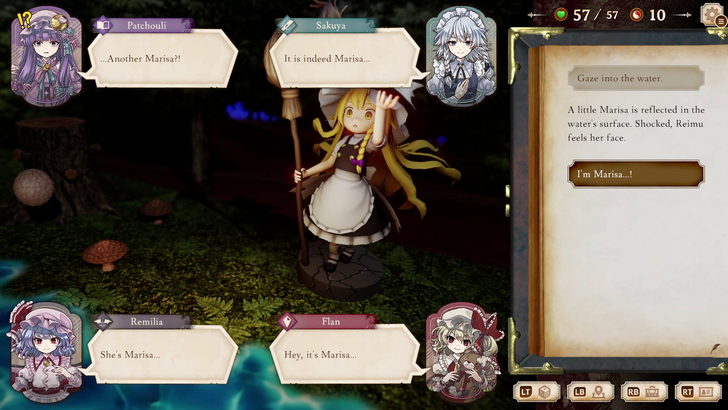
Touhou used to be my favorite franchise. In fact, I have a special history with it, as it introduced me to friends and communities I’ve stayed close with for over a decade. But unlike those who were in it for the music and memes, I got severely addicted to almost every mainline title, spinoff, and more fangames than I can count. I remember sinking hundreds of hours into the first Labyrinth of Touhou (and you can bet I’ll be playing Labyrinth of Touhou Tri and never be seen again), for example, not to mention playing every single Touhoumon ever made. At one point, I even had over 30GB of Touhou fangames crammed into my old laptop…
That said, what really pulled me into Marisa of Liartop Mountain—besides it being a Touhou fangame in the first place—were the visuals. A true tabletop video game based on Touhou? The only thing remotely comparable, at least in video games and from memory, was the old Touhou Sugoroku… which, gameplay-wise, was basically just Snakes and Ladders.
Sure, Touhou Danmaku Yuugi Flowers exists, but that’s a pen-and-paper RPG; not exactly ideal if you’re not the type to drag yourself out of the house for any reason besides a fire (like me). What I’m getting at is this: Marisa of Liartop Mountain stands out as something rather unique, if only because of how fully it commits to its design.
A Story By the Fans, For the Fans
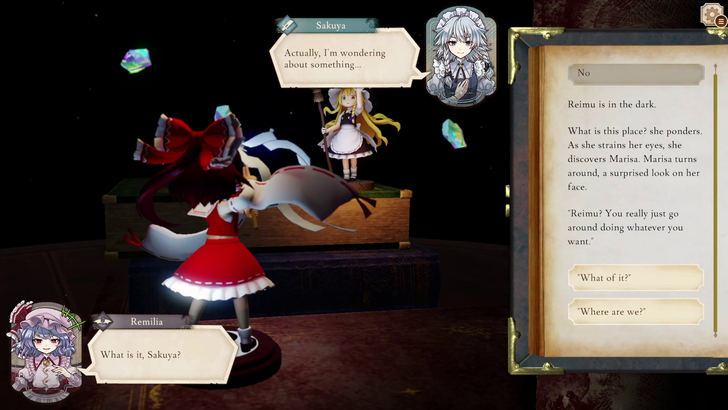
Admittedly, it’s incredibly rare for Touhou fangames to feature a genuinely strong story. This stands in stark contrast to the fandom’s rich library of fancomics over the past decade-plus, such as Morino Hon’s Omoito series or Zounose’s Kaminare. That said, I’m happy to report that Marisa of Liartop Mountain tells a surprisingly good tale, even if it’s a short one.
The setup is this: the Scarlet Devil Mansion crew are enjoying a quiet tea party in the lounge. There’s Remilia Scarlet, the aristocratic vampire lady of the mansion, her younger and far more viole—I mean mischievous sister Flandre, the frail but brilliant magician Patchouli Knowledge, and the ever-dutiful human head maid Sakuya Izayoi (sorry, Hong Meiling and Koakuma. No space for you here). Bored of the uneventful afternoon, though, Flandre demands they do something fun, prompting Patchouli to unveil a tabletop game for them to play.
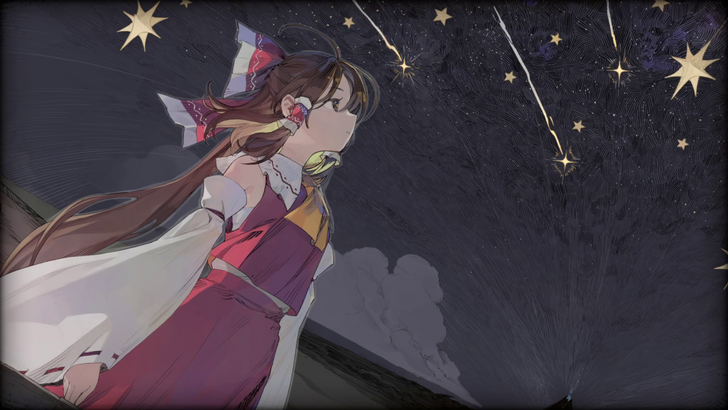
That game’s plot follows Reimu Hakurei, the shrine maiden who serves as the main protagonist of most Touhou titles. After being ghosted by her best friend Marisa Kirisame following an invitation to stargaze, Reimu grows suspicious and decides to investigate. Her search leads her to Marisa’s house in the Forest of Magic, which is eerily barren despite Marisa’s infamous hoarding habits. Inside, Reimu finds a massive book that pulls her into an entirely different world—revealed to be the real venue for their promised stargazing night.
Strangely, though, Sakuya begins noticing troubling details: the events of their tabletop game mirror rumors circulating about the actual disappearance of both Reimu and Marisa, even down to Marisa’s unusually empty home. Yet beyond the cryptic explanation within Patchouli’s book, that’s all they have to go on.
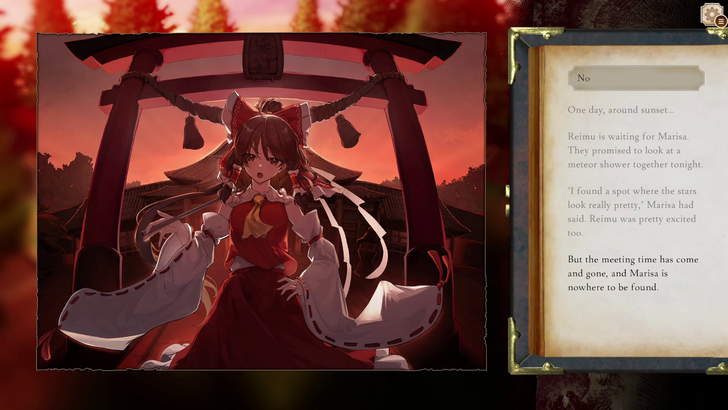
The narrative wastes no time with introductions and jumps straight into business. So if you read the paragraphs above and thought, "who the hell are all these people?" you won’t be alone. That’s because Marisa of Liartop Mountain is very much aimed at players already familiar with the franchise, much like the great fancomics I mentioned earlier. If you don’t fit into that demographic, you’ll probably spend most of the story collecting questions instead of answers.
Honestly, I’d almost discourage newcomers from starting here because of that. The game leans heavily on character-specific traits to deliver its themes, to the point where being unfamiliar with them can be actively detrimental to the experience. The recurring bosses, for example, are just different versions of Marisa herself—like Hollow Marisa in the first chapter or Chief Marisa in the second.
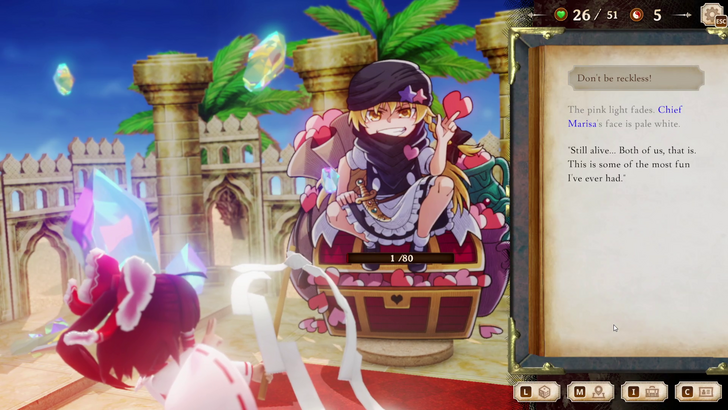
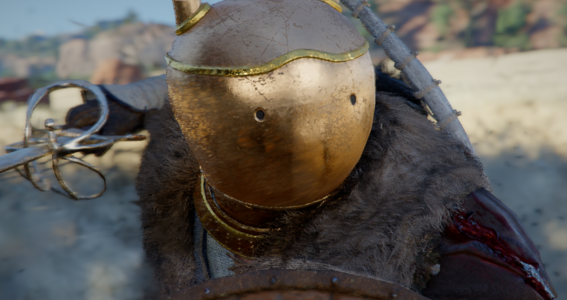
These alternate versions aren’t just palette swaps, though; they’re commentaries on Marisa’s personality. Hollow Marisa, for instance, seems to reflect her past as the girl expected to inherit her father’s business—an empty, dreamless version of herself. Chief Marisa, meanwhile, rules over the Love Thieves in a desert, playing into her kleptomaniac tendencies and her reckless drive to live every moment to the fullest, even if it means cutting that life short.
For longtime fans, these depictions will, guaranteed, hit home. Marisa has always been one of Touhou’s most fascinating characters: a human magician who started from normalcy, who loves life fiercely yet refuses to embrace the immortality her magic could grant. For newcomers, though, these alternate forms might just come across as random clones made to match each stage’s theme, severely disservicing the character’s depth developed after decades of sequels.
Easy to Learn, Hard to Optimize
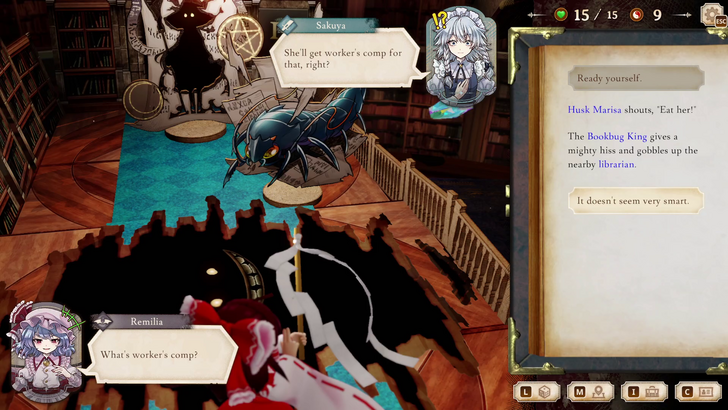
As far as tabletop videogames go, this is as close as you can get to a singleplayer experience of playing with "friends." Not only do the visuals attempt their hardest to deliver such an experience, but the gameplay itself is also entirely driven by narrative and the RNG of the dice.
Now, if you’ve never played a tabletop game before, that might have gone over your head. But to put it succinctly, Marisa of Liartop Mountain plays like an RPG with the genre-specific distinction of having many of your decisions resolved through dice rolls. For example, if an enemy is trying to attack and you opt to dodge, your success hinges on a good roll, which could even trigger additional effects depending on the outcome.
The game’s elements reflect the genre’s unique mechanics as well. Just like many tabletop RPGs, nearly everything is narratively driven—including how you explore the world and how you engage in combat. It stands apart from parallel titles like Final Fantasy, where your choices are neatly categorized into menus such as Attack, Skill, or Items and are limited by your character and progression. In Marisa of Liartop Mountain, your options are instead dictated by circumstance.
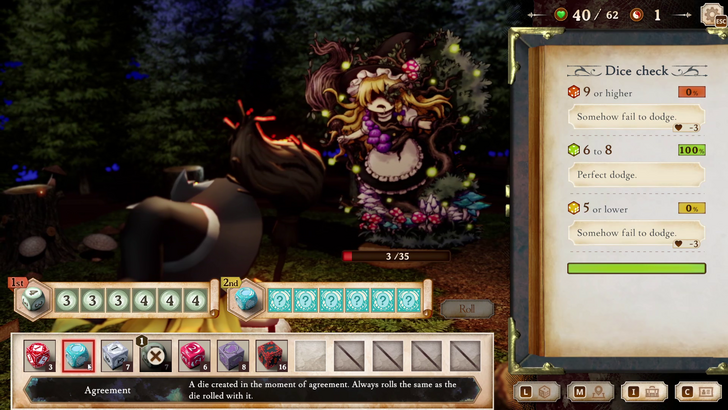
Take, for example, the boss fight in the third chapter. Unlike previous encounters, you can’t actually damage the enemy. Instead, the fight plays out as a tense game of cat-and-mouse, requiring you to destroy key structures scattered across the map. Your available actions reflect this shift in focus: you can’t attack the enemy directly—only dodge, hide, or make a run for it—and each option is presented like a choice event in a visual novel.
Much like most tabletop games, Marisa of Liartop Mountain heavily relies on dice rolls, too. Many of your actions require one to determine an outcome from a shortlist of possibilities. This is most noticeable in combat, where your attacks might result in a miss, a clean hit, a critical strike, or even a cross counter (and the same goes for your enemies). But dice rolls also factor into exploration, where even something as simple as posing for a sculpture can fail—because, according to the game, you were too busy hitting the artist instead of being a decent model.
Fortunately, you’re not stuck with a set of boring, real-world dice. Marisa of Liartop Mountain offers a huge selection of custom dice that, put simply, let you manipulate outcomes to some degree. For example, there are dice with only a specific value on every side like 0s or 2s, dice that roll only even numbers, dice that copy another die’s result, ones that multiply your other rolls by a set value, and even one that guarantees a single predetermined outcome.
These custom dice are incredibly helpful throughout your journey, as different stages demand different dice behavior. A great example is in the second chapter, where you’re encouraged to roll low numbers to avoid overexertion under the blazing sun. But the most critical rolls usually require extremely specific results, like pulling numbers from the Fibonacci Sequence to solve a riddle. As you’d expect, these custom dice quickly become essential to your success.
And of course, what’s an RPG without stats to build and experience to grind? Marisa of Liartop Mountain includes that too, though in a far more streamlined form. Instead of a long list of attributes or skill trees, you only manage HP, CP (used to reroll unfavorable dice), Attack Power, and Dice Capacity (the number of dice you can carry). Honestly, you don’t need much more than that, since, as mentioned before, your combat options are dictated almost entirely by circumstance.
Movement is a Pain
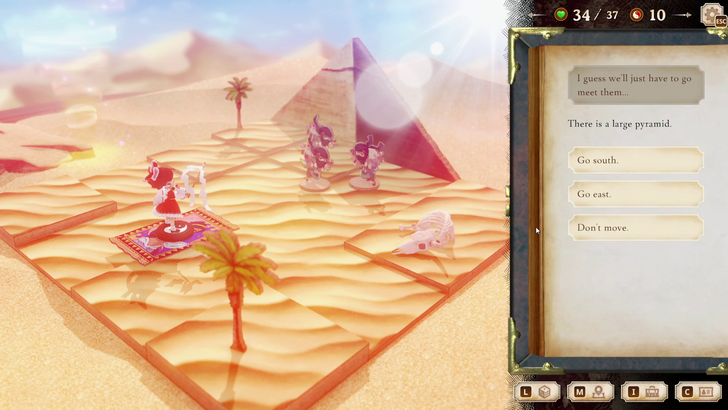
While the game’s commitment to delivering a stylized tabletop RPG experience is commendable, it does come with some caveats. Combat, for instance, takes some getting used to, since you never truly know what options are available until you pick a general course of action for the turn, thanks to its narratively driven structure. But in my opinion, the most frustrating part isn’t the battles—it’s navigating the map.
When I say the game commits to narrative delivery, I mean it. Everything is presented as text on a book page at the right side of the screen, laid out in a strictly cascading order. This includes not just narration and dialogue (outside of the supporting cast’s spoken lines) but also the choices you need to make—except for the dedicated mechanics like dice rolling, which are handled elsewhere.
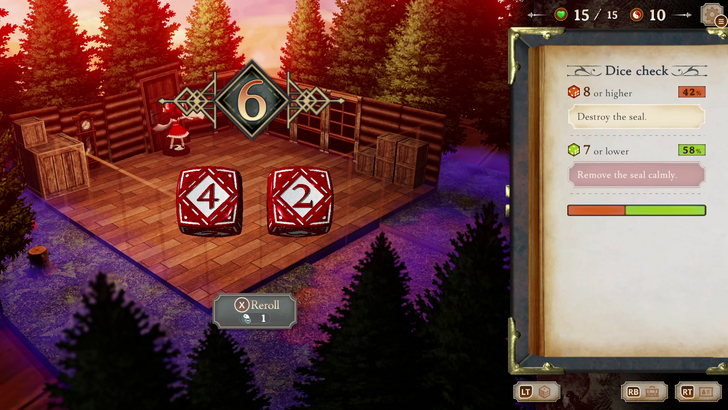
Well, here’s the thing: map navigation follows the exact same rules. Every move is another text entry on the page, listed neatly in order, written narratively. On paper, that sounds fine. But when you’re trying to move from point A to point B through multiple branching paths with uneven layouts, mistakes aren’t just possible; they’re practically guaranteed.
And before you say (or, like, type in the comments), "that sounds like a weird fringe case"—oh no, friend. That’s the daily grind. This isn’t an exception; this is the rule. And if you’re the kind of person who spams left click to blaze through seemingly repetitive dialogue, you’re going to have a not-so-pleasant time ending up in places you really didn’t want to be.
The Support Cast Adds a Lot of Flavor
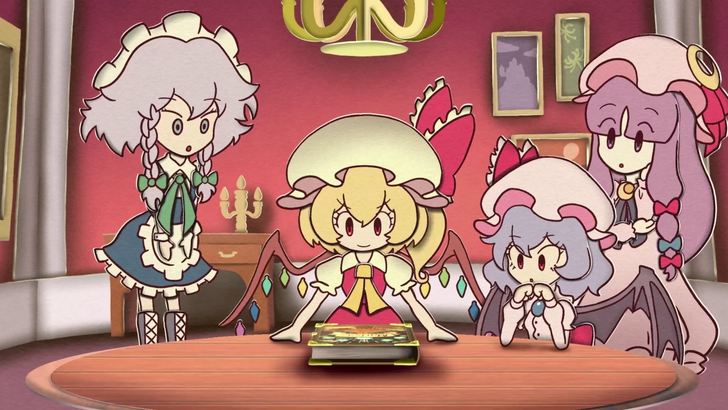
What’s a Touhou game without its charming cast of characters front and center? Sure, the series is known as a bullet hell that runs a little tougher than most of its peers, not to mention the endless U.N. Owen Was Her remixes, the many fanworks that range from games to comics and music, and the classic "Ehh? Easy Mode?!" memes that have spread everywhere. But the real crown jewel of Touhou has always been, and will always be, its characters; in this case, the supporting cast.
This time around, the lineup includes the four central Scarlet Devil Mansion residents plus Reimu Hakurei. And yes, despite being the playable protagonist, Reimu takes more of a supporting role in a story that very clearly revolves around Marisa herself—and honestly, the game absolutely nails that fact.
Reimu’s role is straightforward, you see: she’s the heroine searching for her best friend, encountering Marisa’s many alternate forms along the way, each representing a different aspect of her character. The Scarlet Devil Mansion crew, however, serve a more nuanced purpose. They act as distinct voices of reason, sprinkling their unique personalities into the narrative while doubling as guides for your progress, never once feeling out of character in the process.
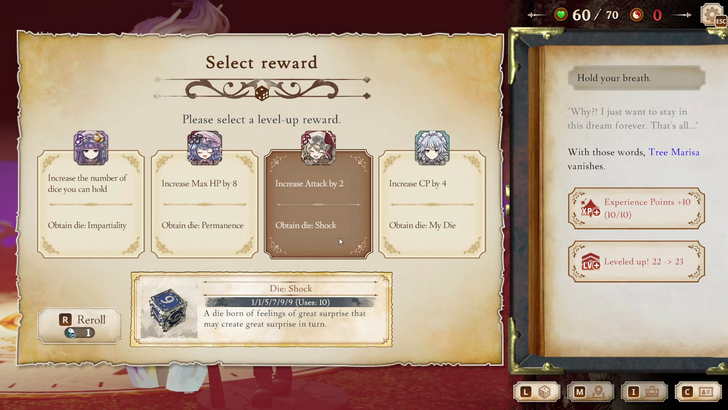
Take Flandre, for example. True to her nature as a vampire who freely uses her strength to get what she wants, she pushes you to confront problems directly; a mindset Reimu herself embodies, often described as someone who "attacks before she asks." Patchouli, by contrast, values knowledge above all as the head librarian of the mansion, urging careful study before action.
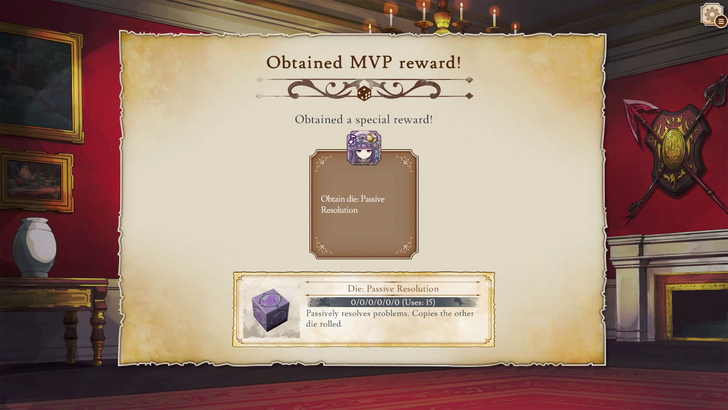
The game even ties rewards to their guidance. Leveling up grants you new dice or stat bonuses based on whose advice you’ve followed, and certain narrative or combat choices shift their influence over your run. And at the end of each chapter, the title of MVP goes to whichever character had the greatest sway over Reimu’s journey, unlocking a unique bonus die tied to their traits like Remilia’s power to "manipulate fate," which here translates to fixing dice rolls in place.
The Voice Acting Really Sells the Experience
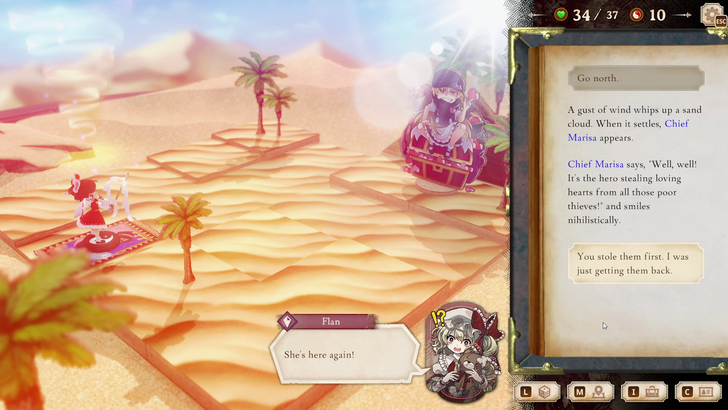
Lastly, I want to talk about the voice acting… because despite there being only two voiced characters in the entire game, the narrator and Marisa herself, they add an incredible amount of immersion to the experience.
Given the asking price, I wouldn’t have faulted the developers for skipping voice work altogether. But they didn’t, and what’s here is immaculate. The narrator’s calm, steady delivery keeps the story moving at a perfect pace, setting the tone for each scene. Then, when Marisa cuts in, her voice actress brings just the right energy and emotions to make it feel like you’re truly talking with the character inside the game.
Frankly, this game wouldn’t have hit nearly as hard without its voice acting. Without it, it would have been good—great, even—but with the performances of Mariko Honda as Marisa and Chiaki Matsuzawa as the narrator, it becomes something exceptional. Paired with the rest of its strengths, Marisa of Liartop Mountain easily stands as one of the best Touhou fangames of the year.
Is Marisa of Liartop Mountain Worth It?
Any Touhou Fan Will Love It
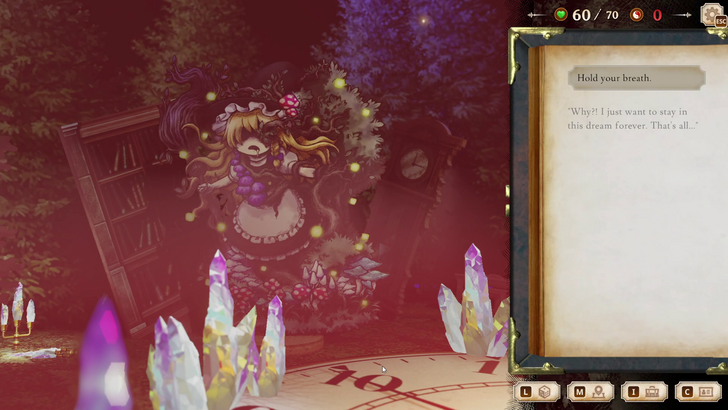
Marisa of Liartop Mountain is an incredible piece of work. Not only does it dive deep into one of the most fascinating characters in the series, but its overall quality, especially in terms of audiovisual presentation, could stand shoulder-to-shoulder with high-budget titles from major publishers at the same price point.
That said, it’s a game that can feel downright hostile to newcomers. Its reliance on established Touhou knowledge is so heavy that without it, even the smallest details can be confusing—let alone the overarching narrative.
So, tread carefully if this is your first brush with the series. In fact, you may be better off starting elsewhere. But if you’re already a Touhou fan, then this is an easy recommendation—absolutely worth picking up, even at full price.
| Platform | Price |
|---|---|
| Steam |
$14.99 |
| Nintendo Shop |
$14.99 |
Game8 Reviews

You may also like...

Marisa of Liartop Mountain Product Information
 |
|
| Title | MARISA OF LIARTOP MOUNTAIN |
|---|---|
| Release Date | September 19, 2025 |
| Developer | UnknownX |
| Publisher | Alliance Arts |
| Supported Platforms | PC, Nintendo Switch |
| Genre | RPG, Tabletop, Visual Novel |
| Number of Players | 1 |
| ESRB Rating | E |
| Official Website | Marisa of Liartop Mountain Website |