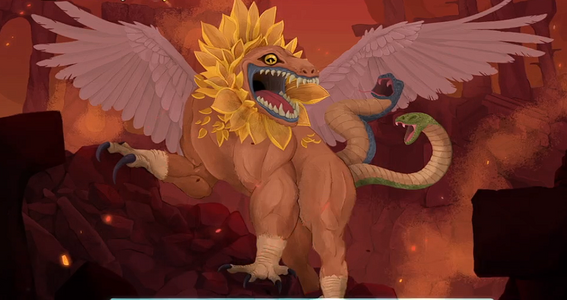

Sultan’s Game is a strategy simulation game where you play a cruel game with the all-powerful Sultan and his deck of debauchery. Read our review to see what it did well, what it didn’t do well, and if it’s worth buying.
Sultan's Game Review Overview
What is Sultan's Game?
Sultan’s Game is a narrative-driven strategy simulation where players take on the role of a royal minister navigating the demands of a high-stakes political game forced upon them by the all-powerful Sultan.
Each in-game week, players must draw a Sultan’s Card and carry out its directive using their influence, resources, and knowledge of the court. Failing to accomplish the card’s task will result in their execution if the choices the card forces them to make don’t come back to haunt them first.
Sultan's Game features:
⚫︎ Non-linear, player-choice-driven story
⚫︎ Minor meta-progression mechanics
⚫︎ Resource allocation gameplay with semi-random events
⚫︎ Three difficulty settings for players of all skill levels
 Steam Steam |
$24.99 |
Sultan's Game Pros & Cons
| Pros | Cons |
|---|---|
 Unique Concept, Unique Execution Consistently Impressive Stylization Non-linear Storytelling Done Right Just Enough Meta-progression Unique Concept, Unique Execution Consistently Impressive Stylization Non-linear Storytelling Done Right Just Enough Meta-progression |
Quite the Learning Curve Content Warning: Pretty Much Everything Rather Repetitive, Sometimes Unfair |
Sultan's Game Overall Score - 80/100
Debauched. Depraved. Excessive. Three words that embody the essence of the Sultan’s Game—both as a concept and as the tormenting trial players must endure in the role of the unfortunate minister handpicked for the Sultan’s amusement.
But it’s the kind of suffering that fascinates. The kind laced with artistry, where each passing day and every drawn card reveals another layer of cruelty—of the game, of the Sultan, of power itself. It’s sublime in its design, and far more intricate than you’d expect. If you’ve the stomach to wield such twisted authority, then this game is your descent to savor.
Sultan's Game Story - 8/10
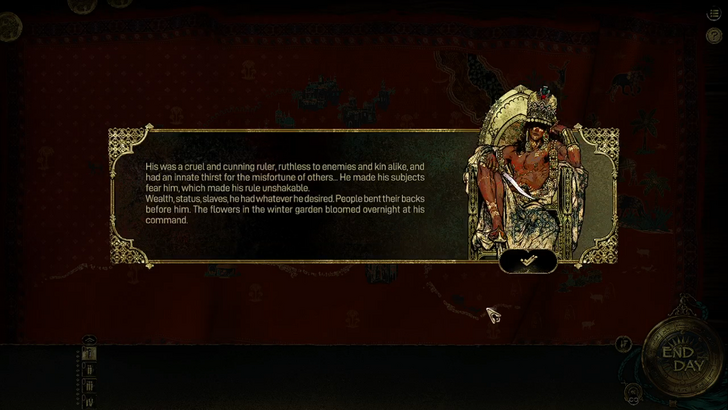
Sultan’s Game weaves a wonderfully non-linear story shaped by your choices—and it doesn’t shy away from landing its blows. It fully embraces the cruelty at its core, refusing to soften the edges of the Sultan’s authority, the decadence of his game, or the suffering you inflict on his people. It’s wicked, and all the more compelling because of it.
Sultan's Game Gameplay - 7/10
Sultan’s Game earns plenty of credit for its uniqueness, though taking the road less traveled tends to come with its fair share of bumps. The gameplay can feel repetitive, even if it’s frequently rewarding, and the randomness of drawing Sultan Cards can doom a playthrough before it even begins. It’s a gamble—sometimes frustrating, sometimes brilliant—but more often than not, it lands where it counts.
Sultan's Game Visuals - 9/10
This game wears a style worthy of a Sultan’s whims—gilded cards, flashes of crimson, and a flourish of filigree and spectacle in every action that captures the grandiosity of the experience. It’s striking, impossible to ignore even when you wish you could look away from the horrors you’re made to commit. But at times, it does push the excess a little too far.
Sultan's Game Audio - 8/10
The music in this game is surprisingly charming and well-crafted, capturing the feel of the Sultanate with flair. It steers clear of sounding too derivative or lazily composed, though it does tend to loop a bit too often for its own good.
Sultan's Game Value for Money - 7/10
At a not-so-extravagant $24.99, Sultan’s Game won’t be cashing in any Gold Extravagance Sultan Cards anytime soon, but it’s still a decent investment—and one you might come to regret if the game’s steep learning curve doesn’t click with you. Best to watch a few playthroughs first.
You may also like...
Sultan's Game Review: Depravity and Excess Writ Large
Morality is gamified more often than we realize. If you’ve ever played a Telltale title or anything from Bethesda, you’ve already engaged in a grand game of moral chess—trading one extreme for another in pursuit of consequence or reward. Some games reward good or evil in equal measure, but far fewer dare to embrace the rewards of cruelty, indulgence, and depravity. Rarer still are those that make them your only path forward.
Sultan’s Game is exactly that—a deliberate exercise in cruelty inflicted upon a helpless world. It’s the kind of game you instinctively recoil from, shaped by the norms of modern morality, yet impossible to look away from thanks to its unwavering commitment to its premise. Gold is stained with blood here, wrapped in the parchment of a Sultanate’s decree, and littered with hesitation and flickers of false hope. I hope you’re ready for what it asks of you—because I sure wasn’t.
A Game of Life, Death, and Every Evil in Between
It’s tricky to pin down exactly what Sultan’s Game is, for two reasons. First, “The Sultan’s Game” refers both to the game you bought and downloaded from Steam, and to a diegetic system within the story itself—a narrative and mechanical device that players engage with constantly.
Second, it’s a strange, specific blend of strategic resource management and visual novel elements. There are certainly comparable systems in other genres, but this one’s wrapped in the unique flavor of the in-universe Sultan’s Game. It can be a bit confusing, so let’s break it down step by step—starting with what the Sultan’s Game actually means within the world of the game.
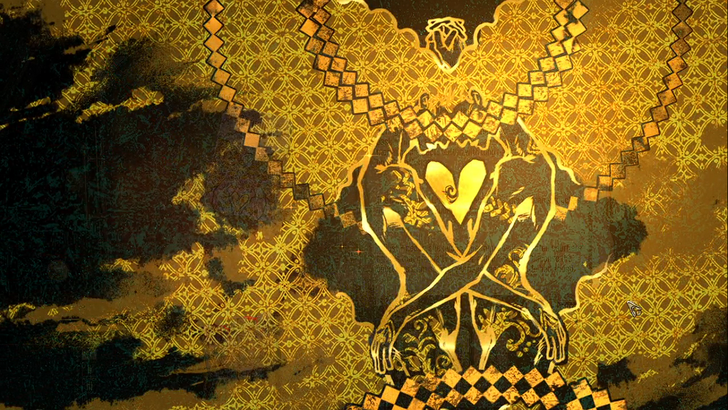
The Sultan’s Game, referred to both in and out of universe as just Sultan’s Game, originates from a deck of cards gifted to the Sultan by a mysterious magician. Restless and jaded by his own excess, the Sultan accepted it as a new form of amusement. The premise was deceptively simple: draw a card, fulfill its command. But the nature of those commands is where things begin to spiral.
There are four types of cards: Carnality, Extravagance, Bloodshed, and Conquest. Each card is also assigned a rank—Stone, Bronze, Silver, or Gold—signifying its rarity and the severity of what must be done.
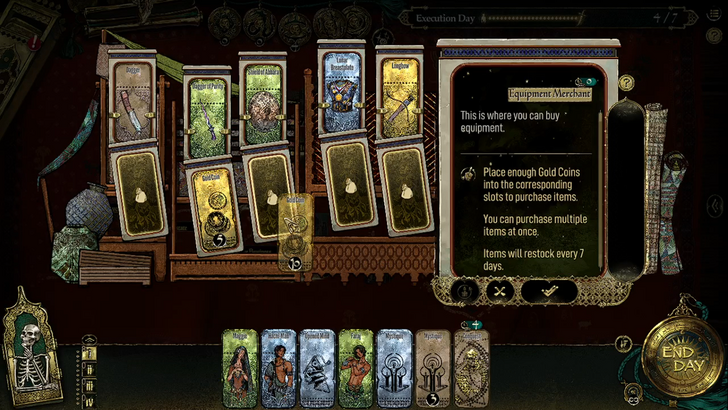
Carnality demands indulgence in physical pleasure, often through intimacy. Extravagance calls for grand expenditures in the name of luxury. Bloodshed represents violence and death in any form. Conquest, as expected, is about domination—political, territorial, or personal.
For a Sultan, these would be trivial tasks. With bottomless coffers, legions of soldiers, and entire harems at his disposal, he could fulfill any card’s demands without breaking a sweat. But you’re not the Sultan. You’re a lowly minister, one who dared to speak out against the game and now finds himself forced to play it. That’s where your story begins.
Forced to Play a Game Most Foul
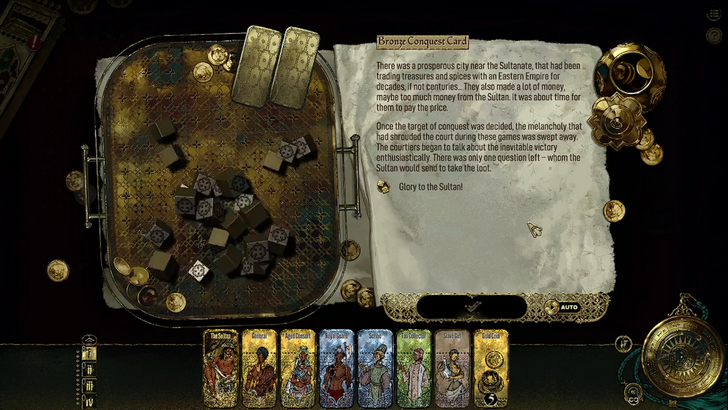
You don’t have the luxury of the Sultan’s endless resources, which makes playing his game far more dangerous, demanding, and time-consuming for you. But the stakes remain the same. Each week, you’re tasked with completing the demands of a Sultan Card, and, if you're lucky or clever enough, maybe even finding a way to stop the game altogether.
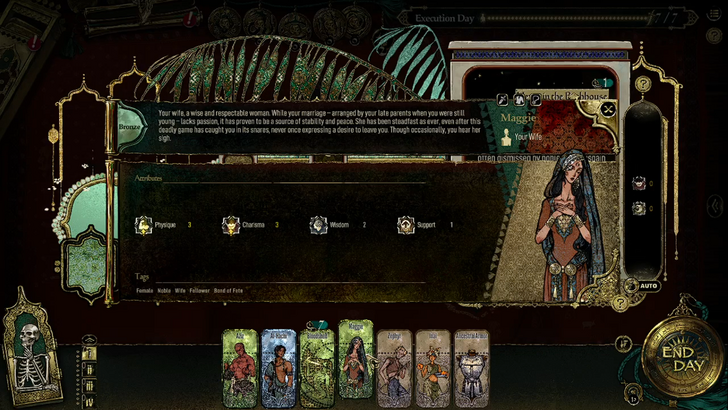
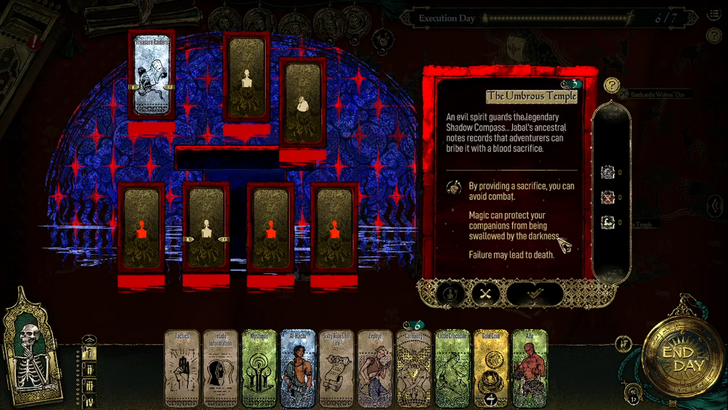
Your main tools are your estate, your resources, and your people. It’s up to you to manage them wisely, sending agents out to investigate leads, gather supplies, or uncover potential ways to meet the card’s requirements. Gameplay functions much like a point-and-click adventure or visual novel: you assign a character to a location and wait to see what happens the next day. There are light RPG elements as well, especially when it comes to the game’s skill checks.
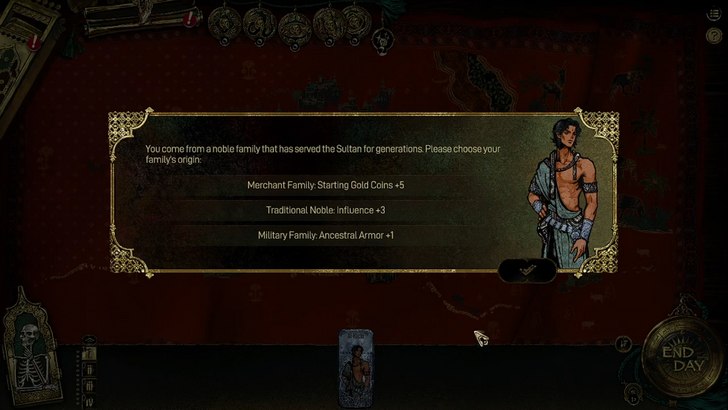
Most actions aren’t guaranteed to succeed, even if you send the best person for the job. Every action has a difficulty rating, which is compared against the stats of your chosen agent. Based on that, the game calculates how many six-sided dice you get to roll. Each die has one success face, and you’ll need to hit a certain number of successes to pass.
Succeed, and you’ll get something tied to the action; maybe you bargained for a book, eavesdropped in the Sultan’s court, fought off bandits, or simply stayed home to earn coin. That’s the gameplay loop in its simplest form, though it deepens as time goes on and more story elements unfold.
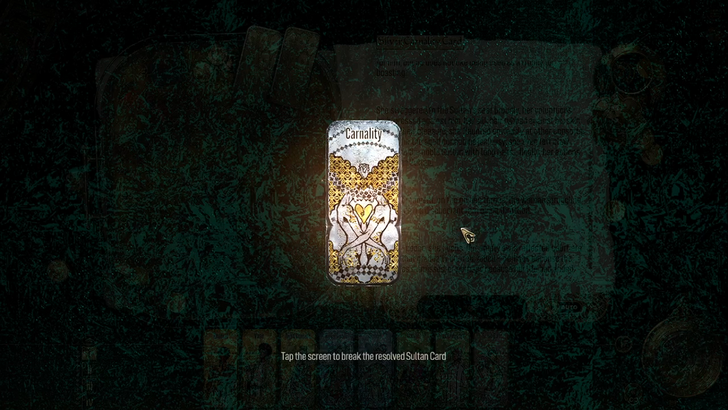
At the center of it all are the Sultan Cards—they’re what truly drive the game forward. Every decision you make, every move you plan, is shaped by the demands of the card you’ve drawn. They guide your hand, define your goals, and cast a shadow over everything you do.
Draw a golden Bloodshed card, and suddenly you’re hunting high-ranking nobles to assassinate, gathering tools and information for a task that demands precision and power. Pull a lowly Stone Carnality card, and a visit to a common escort might be enough, giving you a brief window to regroup, gather resources, and prepare for the harsher demands that surely lie ahead.
But the Sultan Cards aren’t the only forces at play; you’ll also have to contend with the consequences of your past choices and the ever-churning gears of a living, indifferent sultanate. Slander might spread through the court, eroding your influence unless you send someone to stamp it out. A rival could emerge, seeking vengeance for a murder you orchestrated days ago.
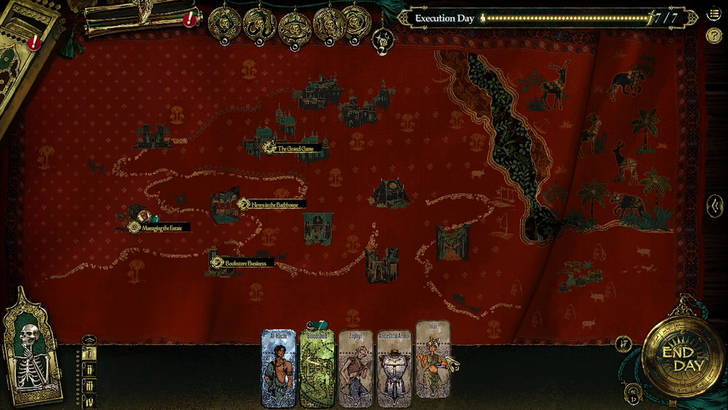
The beauty of all this chaos is that while these developments threaten your position, they also open new doors. That rival? They might just be the perfect target to satisfy a Bloodshed card. Every problem is also a potential solution, if you’re clever, desperate, or ruthless enough to see it.
Eventually, you’ll run out of time, people, or resources, and when you fail to meet your Sultan Card’s demand, you die. No ceremony, no recognition for your sacrifices. The game is cruel like that. Then again, fate might not be entirely done with you, especially given the role metaprogression plays in the grander design.
You may also like...
Winning the Game Through Fate’s Design
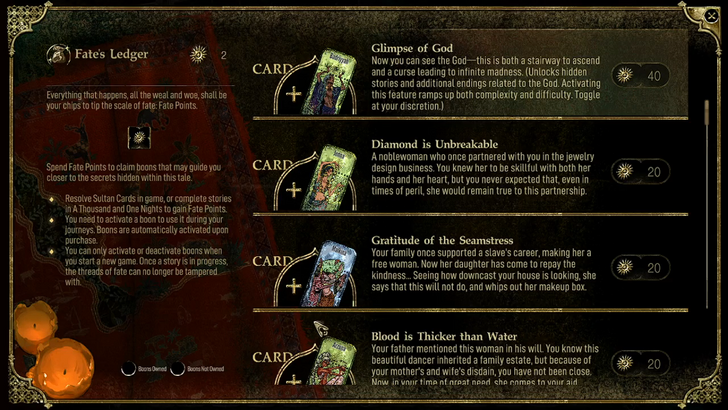
What really impressed me about the game’s metaprogression is how well it strikes a balance—it’s impactful enough to ease the sting of failure, but not so overpowered that it undermines the harshness and difficulty at the core of Sultan’s Game. You still feel the weight of every decision, every loss, and every desperate gamble.
Progress is tied to Fate points, which you earn by completing the 1001 Nights—a collection of achievements awarded for unlocking new events, hitting progression milestones, or pulling off wildly ambitious feats. These points can be spent on meaningful upgrades for future runs, like improved stats for yourself and your agents, extra starting funds, or even the ability to pursue the divine and try to end the Sultan’s game once and for all. Yes, it really gets that desperate.
What makes it all work so well is that it’s optional. You can toggle all of it off if you’d rather face the game in its purest, most punishing form. Whether you're a newcomer or a glutton for punishment, the game makes room for your preferred kind of suffering.
Sometimes, Artful Cruelty is Just Plain Cruelty
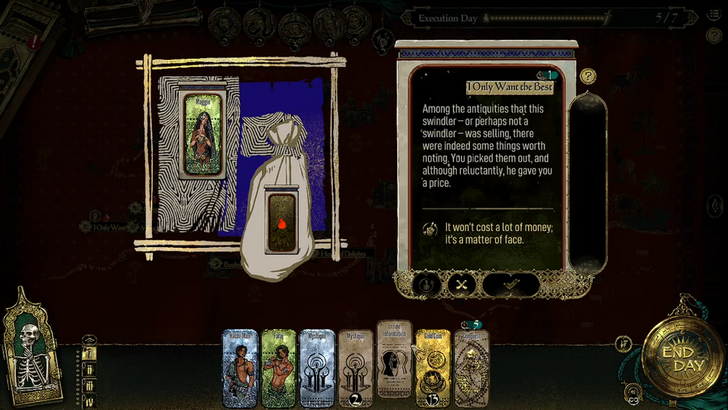
Unfortunately, for all its creativity and the brilliance of its metaprogression, Sultan’s Game isn’t without its flaws. Chief among them is the sheer randomness of the Sultan Cards—pulling a golden card on your very first day can all but guarantee a swift end to your run, and no amount of Fate points will save you from that kind of bad luck. It's a harsh mechanic that sometimes punishes you before you've even had a chance to play.
This already delicate balance is further shaken by the occasional bug or glitch—errors that affect your resources or skew event outcomes. In a game where the smallest misstep can cost you your head, these technical hiccups can be game-breaking.
And then there’s the learning curve. While the game offers three difficulty settings to ease new players in, even the easiest mode leaves plenty of ambiguity. You’re given the freedom to explore countless paths, but early on, it’s hard to tell what any of them actually do. Not knowing how events connect to your goals, how hard they really are, or if they even help you at all can be just as deadly as the Sultan Cards themselves.
Definitely Gonna Trigger Someone
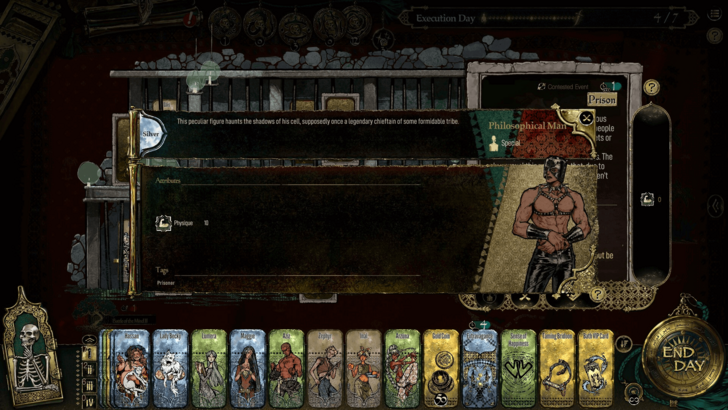
And naturally, with a premise rooted in debauchery and unchecked excess, Sultan’s Game doesn’t shy away from taboos—quite the opposite. It tackles heavy, often uncomfortable topics, and rarely does so with subtlety or grace. For that reason alone, it may not be your cup of tea, and that’s more than fair.
The game forces your hand in ways that are unsavory in every sense. You’ll abandon moral convictions, break promises, and adopt a twisted new logic just to survive. For some, that compromise won’t be worth the experience, and if you can’t stomach that shift, enjoyment may never come.
It’s an acquired taste, and it doesn’t compromise. Either you acquire it, or you miss out on the game it truly wants to be.
Repetitive in a Good Way Sometimes, Bad for Others
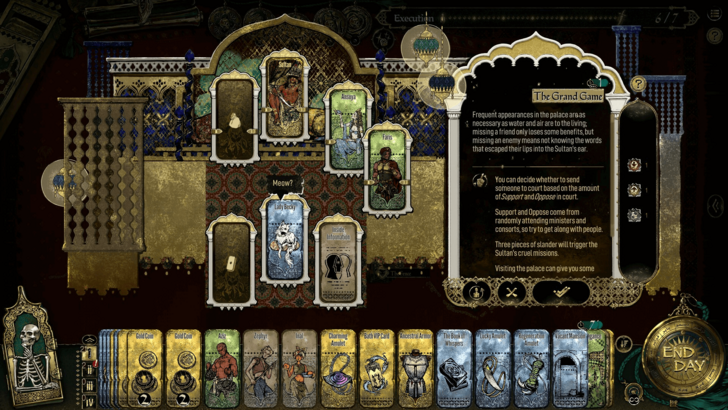
That said, the most noticeable thing about Sultan’s Game is how formulaic it feels—even with all the randomness and chance built into its design. In some respects, this works to its benefit, particularly when it comes to its presentation. The visuals and music never wear thin for me.
Fluid, gilded, and rich with cultural flair and artistic liberties, the game is consistently a feast for the senses. I genuinely enjoy just looking at it, even if I had to die fifteen times to do so. The soundtrack, too, is beautifully composed—layered with emotion and a certain weight that makes every heinous act land all the harder.
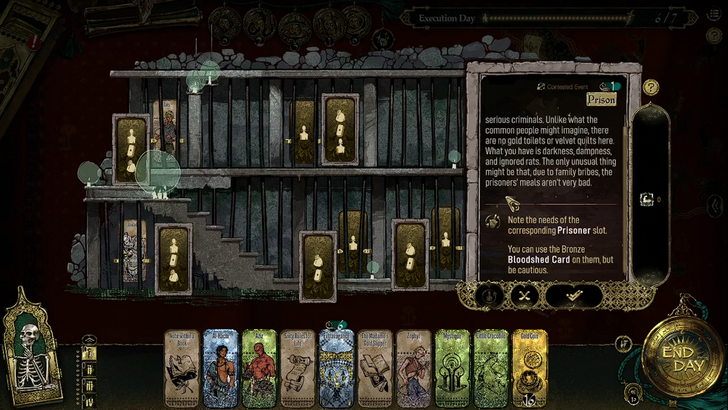
Then there’s the story. It’s such a simple yet distinct premise, eloquently told and endlessly replayable. By placing the player in control after the Sultan's decree, each run becomes its own tale of desperation and strategy. Every playthrough feels different, even if the core structure remains the same—and honestly, I wouldn’t have it any other way.
But the gameplay itself? It wears thin. The branching narrative and story reveals do help cushion the repetition, but there’s no denying that the loop becomes stale after enough runs. Dying repeatedly dulls the sense of reward, and eventually, that familiar tug to play something else creeps in. It’s just too simple, and death is just too frequent, for every failure to feel like a step forward.
Full-flavored and Rich, If You Can Handle It
And so we reach the end of Sultan’s Game—something the poor minister trapped within its twisted rules may never get to say. It’s a game that knows exactly what it is and never pretends otherwise. It doesn’t flinch, doesn’t soften the blow, and is all the better for it. It dares to test your principles, even if only through a screen, and shows you the cost of playing by its rules.
At its core, it’s a unique experience built on a simple narrative hook and the most stripped-down visual novel and RPG mechanics, yet it delivers a story packed with weighty themes and a desperation that rivals even the most brutal survival games I’ve played in years.
If you’ve got the stomach for it, you’ll find something worth enduring here. And if not? Then the game was never for you to begin with. It’s depravity and excess writ large, and it cannot be anything else.
Is Sultan's Game Worth It?
A Bit Pricey and Questionable, But Could Be Worth It
You’re no Sultan, and thankfully, you won’t have to spend like one. Sultan’s Game comes in at a reasonably priced $24.99. Whether that cost feels worth it, though, depends entirely on your appetite for its niche appeal, heavy subject matter, and repetitive gameplay.
But if you value story and style over ease and accessibility, there’s a lot here to appreciate. Just be honest with yourself about your tastes. If this is the kind of experience that satisfies them, you’ll be more than fine
| Digital Storefront | |
|---|---|
| Steam |
$24.99 |
Sultan's Game FAQ
How Do I Fix a Broken Save Data Profile in Sultan’s Game?
According to the game’s developer, force-quitting the game can lead to your save profile no longer loading. To fix this, locate your save file at the following file address:
⚫︎ C:\Users[Your User Name]\AppData\LocalLow\Double Cross\Sultan's Game\SAVE
Then, you may delete the auto_save.json and find your latest round (such as round_73.json), and rename it to auto_save.json.
Find global.json in this folder and change inGame
, false to inGame
, true. You can then save the file, and your save should work again.
You may also like...
Game8 Reviews

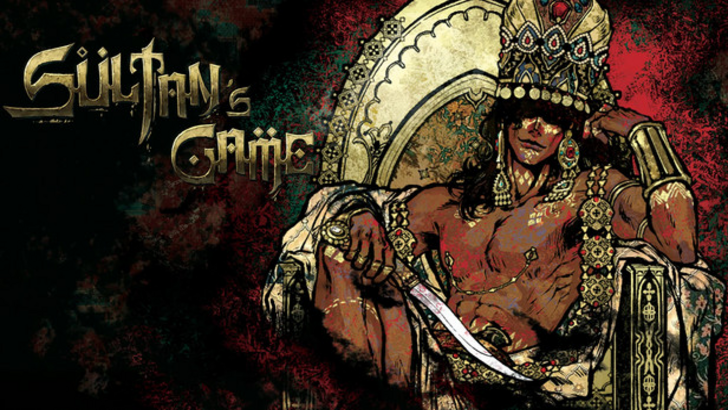
Sultan's Game Product Information
 |
|
| Title | SULTAN'S GAME |
|---|---|
| Release Date | July 21, 2025 |
| Developer | Double Cross |
| Publisher | 2P Games |
| Supported Platforms | PC (Steam) |
| Genre | Card, Simulation, RPG, Strategy |
| Number of Players | 1 |
| ESRB Rating | RP |
| Official Website | Sultan's Game Website |