
Quartet Review Overview
What is Quartet?
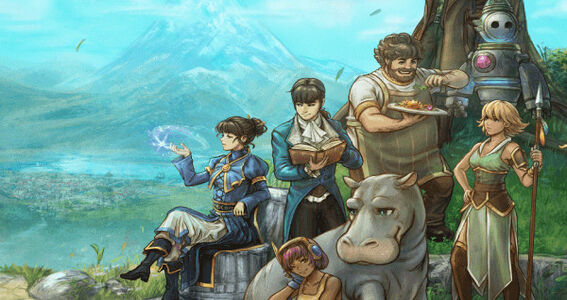
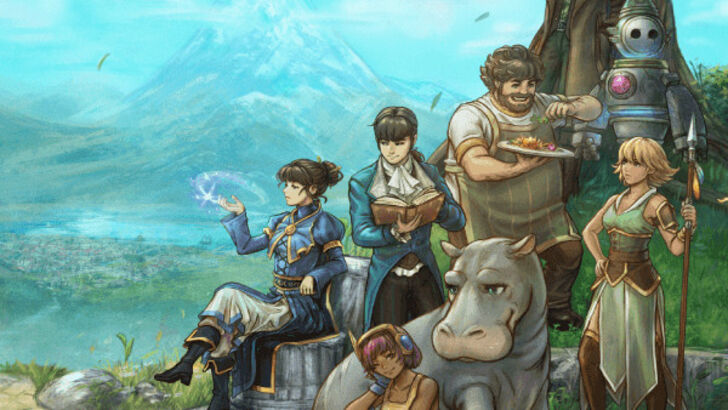
In Quartet, eight heroes are drawn together by events that shake the very foundations of their world. A string of train robberies reveals the shadow of a government conspiracy. A mysterious deck of cards grants a young girl visions of another realm. Across the Imperial frontier, deadly airships carve fiery scars into the sky. And amidst it all, the most unlikely of heroes awakens to incredible magical power. As their stories converge, the group uncovers a centuries-old conflict that reshaped the world itself—and must ultimately decide the future of magic.
Quartet features:
⚫︎ Turn-based combat
⚫︎ Multiple points of view
⚫︎ AP-based skills that automatically recovers
⚫︎ Converging stories
⚫︎ Various side stories
 Steam Steam |
$19.99 |
Quartet Pros & Cons

| Pros | Cons |
|---|---|
 The Combat Hides Depth in Simplicity Remarkably Organic Story Characters Have Unique, But Interchangeable Roles No Random Encounters The Combat Hides Depth in Simplicity Remarkably Organic Story Characters Have Unique, But Interchangeable Roles No Random Encounters |
Narrative Twists Can Feel Forced Early On Rather Simple Antagonists No Random Encounters |
Quartet Story - 8/10
Anyone willing to play through an admittedly rather confusing early narrative will find one of the most organic storytelling among indie RPGs out there. Its protagonists are thoughtfully written and tied together by a genuinely convincing reason, rather than the half-baked excuses so common in the genre. The villains, on the other hand, vary a bit too much in quality, but even so, the story as a whole remains nothing short of excellent.
Quartet Gameplay - 9/10
Quartet doesn’t boast the mechanical complexity of many modern pixel RPGs, with its options and outcomes kept almost painfully simple. Yet this simplicity is sharpened to a razor edge, giving the game a natural flow that works remarkably well. As a result, it feels incredibly intuitive, allowing even newcomers to pick it up with ease, even without any pesky tutorials.
Quartet Visuals - 8/10
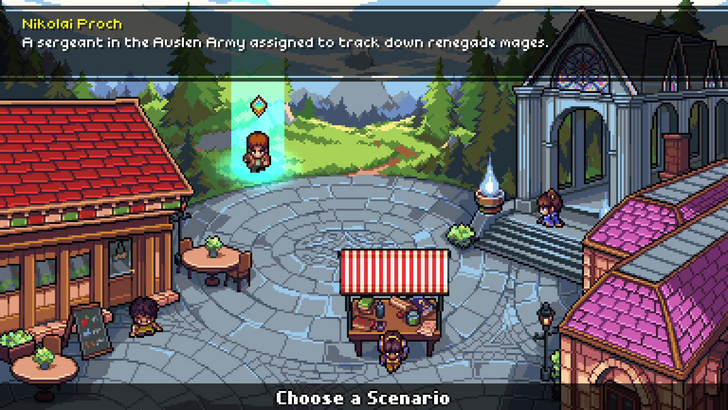
Quartet boasts some of the most beautiful and expressive pixel spritework I’ve seen in recent memory, making it an immediately eye-catching purchase. The world feels alive with the bustle of towns, the solitude of towering structures, and the vitality of forests and plains, though it loses some visual charm in its more utilitarian visual effects. On the other hand, combat sprites are a mixed bag, with enemies looking great but completely static, and player characters having smooth animations but much plainer designs.
Quartet Audio - 9/10
Despite the lack of voice acting, which could have helped the story land harder, it isn’t something you’d really miss in a game that aims for the traditional JRPG experience. What stands out instead is the excellent soundtrack and the immersive, satisfying sound effects that push the experience to greater heights. There are a few nitpicks of course, like the absence of a proper victory theme to punctuate even the toughest battles, but those pale in comparison to everything the game gets right.
Quartet Value for Money - 9/10
For a game that offers a couple dozen hours of gameplay—or more, depending on how thoroughly you like to explore—being priced at just under 20 dollars is an incredible deal. There’s a lot of content to dig into, stories worth reading through, and plenty of lineups and builds to experiment with. Unfortunately, it doesn’t offer much replay value, especially with how its climax is designed.
Quartet Overall Score - 86/100
Quartet is easily one of the best traditional pixel RPGs to release this year. It’s a clear reminder that you don’t need flashy gimmicks or over-the-top animations to deliver an outstanding experience. All it really takes is being fun and engaging, and that’s exactly what this game achieves.
Quartet Review: Absolutely Buy This Game
Exceptional Among Many
I don’t think it comes as a surprise that someone who loves RPGs so much like me would also love its traditional forms, regardless of its date of release. These come in all sorts of subgenres throughout its colorful history, ranging from old classics such as Final Fantasy III from the early 90s to the more modern and slightly more mechanically engaging Sea of Stars of 2023 and everything in between—many of which I have had the pleasure (and the occasional displeasure) of playing in my spare time.
Chrono Trigger is something everyone should try, by the way.
That said, it’s exactly why Quartet was such an appealing game right from the start. A brief look into their Steam page shows the kind of gameplay and audiovisuals any turn-based RPG enthusiast who doesn't mind the lack of photorealistic graphics in 2025 would eat right up and question later. Like, who among us could refuse a party-based game with multiple storylines, turn-based combat, and character customization, all on a game that looks like it was made during the early 2000s?
Certainly not me.
A World That Lost Its Magic, and One That Kept It
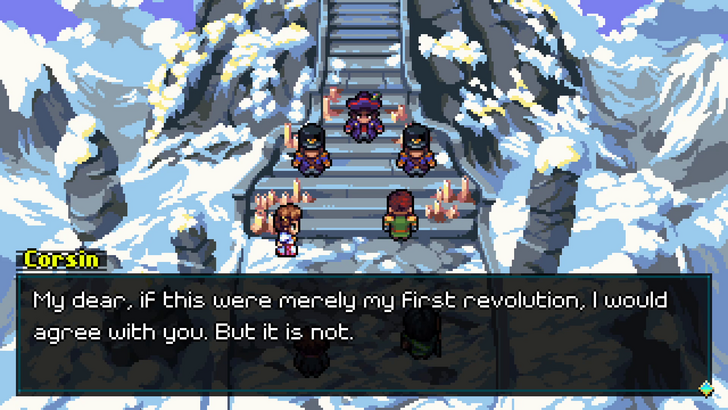
Quartet has a handful of different settings depending on which character you choose to play as. However, they all share a common origin.
It’s not unusual for a game to present a world deprived of some essential element of its existence, with the plot then revolving around that loss until it eventually reaches a conclusion. Notable examples include Punishing Gray Raven and NieR: Automata, where humanity has either mostly or entirely fled Earth—whether to escape the all-consuming Punishing Virus or the threat of hostile machines.
In Quartet, though, what’s missing is something even more fundamental to everyday life, at least within its lore: magic. Hundreds of years before the game’s events, magic was as natural to some as breathing. It was present in agriculture, education, and war—woven into nearly every facet of human life. More than that, it allowed humanity to spread freely across the continent, bending nature itself to their will.
However, one day, humans suddenly lost the ability to use magic, almost as if it had been patched out of existence in some massive update. The result was predictable: famine, unrest, and all manner of political and social upheaval. In time, though, life eventually stabilized, and magic faded from memory, becoming little more than a forgotten relic of the past.
The catch, however—though it's hardly one if you begin with certain characters—is that magic never disappeared everywhere. In the East, entire nations still wield it freely.
This disparity, along with the ripple effects of unfolding events, is what ultimately draws the four main protagonists, along with four key allies, together. Under normal circumstances, their paths would never have crossed, but here, their journeys converge.
Embrace Gameplay Tradition in Modernity
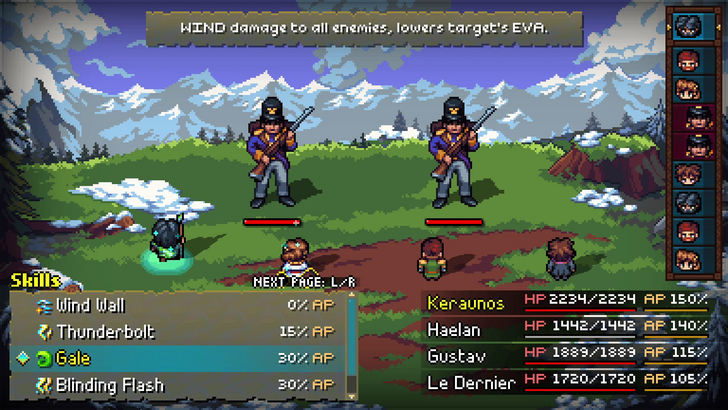
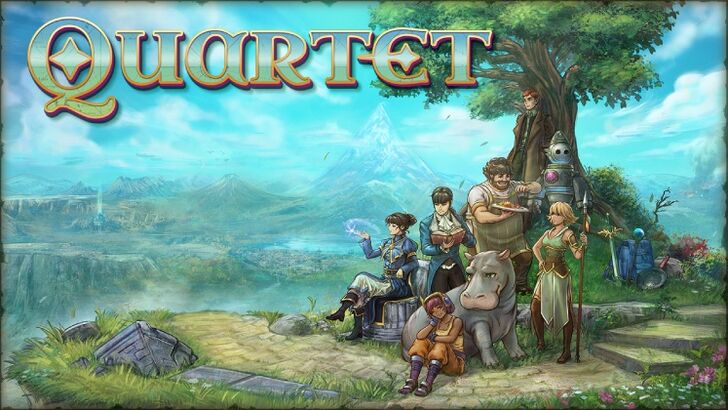
Quartet is a narratively-driven adventure RPG built around a traditional turn-based combat system. You step into the shoes of Alexandra, Cordelia, Nikolai, or Ben—and often all of them together—as they pursue the personal goals that ultimately bind their journeys. Each is joined by a companion in Juna, Jerome, Zikaron, or Agata, all of whom are fully playable in combat and bring their own stories to the table.
The combat system, as mentioned, is a straightforward turn-based setup where characters take their turn before passing it along to allies or enemies. Each has access to skills with various secondary effects that consume Action Points, which conveniently regenerate at the end of every turn, as well as a handful of basic commands like Attack, Use Item, and Escape. These options define each character’s role in battle, whether it’s Alexandra serving as a shield-heavy tank or Cordelia unleashing her powerful water magic as the party’s main damage dealer.
Outside of combat, you’ll spend time exploring cities and dungeons, picking up valuables on the streets, selling and buying gear, and outfitting your party with equipment. Puzzle sections also make an appearance, with difficulty that swings from very simple to surprisingly tricky. One detail that stands out, though, is Quartet’s approach to encounters. There are no random battles to grind; instead, enemies appear as visible figures on the map. Once defeated, they’re gone from the scenario.
The Simple Combat Makes Its Mechanics Shine
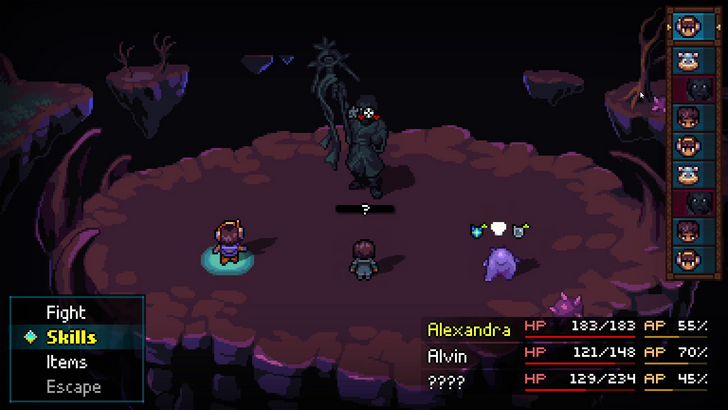
To say that Quartet’s gameplay is simple is perfectly fair. There are no gimmicks like Sea of Stars’ Timed Hits and Combo counters, nor timed transformations like in Neptunia. Characters take their turns, pass control to allies or enemies politely, and repeat. Combat options are straightforward too: attack, use a skill (guard is here for some reason), use an item, or attempt to escape.
Yet despite that, the game is far from unengaging. Its simplicity actually highlights the polish beneath it. With no gimmicks to exploit or mechanics to abuse, fights demand thought. You’ll need to weigh party composition, manage AP carefully, read your opponents, and plan around their weaknesses.
The real star here is the party system, though. Because roles overlap slightly between the main and supporting characters, team-building becomes its own kind of “meta” beyond gear choices. You might run debuff-heavy lineups with Zikaron and Cordelia, backed by Agata and Nikolai for bulk and damage. Or you can field the four main protagonists for a more balanced approach, since their specialties barely overlap.
There’s a Strong, Organic Feel to the Story
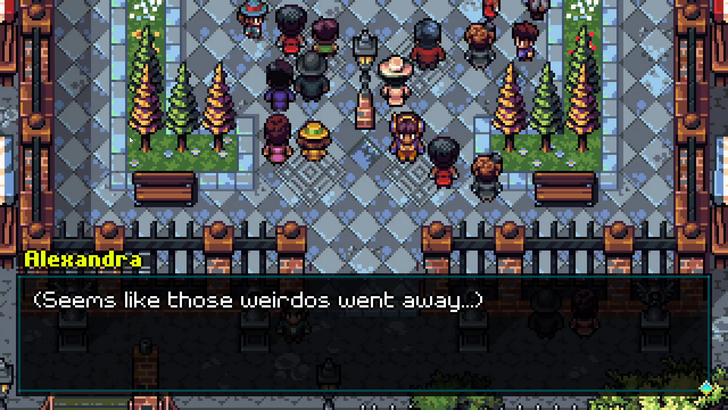
Honestly, I was a bit put off during my first couple of hours with Quartet. The gameplay was enjoyable enough, but the story failed to hook me right away. Conflicts often felt like they appeared out of nowhere, and there was little buildup to explain what was unfolding on screen. Sure, you could piece things together from scattered hints, but the narrative didn’t feel cohesive at all.
That changes after a while. Once you’ve cleared a couple of the opening acts for the main characters, the pieces begin to fall into place more naturally. It even leaves you wondering why you hadn’t picked up on certain details earlier, which makes some of the reveals feel clever in hindsight—though not every event manages to escape being confusing even later on.
In a way, it makes you feel like a mere spectator in a world that exists independent of your actions or needs. That sense of detachment makes the world feel more authentic, and it sets the stage for later events that might have felt cheap or forced if the game had spoon-fed you with context from the start.

But what I especially appreciated was how naturally the main party came together. Unlike the contrived bonds you see in many webnovels where characters stick around because of some half-baked, half-hearted romance or shallow excuse, Quartet makes it feel like Alexandra, Cordelia, Nikolai, and Ben were truly destined to cross paths. For them to unite for such a long journey despite having different goals and even clashing personalities is, in my view, worthy of real praise.
The same can’t quite be said for the game’s antagonists, though. Their quality varies wildly, with some coming across as villains for no reason other than “the story needs a bad guy.” Thankfully, most manage to serve as decent foils for the party, making the overall journey enjoyable enough for those willing to overlook the occasional weak link.
Is Quartet Worth It?
It’s Easily Worth the Asking Price
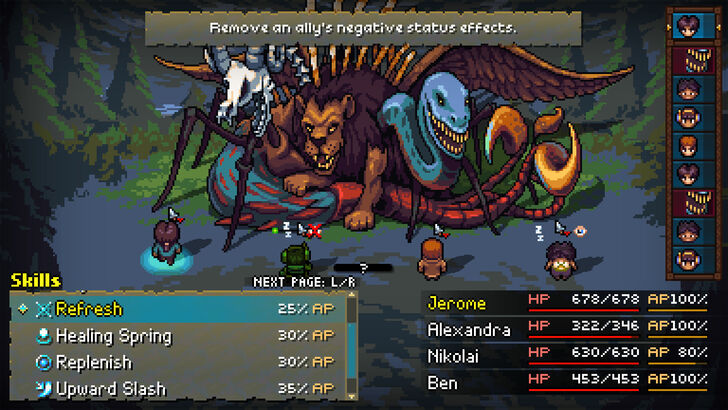
Unless you’re the kind of person who thinks every game needs to be Disgaea where you can grind levels on top of a mountain of enemy carcasses to make the game easier to beat, Quartet is, in my opinion, a must-play for any RPG fan. Despite its simplicity, and despite its eyebrow-raising narrative and character design at times, the game is a truly rewarding and joyous experience to play and I cannot recommend it enough.
| Steam |
$19.99 |
Quartet FAQ
How many playable characters are there?
There are eight basic playable characters, which includes the four main characters Alexandra, Cordelia, Nikolai, and Ben, as well as the four supporting cast in Juna, Jerome, Agata, and Zikaron. There are various other characters that are temporarily playable as well, such as Alexandra’s brother and Nikolai’s troops, though.
Game8 Reviews

You may also like...

Quartet Product Information
 |
|
| Title | QUARTET |
|---|---|
| Release Date | August 26, 2025 |
| Developer | Something Classic Games LLC |
| Publisher | Something Classic Games LLC |
| Supported Platforms | PC |
| Genre | Adventure, RPG |
| Number of Players | 1 |
| ESRB Rating | TBD |
| Official Website | Quartet Website |