


| People of Note | |||
|---|---|---|---|
| Release Date | Gameplay & Story | DLC & Pre-Order | Review |
Overview
What is People of Note?
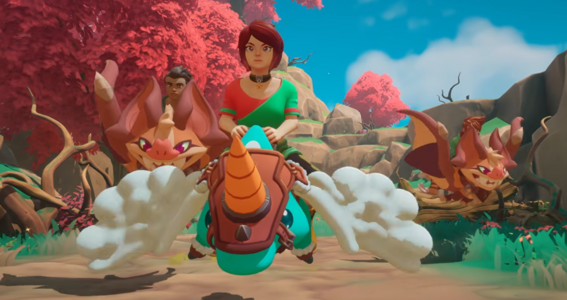
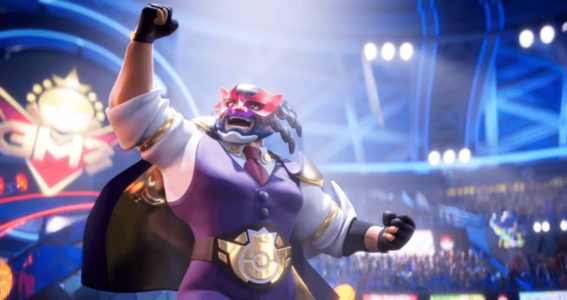
People of Note is a musical role-playing game (RPG) from developer Iridium Studios and publisher Annapurna Interactive, released on April 7, 2026, for PC, PS5, Switch 2, and Xbox Series X|S. It follows a pop singer named Cadence as she pursues recognition in a competitive musical world of Note, where musical genres define different regions. Cadence forms a band while confronting a larger threat tied to a phenomenon known as the "Harmonic Convergence," which disrupts the balance of music itself.
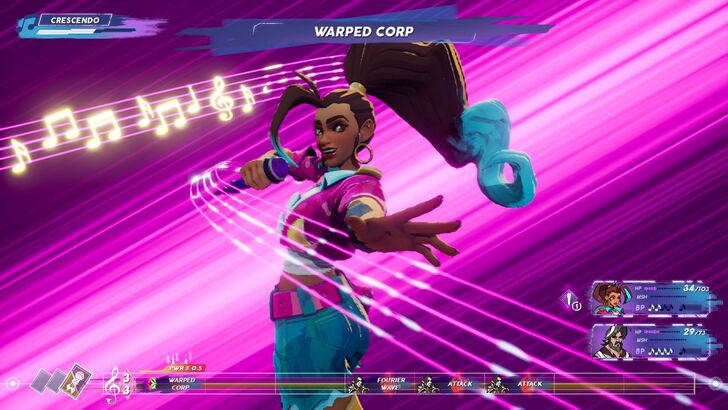
The game’s combat is turn-based. Here, battles are framed as interactive musical performances. Fights are dictated by a musical stanza at the bottom of the screen. This represents the time signature and determines the number of actions available to the party. One of the game’s features, called Mashup, allows players to combine the specific musical styles of different party members to perform powerful attacks. Players also explore various environments and dungeons tied to specific genres.
People of Note features:
⚫︎ Dynamic Battle Soundtracks
⚫︎ Music-Themed Combat
⚫︎ On-Demand Random Battles
⚫︎ Music Video Story Segments
⚫︎ Puns and Pop Culture References
⚫︎ Genre-Specific Realms
For more gameplay details, read everything we know about People of Note’s gameplay and story.
| Digital Storefronts | |||||
|---|---|---|---|---|---|
 Steam Steam |
 Epic Epic |
||||
 Switch 2 Switch 2 |
 PlayStation PlayStation |
 Xbox Xbox |
|||
| $24.99 | |||||
People of Note Review: Good, But Not Noteworthy
A New Musical Game Approaches
There is no shortage of games that feature music, but you can probably count on two hands the number of titles that actually function like stage musicals, where characters naturally burst into song to move the plot forward. 2023’s Stray Gods is my favorite in this niche, and the Figment series hits a similar chord. You could argue Sayonara Wild Hearts touches on this energy, as does the underrated mobile gem Peter Panic. We’re still waiting for Harmonium: The Musical, though the concept technically stretches back to 2004’s The Bard’s Tale. Now, Iridium Studios has thrown its hat into this very specific ring with People of Note.
I have spent my whole life loving video games and just as long loving musical theater, so a project like this feels like it was designed specifically for my tastes, especially when it feels like a classic RPG. However, although the game has plenty of high notes, a few flat moments in the arrangement hold it back. As much as I liked the game, some issues prevented me from yelling "encore" the second the credits rolled.
The Story’s Rushing, Not Dragging
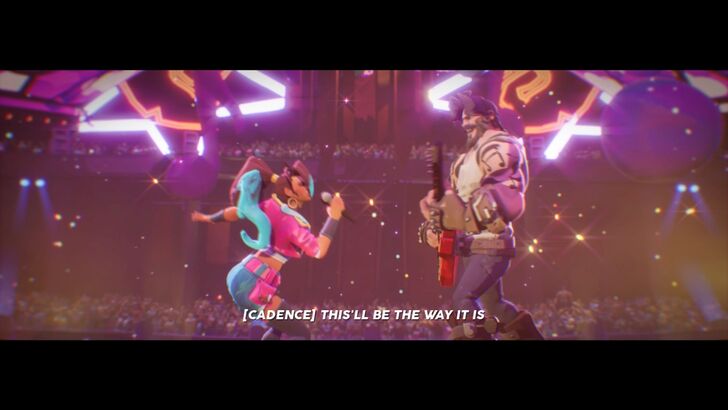
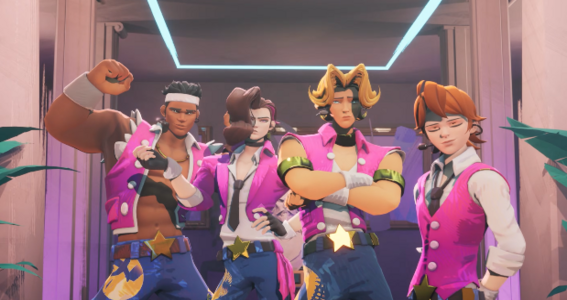
Music is the literal foundation of physical reality in the world of Note, where Cadence, an aspiring pop singer living in the melody-saturated city of Chordia, grows tired of the repetitive pop sound dictated by the city's dominant boyband Smolder. After failing her audition at the Noteworthy song contest and gaining a second chance to compete, she decides to leave Chordia with the goal of traveling across the various city-states of Note, each defined and governed by a specific musical genre, to prove that art should be more than just comfort food.
This premise drives the entirety of the plot. The game argues that art should not merely give an audience what they want, but should be bold enough to innovate and challenge expectations. This theme is most visible through the diverse character arcs of Cadence’s party members.
Cadence herself struggles with the need for external validation of her sound. She is joined by Fret, an aging rockstar who clings tightly to the old ways of rock and roll that he finds it nearly impossible to accept its evolution. There is also Synthia, who grapples with feeling like an "imposter," and Vox, a noble who envisions a progressive future for his strictly traditional kingdom.
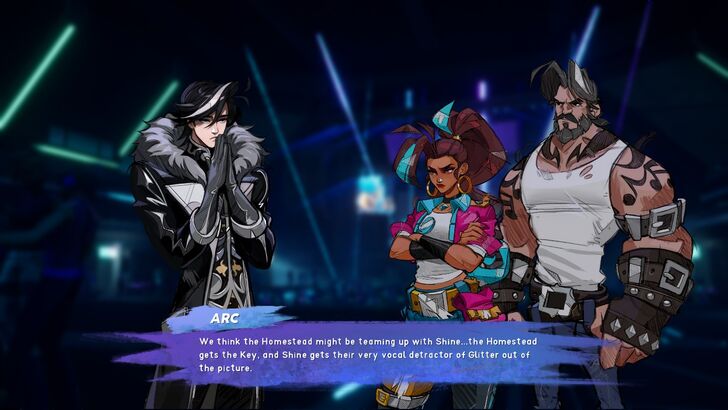
The narrative attempts to balance these personal journeys against the impending threat of the Harmonic Convergence, which disrupts the world’s musical energies, and a deep-seated conspiracy to maintain the status quo. However, the game attempts to resolve all these threads, including the arcs of the antagonists, within a relatively short runtime of 20 hours. It squeezes much of the character development in this timeframe. Because the game moves quickly from one beat to the next, the complexities that could have come from its plot beats are often simplified.
The story is decent and will likely resonate with anyone who has ever pursued a creative endeavor, even when the game presents these struggles through a humorous lens. However, the pacing suffers because a disproportionate amount of the plot is pushed into the final act.
By the time you reach the conclusion, there is simply too much happening at once. Consequently, some characters do not receive the screen time necessary for their individual arcs to reach a satisfying resolution.
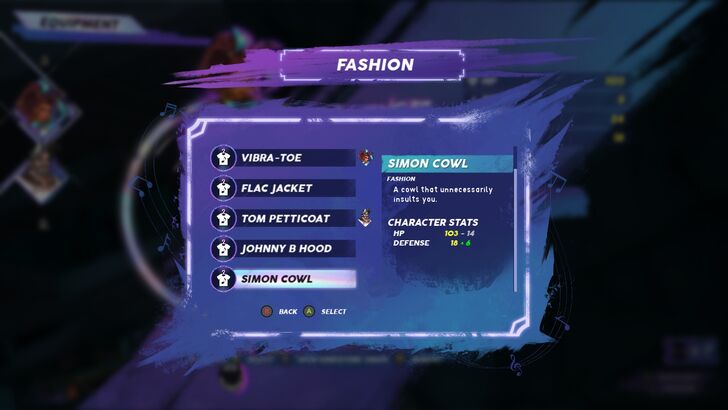
Despite these pacing issues, the writing excels in its tone and world-building. The game is packed with musical puns and pop culture references that, quite admittedly, had me sighing with a defeated smile. The equipment menu haunts me even now, but my favorite is probably the enemy called "Fires and Flames," as a fan of the power metal band DragonForce.
This wit extends to the NPC dialogue as well. If you take the time to speak to the citizens in each city-state, you’ll find that the world-building is bolstered by genuine comedy. These small interactions give charm to a story that is otherwise rushing toward its finale.
Classic and Modern RPG Mechanics, Though Pretty Surface Level
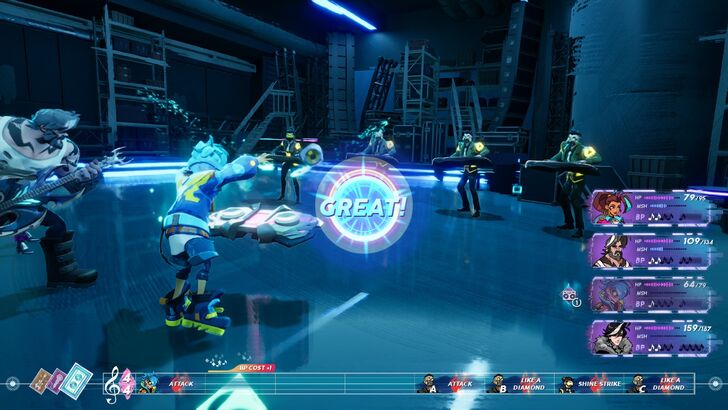
Despite my gripes with its story, People of Note is admittedly still a fun RPG that brings to mind the Final Fantasy games of yore. Its combat is turn-based. Here, it is called Stanzas, with turn orders or Measures placed on a musical staff at the bottom of the screen. Each Stanza dictates a specific time signature, which represents the total number of actions the player and enemies can take. For example, in a 4/4 time signature, the player acts four times, and the enemy acts four times.
Your basic attacks help build up Beat Points (BP), which is the resource used for skills. Sometimes, the background music changes, and when it does, the party member associated with that track’s genre gets buffed. There are also Mashups, where two characters combine their attacks to deal massive damage.
It’s a traditional RPG through and through, down even to how exploration uses static camera angles that often hide treasure chests.
The game also borrows mechanics from more modern titles like Sea of Stars or the Mario & Luigi series, though it keeps things simpler. When you execute an attack or a skill, a rhythmic prompt appears on the screen. Timing your button presses to this visual cue determines the quality of the move, from Poor to Perfect. This directly affects the amount of damage dealt or health restored. Unlike Clair Obscur: Expedition 33, however, you cannot parry attacks.
Regardless, the combat is fun enough for me, as someone who loves turn-based RPGs, even if its mechanics are a bit light. There are interesting twists, such as certain spots on the musical staff granting positive or negative effects, like doubling the BP cost of a turn. However, the game doesn't offer much depth in terms of character stats. You only really have to worry about three metrics: Offense, Defense, and HP. There isn't much room for specialized builds or complex stat management, which left me wanting for more depth hours into the game.
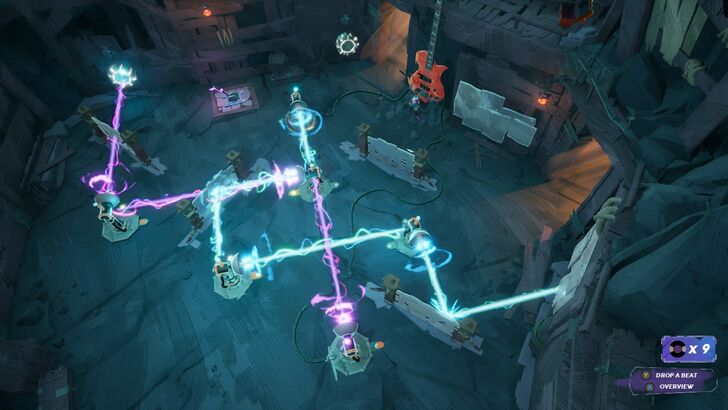
Even the puzzles feel thin, consisting of little more than walking to Item A, interacting with it, and trudging over to Item B—a cycle that repeats ad nauseam.
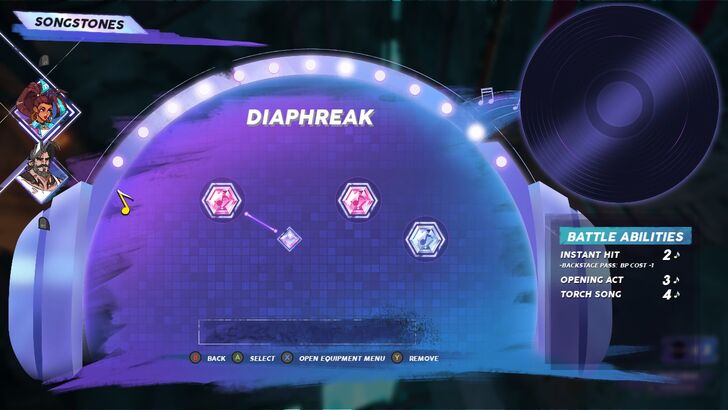
The most customization you will find is in the Songstones you equip, which feels like a more streamlined version of Final Fantasy VII’s Materia. Each weapon has a set number of slots for these Songstones. These allow you to choose which skills your characters can use. You can further amplify these with accessories called Remixes, which, as the name figuratively implies, change the effectiveness of the connected Songstone with buffs. After battles, you earn Ability Points that can be spent to level up these Songstones and make them more effective.
I enjoyed tinkering with these combinations to see how they changed my party’s capabilities, but once you find a set that works, there really isn’t much reason to change it.
Music is Just Cosmetic During Combat
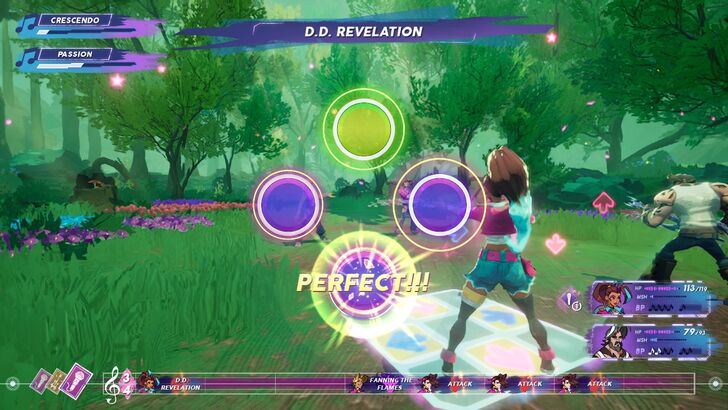
The surface-level nature of the mechanics is most apparent when you look at how the game handles its rhythm-based combat. Being a fan of musicals, I expected the combat to lean heavily on its rhythmic potential. However, as decent as the combat system is, it fails to truly utilize the fact that it is a musical.
The timing for your attacks and abilities isn’t tied to any musical cue, not even the tempo of the battle music itself. You are forced, instead, to rely almost entirely on visual prompts. In fact, you could essentially play through every fight on mute, and very little would change about the experience.
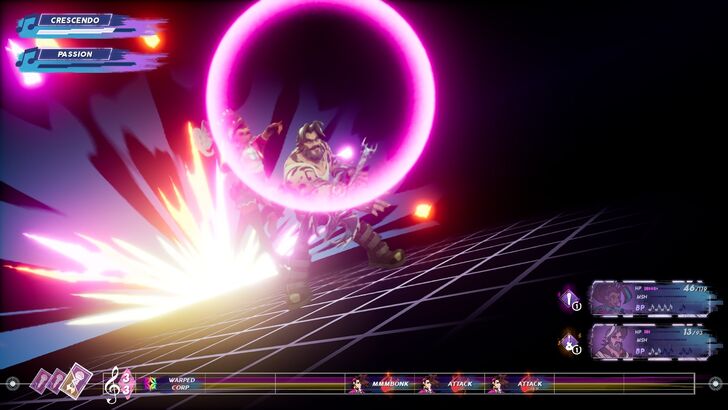
It’s quite unfortunate that the game is musical-themed in name only. It uses musical terms as witty descriptions for existing gameplay terminologies, which is a witty way to frame the world-building, since music is the foundation of Note, sure, but it ultimately is a cosmetic choice. It abandons music theory instead of applying even just a few of those rules to the combat system.
This was a disappointing revelation for me. When the reveal trailer dropped, I was really excited to see how a developer might marry the strategy of turn-based combat with the rigidity of music theory. I expected to be counting beats or matching melodies to gain an advantage. But we didn’t get that.
It is decent, functional, and easy to learn. However, it lacks the rhythmic depth that could’ve made this game a groundbreaking title in the genre.
Audio is Good, Though Some Songs are Bogged by Simplistic Lyrics
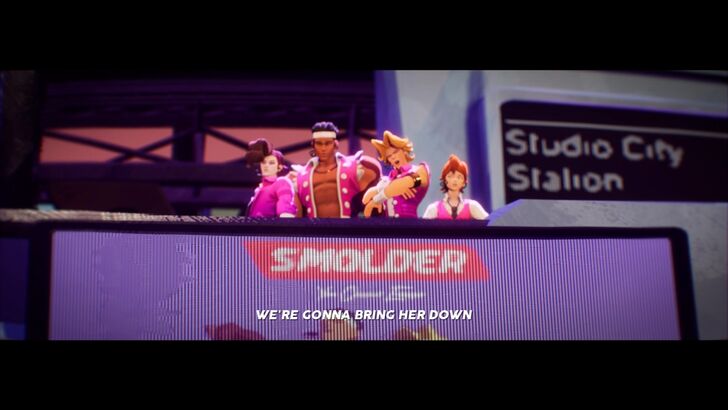
If there is one area where the game consistently excels, it is the audio design. The voice cast does an incredible job of bringing these musical archetypes to life. Heather Gonzales delivers a grounded and relatable Cadence, while Jason Miller gives the perfect gravelly tone for Fret. It was also a pleasant surprise to hear Griffin Burns, whom many will recognize as Childe from Genshin Impact, lending his voice to Anthony, the leader of the boyband Smolder.
The sheer variety of music on display is impressive, too. Many of the battle tracks have multiple variations that shift seamlessly depending on which genre is currently receiving a boost during a specific Measure of the Stanza. The music can transition from pop to rock, hip-hop, or EDM almost instantly. Depending on your location and the enemies you face, you’ll encounter a wide range of styles, including K-pop, punk, grunge, and even Celtic.
Although I still wish these tracks were more integrated into the actual combat mechanics, the musical diversity alone is great.
I even enjoyed the some of the music videos. In these moments, characters burst into song, and the world transforms around them to match the mood, much like a traditional stage musical. Vox’s song, Spitting Image, is my favorite sequence in the game, as it summarizes his inner conflict through hip-hop.
However, a lot of the tracks suffer from a common musical theater problem, where the lyrics fail to push the story forward to any meaningful degree. This is often a result of characters feeling one-note in their songs. The first version of Cadence’s song, "Under the Lights," falls into this trap by explaining her motivations using lyrics that are, quite frankly, simplistic. A lot of lines don’t even perfectly rhyme.
Is People of Note Worth It?
Not Noteworthy Enough for an Encore, but Fun Nonetheless
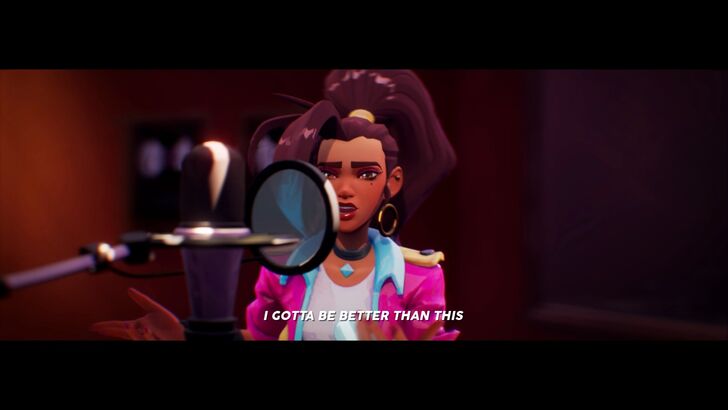
I still think that People of Note is worth the $25 asking price. It is an adequate RPG that has plenty of enjoyable moments and a solid collection of songs. Despite the issues I mentioned above, my 20-hour playtime had a lot of genuine smiles.
Even though the game has a lot of rough patches and the game doesn’t always reach its full potential, it is apparent, still, that the developers made it with love. Like Cadence, People of Note tries to be something unique in a market that is often filled with safe imitations or titles designed to please a crowd. These creative risks do not always land perfectly, and there are times when the execution is off-key. However, the effort is commendable. I admire the attempt and the vision. If you are looking for a game with heart and style, you will likely find enough here to enjoy the performance.
People of Note FAQ
Who Voices Who in People of Note?
People of Note’s cast is made up of a star-studded ensemble of voice actors and professional musicians. These are:
⚫︎ Cadence - Heather Gonzalez (Speaking) / LEXXE (Singing)
⚫︎ Synthia - Erika Ishii (Speaking) / Amanda Angeles (Singing)
⚫︎ Sharp - Joe Zieja (Speaking & Singing)
⚫︎ Anthony - Griffin Burns (Speaking & Singing)
⚫︎ Fret - Jason Charles Miller (Speaking & Singing)
⚫︎ Martell - Debra Wilson
⚫︎ Vox - Mansa "Wakil" Wakili
⚫︎ Annette - Erica Lindbeck (Speaking) / Elizabeth Zharoff (Singing)
⚫︎ Lasso - Sean Kenin Elias-Reyes (Speaking) / Drew Rider Smith (Singing)
⚫︎ Arc - Alex Boniello
⚫︎ Cerrin - Marwan Salama
Game8 Reviews