| PATAPON 1+2 REPLAY | |||
|---|---|---|---|
| Gameplay & Story | Release Date | Pre-Order & DLC | Review |
PATAPON 1+2 REPLAY polishes the classic PSP games from the late 2000s! Read our review to see what it did well, what it didn't do well, and if it's worth buying.
← Return to PATAPON 1+2 REPLAY main article
PATAPON 1+2 REPLAY Review Overview
What is PATAPON 1+2 REPLAY?

Patapon and Patapon 2 were popular Sony-exclusive action rhythm games initially released for the PSP in 2007 and 2011, respectively. They remained exclusive to Sony's ecosystem for a long time, with both receiving remastered versions for the PS4 during 2017 and 2020. During the March 2025 Nintendo Direct, however, it was announced that both Patapon games will receive another remaster as the bundled title PATAPON 1+2 REPLAY for the Nintendo Switch, PS5, and PC.
The Patapon series is a unique combination of rhythm gameplay and strategy where players take command of various "Patapons" that can move forward, attack, defend and retreat by using a sequence of drum beats. The story follows the Patapon tribe on their quest to reach Earthend and behold the mysterious "IT." Along the way, they face formidable beasts and clash with the rival Zigoton tribe, who stand in their way.
PATAPON 1+2 REPLAY features:
⚫︎ Enhanced Graphics and Visuals
⚫︎ Bundles Both Patapon 1 and 2
⚫︎ Much-Needed Quality-of-Life Improvements
⚫︎ Simple Yet Addictive Rhythm Controls
⚫︎ Extensive Customization and Replayability
For more gameplay details, read everything we know about PATAPON 1+2 REPLAY’s gameplay and story.
 Steam Steam |
 PlayStation PlayStation |
 Switch Switch |
||||||
| Price | $29.99 | |||||||
|---|---|---|---|---|---|---|---|---|
PATAPON 1+2 REPLAY Pros & Cons
| Pros | Cons |
|---|---|
 Great Quality-of-Life Improvements Unique and Satisfying Rhythm-Based Gameplay Excellent Value for $30 Great Quality-of-Life Improvements Unique and Satisfying Rhythm-Based Gameplay Excellent Value for $30 |
Repetitive Mission Structure and Grind Can Wear Thin Over Time Story is Rather Straightforward Cutscenes are Underwhelming |
PATAPON 1+2 REPLAY Overall Score - 84/100
Marching to the beat in Patapon 1+2 Replay feels incredibly smooth now, all thanks to some smart quality-of-life upgrades. These rhythm-strategy games finally shine on modern hardware. It's the same quirky, chant-fueled fun we loved on the PSP, just way more accessible and playable. However, this also means it still has some of the original’s quirks. Regardless, it’s still a great excuse to bang the drums one more time.
PATAPON 1+2 REPLAY Story - 6/10
The story here might march in a straight line, but the premise of one-eyed zealots chasing a vague promise called "IT" is still pretty adorable, especially when their chants of murder come from tiny, cyclopean fanatics as cute as the Patapons. There’s a semblance of lore bubbling beneath the surface, though the game barely bothers to explain any of it. It’s not deep in the traditional sense, but there’s just enough weirdness peeking through the cracks to make you wonder what else might be hiding behind those war drums.
PATAPON 1+2 REPLAY Gameplay - 9/10
There’s still nothing quite like commanding an army through perfectly timed drumbeats, and when you’re in sync, it’s almost euphoric. Both games layer on just enough RPG elements to keep the rhythm from getting stale, even if the grind occasionally tests your patience. Patapon 2 especially shines, as it refines nearly everything the first game laid down without losing what it does best. That signature loop somehow still feels fresh almost two decades later.
PATAPON 1+2 REPLAY Visuals - 8/10
Rolito’s minimalist art style still holds up beautifully, now properly scaled for modern displays without a hint of blur. It feels like these little eyeball warriors haven’t aged a day since I last led them into battle as a little kid, and they look just as sharp in motion as they do in screenshots. What’s better is that loading screens zip by so quickly, even on the Switch, that it almost feels like the game forgot they were supposed to be there. The only downside is that some cutscenes still rely on stiff and auto-advancing text without much flair. But hey, they get the job done, and at least the rest of the presentation feels tuned.
PATAPON 1+2 REPLAY Audio - 10/10
The music of Patapon still slaps with every drumbeat doubling as both command and chorus, and it’s just as catchy now as it was back when I couldn’t get Pata-Pata-Pata-Pon out of my head during class as a kid. Every rhythm combo you nail feels like a little concert between you and your Patapon army, and the sound cues are snappy and satisfying enough to keep you in the groove.
PATAPON 1+2 REPLAY Value for Money - 9/10
For thirty bucks, you’re getting two full games that can easily run you 50 hours or more, assuming you don’t mind grinding for that one rare ore or replaying stages to evolve your dream army. It’s a solid deal, especially when you remember that the 2020 PS4 versions are sold separately at $15 a pop without any of the modern tweaks included here. However, the absence of Patapon 3 still stings, and even with what’s here, the repetitive mission structure can start to wear thin if you’re not already in love with the loop. It’s still a great collection, don’t get me wrong, but not one without a few scuffs on the drum.
PATAPON 1+2 REPLAY Review: Pata-Pata-Pata-Pon and On and On
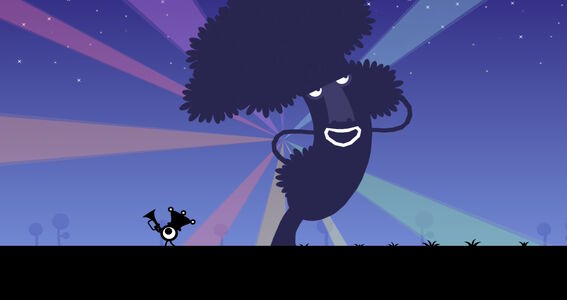
 ⚫︎ Note: Image from Patapon 2
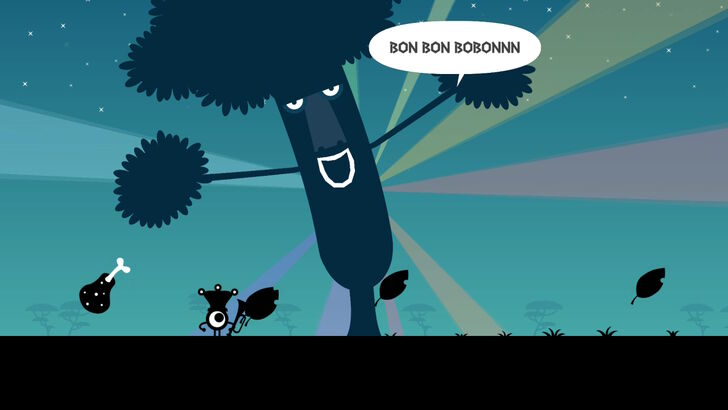
Marching to the beat of your own drum has never been quite as literal as it is in Patapon. For the uninitiated, it’s a series where you lead an army of cyclopean tribal warriors across various landscapes, all through the power of rhythm—Pata-Pata-Pata-Pon!—as they chase after the ever-distant promise of Earthend. It’s a rhythm game that has this kind of audiovisual identity which made the PSP era such a wonderful time to be a handheld gamer. And now, with Patapon 1+2 Replay, this oddity has marched its way onto modern consoles in search of a second wind.
The original Patapon debuted on the PSP in 2008, developed by Pyramid and Japan Studio, the same developers who brought us LocoRoco, Ape Escape, Gravity Rush, and even Astro’s Playroom. Its minimalist art style, courtesy of French artist Rolito, made it instantly recognizable. The core rhythm mechanic, where each face button maps to a syllable, was as mechanically tight as it was infectious. A sequel arrived in 2008 with more customization options and units, and Patapon 3 closed out the trilogy in 2011 with a more radical rework that leaned harder into its RPG systems and online multiplayer. The third game was divisive, but the first two became cult classics.
 ⚫︎ Note: Image from Patapon 2
I remember playing all three back on the PSP, probably with a permanent smudge on those glossy PSP buttons from hammering out those four drums. I remember getting stuck in Patapon 2’s later stages and dreading the grind that followed. I adored all three, even the quirks of Patapon 3. So when Sony announced remastered versions of the first two games for the PS4, I nearly took the bait. Nearly.
The remasters, it turned out, were a little too faithful for their own good. Patapon Remastered launched with a noticeable input lag issue, especially on modern TVs without game mode enabled. The improved resolutions didn’t extend to the 2D assets, which left some parts looking stretched. These weren’t dealbreakers on their own; both Patapon games are still amazing, but when taken together, they painted a picture of a remaster that didn’t quite get the love it deserved. Despite the allure, I sat them out.
We don’t know when Patapon’s spiritual successor, Ratatan, will be released, but at least we have Patapon 1+2 Replay to keep us company. It sounded promising enough, both games together, finally running on modern hardware with modern expectations. But it’s hard not to feel a bit skeptical when it felt as though no one knew what to do with the IP. After all, nostalgia can only march so far before the beat gets out of sync.
Fortunately, Bandai Namco handled Patapon better than Sony did.
Beat by Beat by Beat
 ⚫︎ Note: Image from Patapon 1
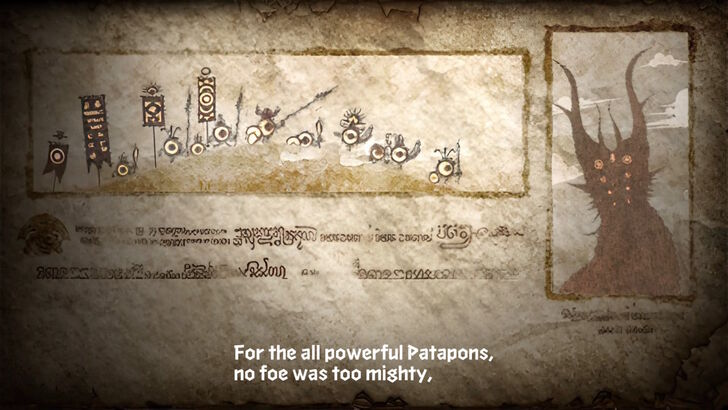
The premise of Patapon is pretty straightforward: you are an omnipotent god summoned by the one-eyed Patapon tribe to guide them in their long-lost quest to reach Earthend, a paradise where "IT" awaits. What exactly "IT" is remains a mystery, even to the Patapons themselves, but that doesn’t stop them from banging drums and marching ever forward with single-minded devotion.
The first game focuses on this journey in its rawest form. The Patapons, scattered and demoralized after years of war, slowly rebuild their strength under your divine guidance. As they advance through deserts, forests, and battlefields, they face off against the Zigotons, a rival tribe convinced that the Patapons’ path will only bring ruin.
 ⚫︎ Note: Image from Patapon 2
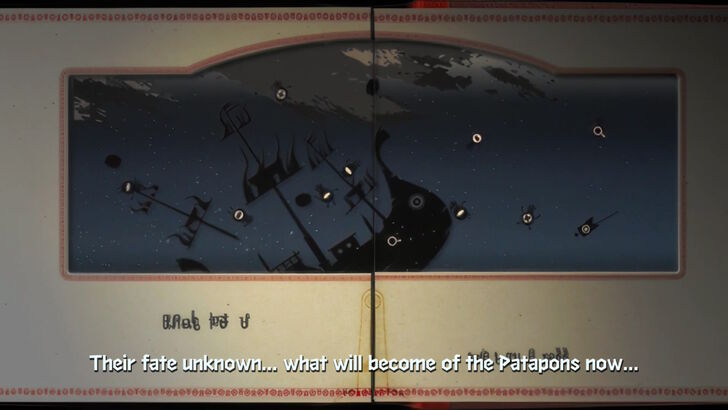
Patapon 2 picks up immediately where the first game leaves off, mid-voyage, as the Patapons take to the sea in pursuit of Earthend. But no sooner have they set sail than disaster strikes, and they find themselves washed ashore in a new land. Here, they encounter the Karmen tribe, a militaristic society with unclear motives.
Compared to the first game, Patapon 2 opens up its world a bit, with stories of ancestral gods and masks that hold untold power. It also introduces a Hero Patapon, a chosen warrior capable of turning the tide of battle with special powers and customizable classes.
The sequel’s plot still follows the same basic template, but it does so with more flavor. There’s a growing sense that this world is big yet fragmented, with deeper mythos buried under layers of drums and dust.
 ⚫︎ Note: Image from Patapon 2
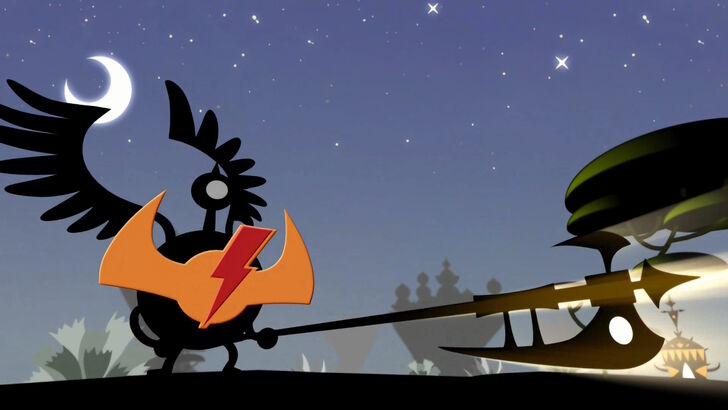
I wouldn’t go so far as saying the story is the main attraction here, though—because let’s be real, it isn’t—but there’s a charm in how it’s told. Most of the narrative is delivered through short cutscenes and flavor text, with the Patapons themselves providing a lot of the world’s personality through their adorable naivety. It’s easy to dismiss the plot as little more than an excuse to keep marching forward, and on the surface, that’s kind of true. But if you squint a little, there’s something compelling about the deeper lore that goes mostly unexplored. Who exactly are the Karmen, and what’s their beef with the Patapons? What drove the Zigotons to oppose the Patapons so fiercely? Why do the Patapons follow a god with such absolute conviction, even when their god is literally you, fumbling to keep a beat on your controller?
It’s these kinds of questions that kept me curious, even when the plot itself felt like it was just pushing me from one boss fight to the next. The Patapons may be simple folk, but the world is anything but. Or perhaps I’m just deluding myself and searching for meaning where there is none, but it’s nice to think there’s more to the Patapons than meets the eye.
Pata-Pon-Don-Chaka!!
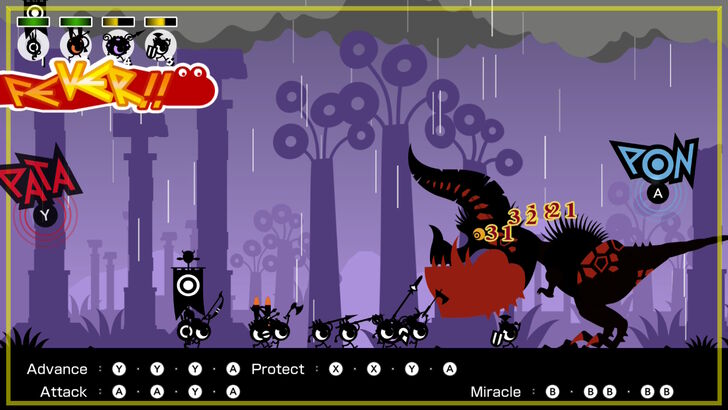
Patapon’s gameplay is rhythm-based, but calling it just a "rhythm game" is like calling a soufflé just a puffed-up egg. The foundation is simple: you press buttons in a four-beat pattern to issue commands to your army of Patapons. For example, on the Switch, Y-Y-Y-A becomes Pata-Pata-Pata-Pon, which makes them march. A-A-Y-A or Pon-Pon-Pata-Pon tells them to attack. The core loop is down to you learning the chants, staying on beat, and leading your troops to glory. Miss a beat, and your army stumbles; keep your combo going, and you enter FEVER MODE, where your units become stronger, faster, and even louder. And when it clicks, it feels good.
⚫︎ Note: Gameplay Images from Patapon 1 (first) and Patapon 2 (second)
The first Patapon sets the table and establishes the basic unit types: Tatepons (Tanks), Yaripons (spearmen), Yumipons (archers). As you play some more, you’ll get three more unit types. The game eases you into the loop of hunting animals, obtaining gear, and battling the Zigotons. But it’s very stripped down. Its simplicity can be charming, but that is also part of the limitation. There’s a point where the game stops introducing new ideas and just expects you to grind longer.
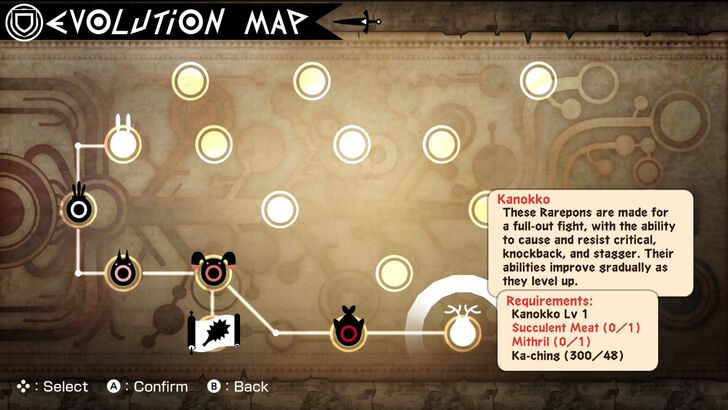
Patapon 2, on the other hand, is where things really open up. It introduces a Hero unit with special powers and customizable classes, flying Toripons, spell-casting Mahopons, and more specialized unit types. The sequel also allows you to evolve Patapons into rare and elemental variants with improved stats or unique traits.
 ⚫︎ Note: Image from Patapon 2
And that’s where the RPG layer really starts to flex its muscles. To unlock certain unit types or build out optimal teams, you’ll need to farm materials from hunting missions and replay previous stages repeatedly. Bosses drop items randomly, and evolution trees require increasingly esoteric ingredients. It’s nice that there’s a tangible sense of progression, sure, but with it comes a sharp spike in how much time the game demands to get there.
You could brute-force your way through early stages, but later missions will chew you up if you don’t put in the effort to evolve your army properly. And unlike other strategy RPGs, where you can just grind experience and call it a day, Patapon’s grind has you more involved, concentrating on not messing up your rhythm. Some bosses have brutal learning curves, and there’s not much wiggle room for improvisation if you bring the wrong team or haven’t spent time grinding for the right gear. You’ll need to love repetition, because it’s baked into the bones of the design.
For me, though, the rhythm never really wore out its welcome. There’s a hypnotic quality to it all—the steady Pata-Pata-Pata-Pon, the swell of the music as you hit FEVER MODE. Even when I was stuck replaying the same hunting mission for the fifth time just to get a single Kibapon, I couldn’t bring myself to blame the game for something that’s clearly my fault for losing focus. There are frustrations, yes. Some systems are needlessly opaque, and the trial-and-error approach to progression can wear you down. However, it never stopped being fun to play god with a drum.
Quality-of-Life Improvements That Hit All the Right Notes
 ⚫︎ Note: Image from Patapon 1
Patapon 1+2 Replay does something the earlier PS4 remasters couldn’t quite manage; it gives these cult-favorite games a fresh coat of paint on top of the long-overdue quality-of-life improvements they deserve. Both games have been adjusted to make them feel more intuitive in 2025. For starters, there’s now a proper input calibration setting, which is an absolute godsend for a game where every command lives and dies on timing. This was a huge oversight in the previous remasters. Docked mode on the Switch still has a bit of noticeable latency by default, but it’s easily resolved by heading into the settings and tweaking the input sync bar. Once you’ve dialed it in, the game sings the way it’s supposed to.
There’s also an optional beat guide that can be displayed on-screen. This shows you the rhythm patterns you’ve unlocked, which is great for players (like me, unfortunately) who maybe haven’t internalized Don-Don-Chaka-Chaka as a reflex. Equipping your army, sorting through dozens of dropped weapons and helmets, and even navigating the Patapon evolution tree are far less clunky now. Everything feels faster and more efficient. It’s subtle stuff, but all of it adds up to a version of Patapon that finally understands it’s being played in a modern context, on modern machines, by players who may not be nostalgic diehards. Plus, if you’re playing on the Switch, you can actually play Patagate on Patapon 2 locally via ad-hoc, just like in the PSP days. You just need two Switch units, a second copy of the game, and friends who are also weirdly obsessed with marching eyeball-people. Easy.
Where’s Patapon 3?
 ⚫︎ Note: Image from Patapon 3's E3 2010 Trailer
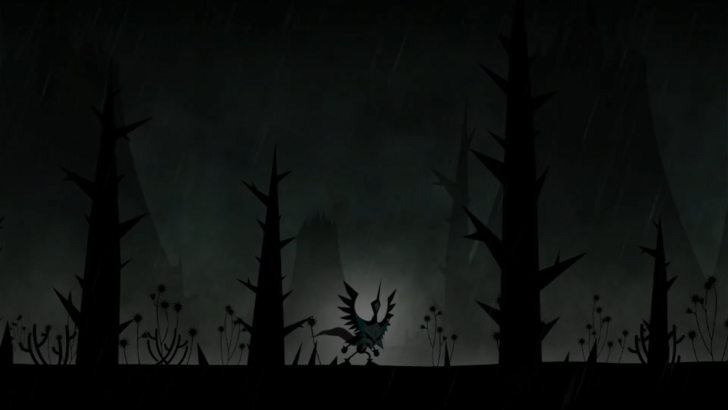
But as polished as Replay is, it does raise a few questions. For one, why just Patapon 1 and 2? The two games aren’t all that different from each other, and if we’re being honest, Patapon 2 pretty much obsoletes the first game. It has more units, more systems, more content, and a much smoother sense of pacing. Unless you’re here purely for the lore (which, hey, fair enough), you could jump straight into Patapon 2 and not miss anything important. So why package these two games together and leave out Patapon 3, the most radically different, and arguably most divisive, entry in the series?
It’s not like Patapon 3 is lost media. In fact, it got a remaster earlier this year for PS4 and PS5, albeit without its original online multiplayer component. Sure, that game was deeply tied to co-op back in the day, but it was still fully playable solo, and most of its campaign is perfectly doable without help. If Sony can rerelease Patapon 3 without online functionality, then surely Bandai Namco could have added the game to Replay too?
Maybe they didn’t want to overshadow Patapon 3 Remastered’s standalone release, or maybe the change in structure between 2 and 3 was too much to neatly include in one package. Whatever the reason, it’s a little disappointing. Patapon 3 was still a Patapon game, and it deserves the same preservation treatment.
Is PATAPON 1+2 REPLAY Worth It?
A Replay Worth Pressing Play On
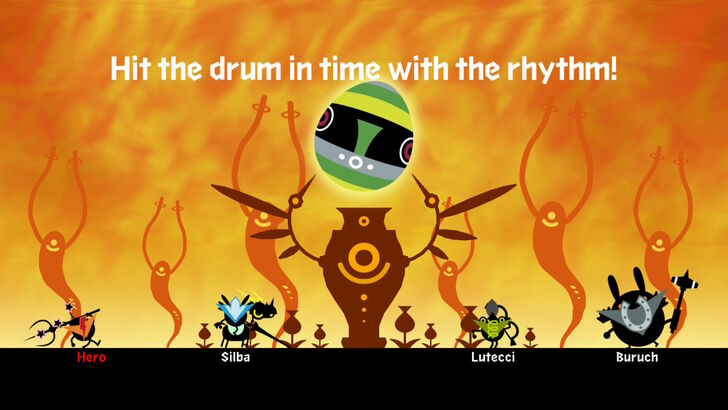 ⚫︎ Note: Image from Patapon 2
For fans and newcomers alike, Patapon 1+2 Replay feels like a much-needed revitalization of one of the strangest duologies to come out of the PSP era. The earlier PS4 remasters had potential but were ultimately barebones ports, marred by input lag and a refusal to modernize. Replay polishes it just enough to let these games roll with the kind of rhythm they always aimed for. It helps, too, that this new release comes at a very reasonable $30 price point. Individually, Patapon Remastered and Patapon 2 Remastered are each sold at $15, and those versions don’t come with the improvements Replay does. Here, for the same combined cost, you’re getting a package that plays better.
And you’re definitely getting your money’s worth in terms of sheer content. Between the two titles, you’re looking at around 50 hours of gameplay, give or take how many times you have to retry a boss because your rhythm fell apart mid-FEVER MODE or just forget to equip the appropriate gear for your Pons. And yes, some of that time will absolutely be spent grinding to get better gear, but one can argue that the appeal of Patapon is also in building your own army or murderous, one-eyed ball people
Would it have been better with Patapon 3 included? Absolutely. Does its absence feel like a gap in what could’ve been the definitive Patapon collection? Maybe. But even without it, both Patapons 1 and 2 are still some of the most entertaining rhythm-strategy RPG hybrids that defies categorization nearly two decades after its debut. It’s proof that great ideas don’t age poorly. And if the beat still echoes in your heart, all that’s left to do is Pata-Pata-Pata-Pon!
| Steam |
PlayStation |
Switch |
||||||
| Price | $29.99 | |||||||
|---|---|---|---|---|---|---|---|---|
PATAPON 1+2 REPLAY FAQ
Does PATAPON 1+2 REPLAY Have Multiplayer?
For PC and PlayStation 5, PATAPON 1+2 REPLAY, much like its PlayStation 4 remastered counterparts, does not include online or local multiplayer. On the Nintendo Switch, however, Patapon supports 4-person local multiplayer, provided each of the four players has their own copy of the game and a Nintendo Switch.
Game8 Reviews

PATAPON 1+2 REPLAY Similar Games
PATAPON 1+2 REPLAY Product Information
|
|
| Title | PATAPON 1+2 REPLAY |
|---|---|
| Release Date | July 11, 2025 |
| Developer | SAS CO.,LTD. |
| Publisher | Bandai Namco Entertainment |
| Supported Platforms | PC (via Steam) PlayStation 5 Nintendo Switch |
| Genre | Rhythm, Strategy |
| Number of Players | Single-Player (1) 2-4 Local Co-Op (Nintendo Switch Only) |
| ESRB Rating | ESRB E |
| Official Website | PATAPON 1+2 REPLAY Website |