
Keeper Review Overview
What is Keeper?
Keeper is an atmospheric puzzle adventure game that tells its story without a single line of dialogue. You play as a lighthouse that mysteriously gains life, accompanied by a small bird who never leaves your side. Together, you traverse 39 handcrafted chapters filled with environmental puzzles, evolving landscapes, and subtle storytelling told entirely through sight and sound. As you cleanse the world from the corruption of the Wither, you’ll grow, transform, and uncover a deeply emotional narrative hidden beneath the surface of its surreal beauty.
Keeper features:
⚫︎ Atmospheric Puzzle-Adventure
⚫︎ Evolving Protagonist
⚫︎ Wordless Storytelling
⚫︎ Distinct Visual Motif Each 39 Chapters
| Digital Storefronts | |||||
|---|---|---|---|---|---|
 Steam Steam |
 Xbox Xbox |
||||
| Price | $29.99 | ||||
Keeper Pros & Cons
| Pros | Cons |
|---|---|
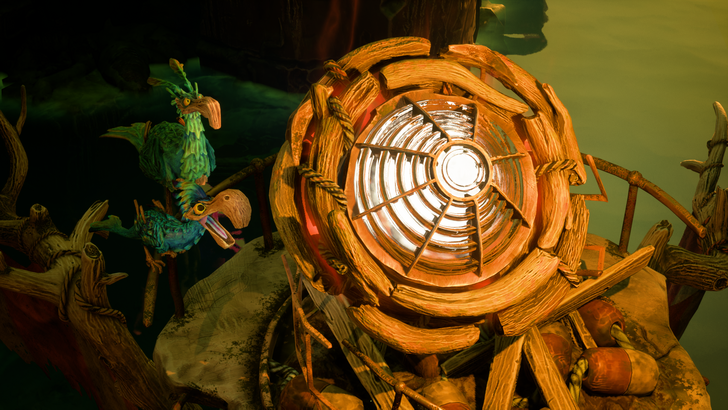
 Stunning Visuals Puzzle Designs Evolves Naturally with Progression Cozy Yet Thought Provoking Experience Stunning Visuals Puzzle Designs Evolves Naturally with Progression Cozy Yet Thought Provoking Experience |
Slow Build-Up Short Runtime Pacing Dips Between Major Evolutions |
Keeper Story - 7/10
Keeper’s story is subtle and emotional, told entirely through its visuals and atmosphere rather than dialogue or text. While this choice makes for a beautifully interpretive experience, it also means the narrative takes time to resonate, and some players may struggle to piece together its meaning early on. The pacing drifts in the first few chapters, with stronger emotional beats only surfacing later in the game. It’s a tale that rewards patience—evocative and poetic, but not always cohesive.
Keeper Gameplay - 8/10
The gameplay is simple yet satisfying, striking a balance between relaxing exploration and gentle puzzle-solving. It’s intuitive with a light-based mechanic that feels clever without ever being overcomplicated. However, the early hours lack momentum, and the absence of variety in movement can make it feel too minimalistic for some. Still, once the game opens up, its puzzles and progression become quietly captivating.
Keeper Visuals - 10/10
Visually, Keeper is breathtaking. Every frame feels like a painting—glowing skies, surreal landscapes, and intricate lighting effects all working together to tell a story of their own. The world’s color palette shifts fluidly between dreamlike and melancholic, giving it an atmosphere that’s both alien and comforting. Technically, it’s flawless—no stutters, no frame dips, just pure, mesmerizing artistry.
Keeper Audio - 7/10
While Keeper’s sound design creates a relaxing and immersive environment, its music doesn’t always rise to meet the emotion of its visuals. There are moments where the soundtrack nails the tone—gentle and reflective—but too often it fades into the background, leaving scenes feeling emptier than they should. The absence of dialogue fits the narrative choice, yet it places more weight on the music’s shoulders, which it only sometimes carries gracefully.
Keeper Value for Money - 8/10
At $29.99, Keeper offers a 10 hour experience of rich and artful experience that’s easy to appreciate but hard to justify for everyone. Its playtime leans short for its price, and replayability is minimal beyond the emotional journey itself. There are no branching paths or alternate endings—it’s a one-sitting kind of experience meant to be felt once and remembered fondly. It’s worth it for those who value artful storytelling, but less so if you’re chasing hours of content.
Keeper Overall Score - 80/100
Keeper is a quiet triumph, a game that stumbles in its early pacing but ultimately shines with emotional depth, creative design, and stunning visuals. It’s not a perfect experience, nor does it try to be, instead, it’s a meditative one that trades action for atmosphere and exposition for emotion. Its flaws in pacing, audio, and value hold it back from greatness, but what it achieves is still remarkable. It’s a strange, beautiful adventure that tells a story about strange friendships and transformation. Imperfect, but unforgettable.
Keeper Review: Starts Dim, Ends Dazzling
Gentle Puzzle Wrapped in Metal
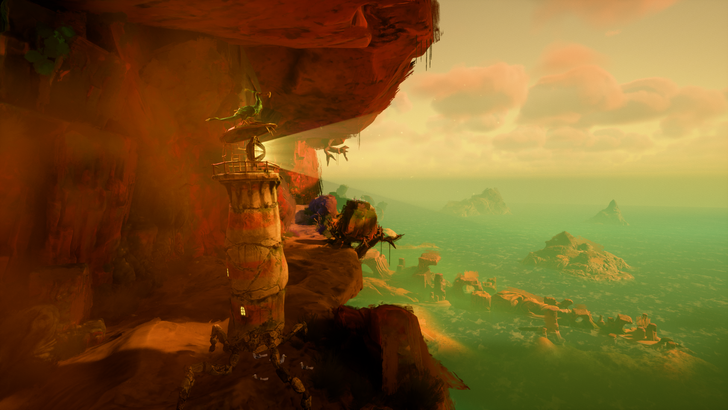
Have you ever wondered what it’s like to walk like a baby giraffe? Yeah, me neither. But that’s exactly what Keeper felt like in the first few minutes—an awkward, uncertain wobble through a strange new world that quickly unfolds into something more graceful, deliberate, and unexpectedly touching.
At first glance, Keeper felt like another quiet, atmospheric "walking simulator." The kind you play on a lazy Sunday, cup of tea in hand, letting the visuals do most of the talking. But that assumption doesn’t last long. Beneath the slow, deliberate pacing lies a puzzle adventure at heart, one that tests not just how you move through the world, but how you observe it. I’ve played plenty of puzzle-driven indies over the years and Keeper fits comfortably among them while still carving out a personality of its own.
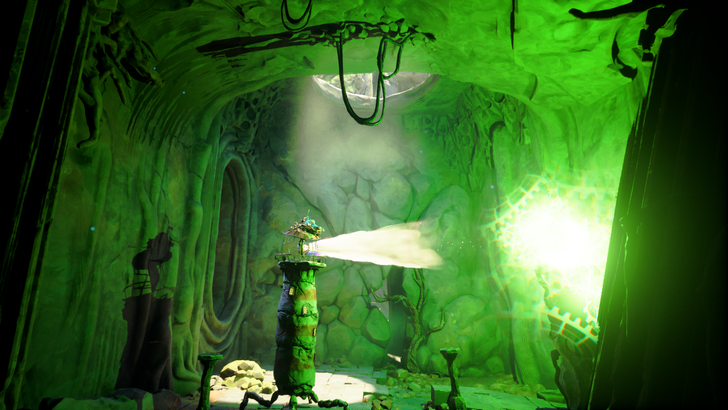
What sets Keeper apart is how it uses its clunky movement, that baby-giraffe energy, as part of its design philosophy. You’re not meant to glide effortlessly across the terrain, you’re meant to feel the weight of your little mechanical frame, to stumble, recalibrate, and slowly understand the world around you. It’s disarming in its simplicity, but deliberate in its rhythm.
And then there’s the narrative—quiet, but resonant. It’s not spoon-fed to you through dialogue or exposition, but told through the environment, through discarded remnants of a world long past, and through your robot protagonist’s silent persistence. It has echoes of The Wild Robot—that same sense of mechanical innocence clashing with nature’s beauty and brutality. You’re piecing together fragments of a story that feels both personal and universal, about purpose, loneliness, and the instinct to protect.
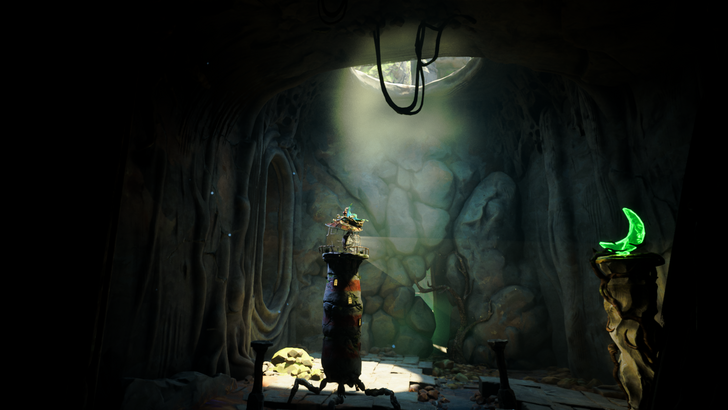
So while Keeper begins as a walking simulator in form, it quickly reveals its heart as something deeper: a puzzle adventure that invites reflection as much as it asks for problem-solving. It’s a game about the small, deliberate movements that make up discovery, about learning how to walk before you learn how to belong.
A Slowly Ending World
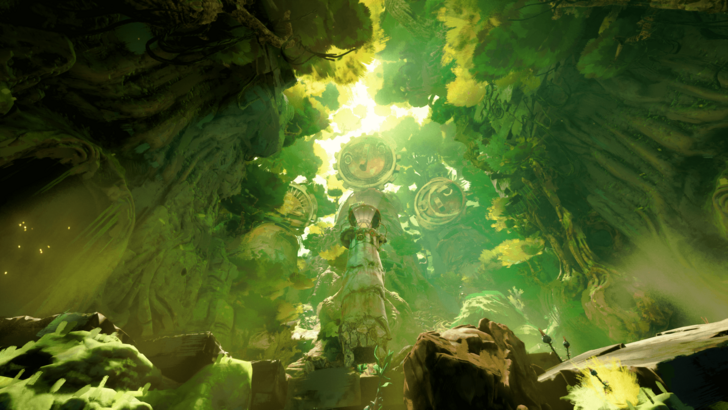
The world of Keeper is unlike anything else, equal parts serene and surreal, like someone melted a dream into a painting and then asked you to walk through it. It’s an atmospheric puzzle adventure built entirely around sight and sound. There’s no dialogue, no written text, no spoken words—only the hum of the wind, the echo of your light, and the quiet rhythm of discovery. It’s the kind of game that doesn’t tell you what’s happening, it just shows you, then trusts you to piece it together yourself.
At first, you might not even be sure what you’re looking at. There’s a sense of psychedelic calm—towering monoliths that seem to breathe, color palettes that shift like mood swings, and environments that feel both alien and familiar. But slowly, Keeper starts to make emotional sense. It’s not about logic or lore, it’s about feeling. The game invites you to linger, to take in its textures and rhythms, to just be in this world rather than rushing through it.
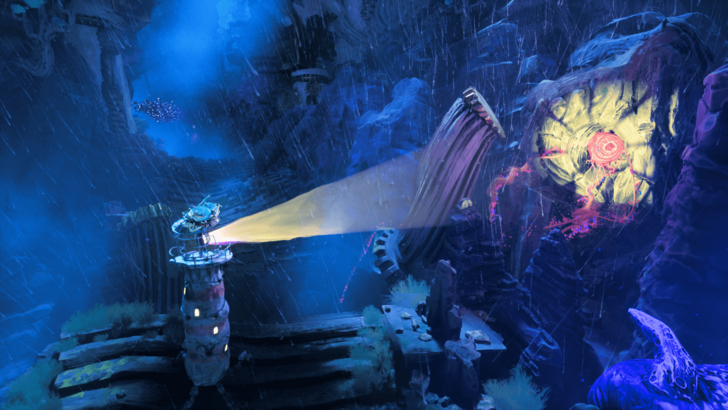
The story begins simply, almost like a fable. A small bird is left behind by its flock, adrift over a dark ocean where inky, shadowy forms writhe—creations of something called the Wither, a corruption that seeps into everything it touches. Just as the bird’s fate seems sealed, a distant lighthouse flickers to life, casting a beam that cuts through the darkness and saves it. In gratitude, the bird stays. The lighthouse then awakens, sprouting legs, consciousness, and a sense of purpose.
Together, they journey toward the center of the world, a pilgrimage of some sort through dreamlike lands, each stranger and more haunting than the last. The game unfolds over 39 chapters, each one a small vignette of exploration and quiet storytelling.
Hauling a Construct Through the End of the World
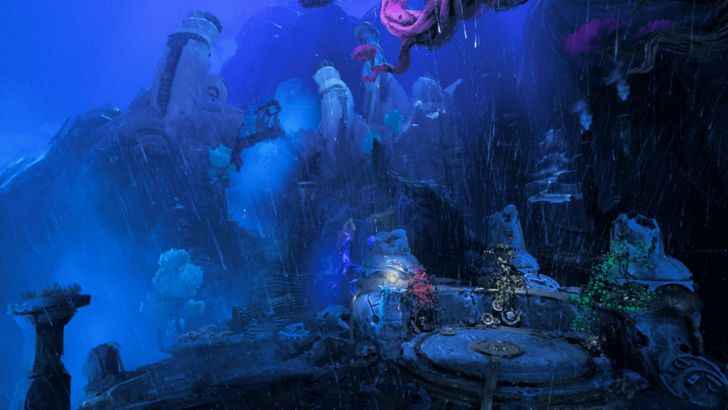
As the lighthouse, your movement is limited, understandably so. You don’t jump or climb, you trudge, with slow, deliberate steps that give the sense of carrying immense weight. You move forward, backward, side to side, and most importantly, you swing your light. This light is everything, it’s your tool, your weapon, your language. It banishes the corruption of the Wither, brings color and life back to dead landscapes, and often reveals the path forward. It’s as if illumination itself is your voice.
The gameplay loop, at its core, is simple but meditative: walk, explore, observe, solve. You move through varied biomes, cleanse corruption, and restore life to the world. There’s a quiet satisfaction in how little the game asks of you—and how much it gives in return. With that, let’s get on with the rest of the review, because Keeper may look simple on the surface, but the way it plays and feels deserves a much deeper look.
Lengthy Beginnings
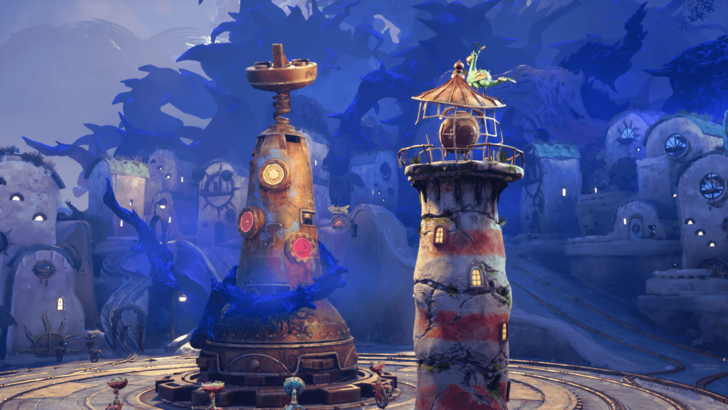
I’m gonna start weak here, because honestly, Keeper starts weak. It’s one of those games that doesn’t immediately sell itself, where your first hour is more confusion than clarity. The very first thing you notice is how slow it feels. You don’t glide or sprint, you stumble. You quite literally tumble down like a baby giraffe, awkwardly learning to exist as a newly awakened lighthouse. It’s clumsy, deliberate, and weirdly endearing… for about ten minutes. Then it’s just slow.
Those opening chapters tested my patience. There’s not much to do aside from walking, swinging your light, and watching the world respond. The puzzles—which you’d think would be the core hook —barely show up early on. And when they do, they’re simple enough to breeze through without much satisfaction. I remember thinking, "Wait, is this really all there is?" For a game built on exploration and mystery, the first impression was almost too quiet, too uneventful.
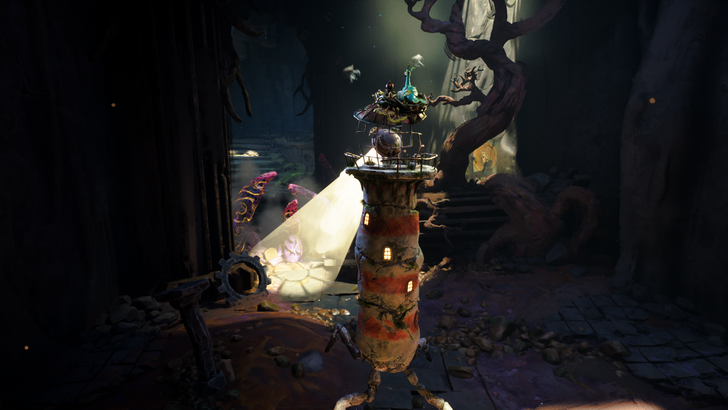
But that pacing is intentional. Keeper lulls you into this false sense of monotony before slowly unfolding into something genuinely magical. When the puzzles finally start to ramp up, they don’t just challenge your brain; they shift your relationship with the world. The act of swinging your light, once repetitive, becomes this intricate dance of cleansing, revealing, and connecting. The way the environment reacts—flowers blooming under your beam, bridges forming out of light, the bird guiding you forward—it’s all deeply satisfying once it clicks.
Still, I can’t deny that the early game could’ve used a stronger hook. A few more narrative beats sprinkled in those first chapters might’ve gone a long way. I understand why the big moments were saved for the middle and late game—it makes the payoff stronger—but the climb to get there is a bit too steep for players who don’t have that initial patience.
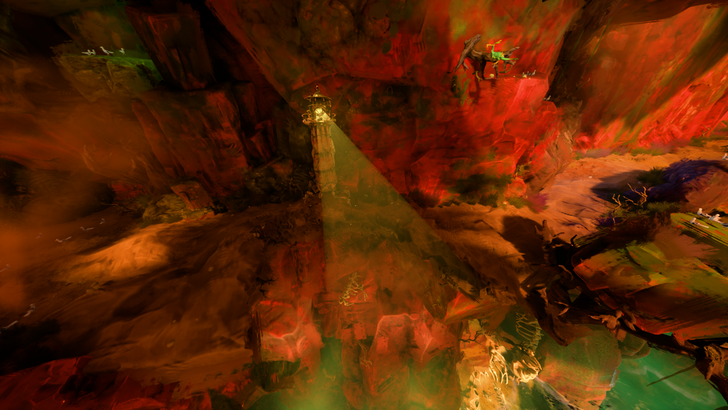
And then there’s the music. For a game with no dialogue or text, I expected the soundtrack to carry more emotional weight. It’s not bad, but it often fades into the background, too ambient to leave a mark. Compared to how stunning the visuals are (we’ll get to that), the audio sometimes feels like it’s just there instead of leading the experience. In a world this expressive, I wanted the music to swell, to guide, to speak where words couldn’t.
But gripes aside, once Keeper finds its rhythm, it transforms from a sleepy stroll into one of the most strangely soothing and heartfelt puzzle adventures I’ve played this year. The clunky start makes the eventual payoff feel even more earned.
With that out of the way, let’s talk about what Keeper actually does well, and why it deserves a place on your cozy, weird, "what even is this game but I love it" list.
The Puzzles and Progression
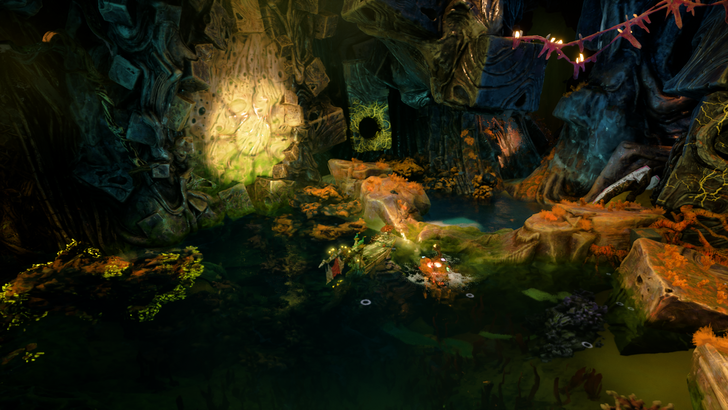
While I did say Keeper starts slow, let me tell you—when the puzzles finally kick in, it’s like a switch flips in your brain. That quiet meditative pacing suddenly has purpose. The game introduces its mechanics with surprising care, teaching you one small idea at a time and then builds on that foundation in the next chapter. It’s smart design, that gradual layering of ideas. Nothing is wasted, nothing is repeated without reason. By the time you’re a few chapters deep, you realize you’ve been learning without realizing it.
I love puzzles. I like when a game makes me think, not necessarily when it makes me feel stuck, but when it scratches that mental itch that says, "Oh, that’s clever." Keeper does that often. Its puzzles aren’t hard—in fact, most are simple enough that a child could solve them—but the way they’re presented feels elegant. They don’t just test logic; they test attention. Even when I knew the solution, there was still satisfaction in executing it cleanly.
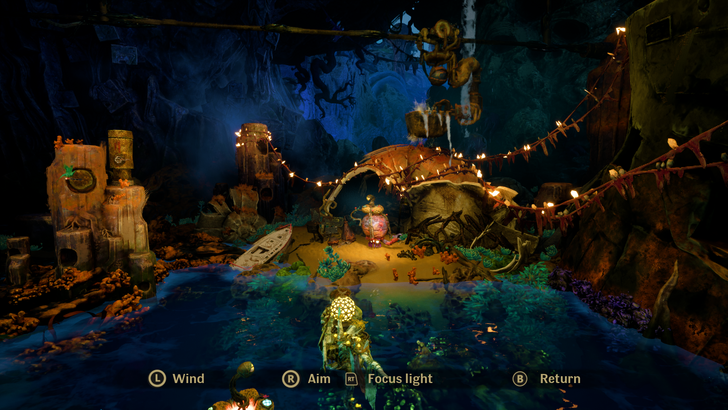
And beyond the main puzzles, each chapter is peppered with smaller things to tinker with, tiny fixes and curiosities that serve no real gameplay purpose. Maybe you’ll free some animals from being trapped, maybe you’ll trigger a cinematic shot that just lets you admire the world for a moment, or unlock an achievement that’s more sentimental than functional. It’s charming, that commitment to detail.
The Middle Chapters
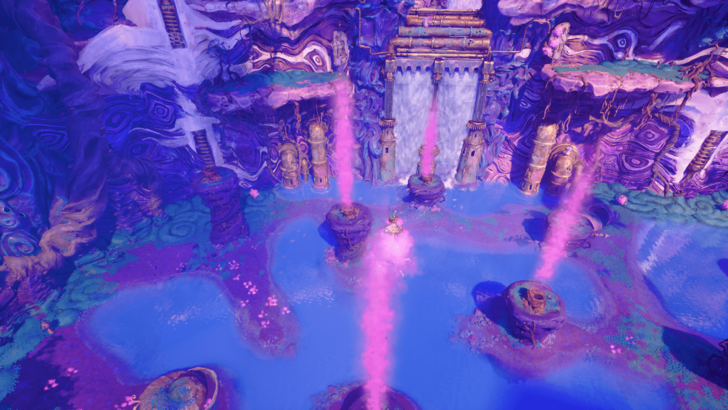
There are 39 chapters in Keeper, but don’t let that number fool you, they’re all bite-sized. Each one is short, digestible, and distinct enough that you never feel like you’re trudging through filler. Every chapter introduces a unique motif, a fresh puzzle structure, or a slight shift in mood. Some are vibrant and hopeful, others heavy and oppressive. And while the background music shifts with them, I can’t say many of those tracks stuck in my mind—pleasant, but not quite memorable.
What is unforgettable, though, are the visuals. I kept catching myself saying aloud, "It’s like playing an animated film." The lighting, the angles, the movement of the environment, it’s all breathtaking. There’s no other word for it.
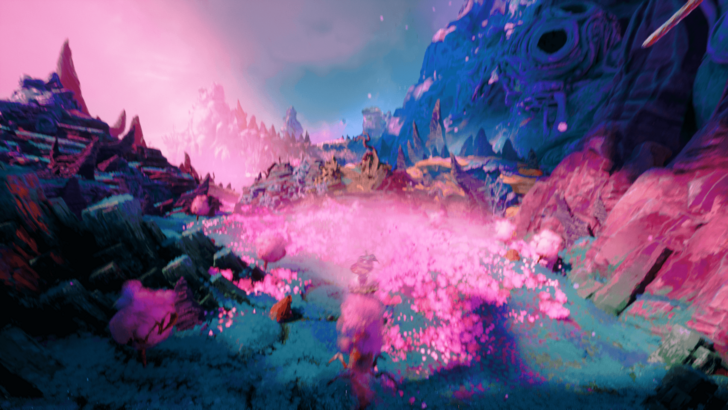
My favorite arc, hands down, was the Pollen trilogy—Pollen Fields, Pollen Falls, and The Great Pollen Tree. These stages are the turning point. The puzzles become more kinetic, blending light manipulation with gentle platforming. Up until then, movement in Keeper is deliberately clunky; you’re a lighthouse, after all. But here? Suddenly, you’re floating. Literally. You’re drifting through sunlit pollen, the world shimmering around you, soft and warm like a dream. It’s one of those "ah" moments, equal parts cozy and awe-inspiring. The calm before the storm.
And yes, it’s midgame at this point, which means the game’s about to flip everything you thought you knew on its head.
Evolution and Purpose
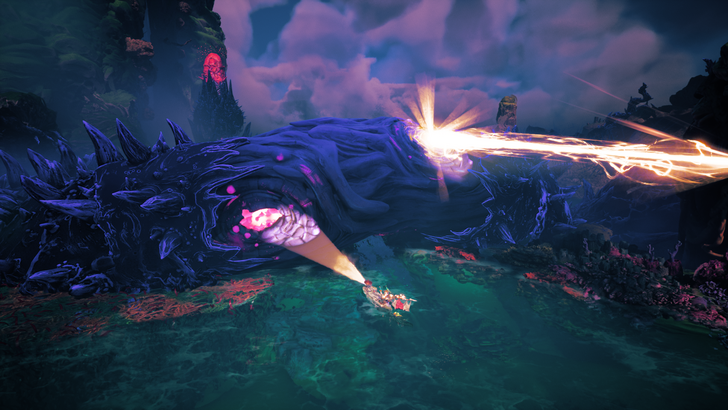
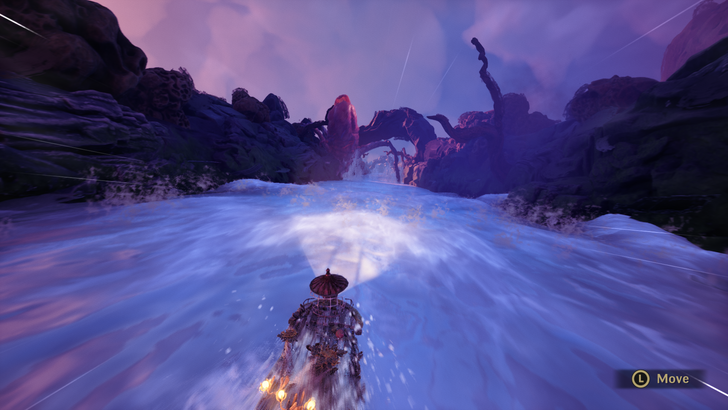
Without spoiling too much, Keeper doesn’t just evolve narratively—it evolves physically. The lighthouse changes. You change. The way you move, the way you solve puzzles, the way you exist in the world—t all transforms. After a certain point, you’ll gain access to the sea. The puzzles are still about guiding light and purifying darkness, but traversal becomes smoother, almost liberating. Compared to your clunky beginnings, this new form feels like freedom. You’re still a heavy construct, but now you glide, dancing with the tide.
And this evolution isn’t just mechanical, it’s emotional. Early on, it feels like you’re affecting the world without really belonging to it. You fix, you cleanse, but the creatures you help mostly scatter without acknowledgment. Midway through, though, that changes. Your work starts to matter. The creatures remember. They help you in return. The cycle of kindness comes full circle, and for a game with no dialogue, it’s shockingly heartfelt.
This arc also introduces the first real boss encounter. Previously, the environment was the enemy—corruption, decay, the big storm. But now you face something tangible. It’s not a hard fight, but it’s symbolic, a moment that says, "You’ve grown. You can stand your ground."
Then comes the third evolution, and oh man, what a moment. If the early game was sluggish, this one feels like pure momentum. You move fast, fluid, alive. The visuals explode with color. You feel like you’ve harnessed the power of light itself—maybe not godlike, but close. And while the puzzles shift to something more about collecting energy and pushing forward rather than intricate logic, it fits the tone. This is power through motion, almost cathartic after so many hours of patience.
Light, Fear, and the End
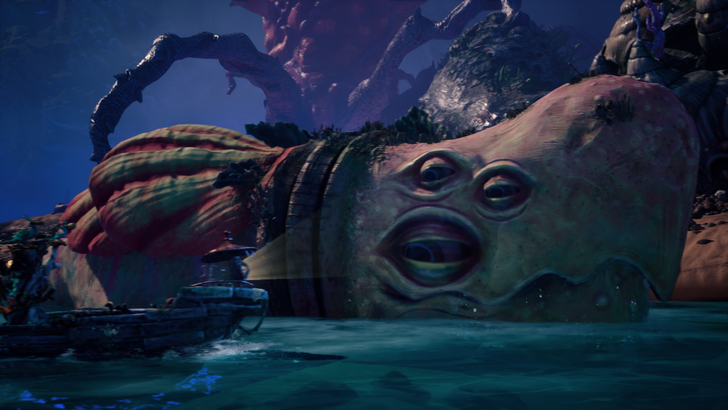
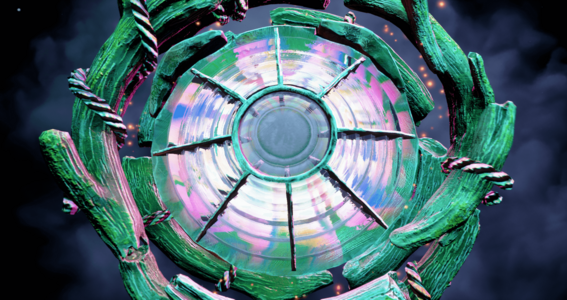
The deeper Keeper goes, the stranger it becomes.The game describes itself as psychedelic. This is where it earns it. The late-game sequences blur the line between dream and nightmare—glowing geometry, pulsing lights, environments that twist like they’re breathing. There’s one sequence that feels like an actual trip (I wouldn’t know, of course), where the visuals melt and reform in impossible patterns.
And then there’s the texture of triggering images. As someone still recovering from a bad bout of trypophobia—thanks, Silent Hill f—some of those final stages nearly sent me running. The holes, the webbing, the organic structures crawling into view… if you’re sensitive to trypophobia or arachnophobia, brace yourself.
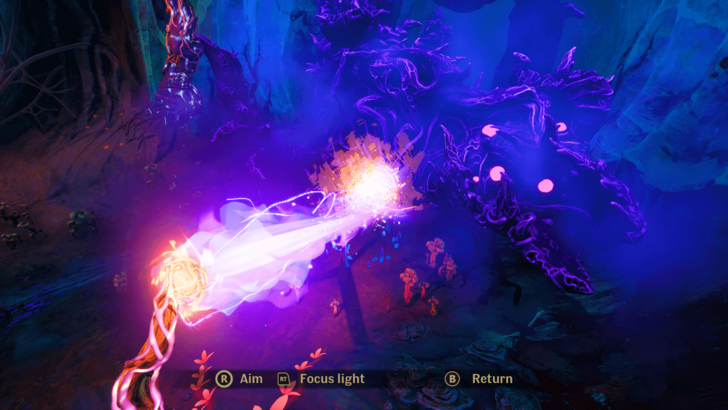
By the time the last evolution arrives (well, arguably the second to the last if you psychoanalyze the ending), your lighthouse has become almost biological. Less structure, more creature—a metaphor for life, or maybe rebirth. You’ll have to decide for yourself.
The storytelling, too, matures here. What started as slow and obscure suddenly feels resolute. You start connecting dots between the short chapters that once felt insignificant and realize how intentional it all was. Even the shortest levels hide emotional weight. There’s one where your lighthouse plants itself into the earth to hold back the Wither’s corruption—part sacrifice, part salvation. Is it a metaphor? A nightmare? A wish? Who knows. But it lingers.
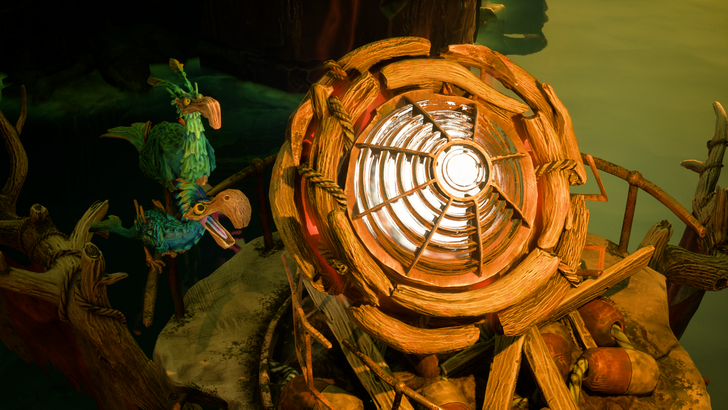
Despite its quiet start, Keeper ends with an emotional crescendo I didn’t expect. For a game with no words, it somehow speaks volumes. I even shed a tear, just one, but that’s one more than most games ever earn from me. It’s the kind of ending that makes you sit there for a moment, controller in hand, letting the last glow fade before you breathe again.
Is Keeper Worth It?
Worth Keeping
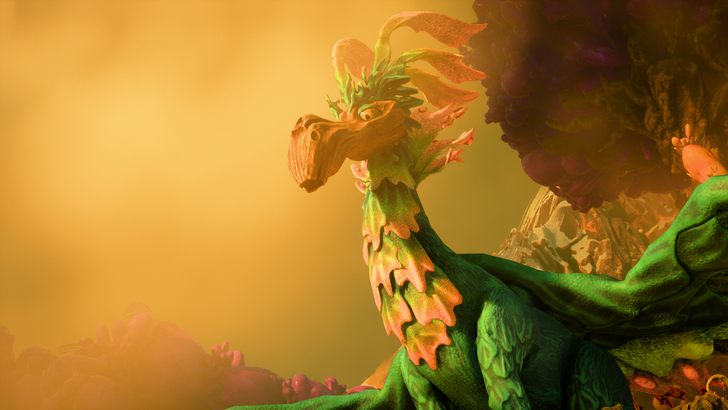
Keeper is the kind of game that doesn’t shout for your attention, it hums for it. It’s weird, slow, and not afraid to let you stumble through its world like a confused newborn tower learning to walk—but that’s exactly what makes it special. For $29.99, what you’re getting isn’t just a game, it’s an experience that unfolds in its own rhythm, a journey that asks you to observe, listen, and feel, rather than to react.
That said, Keeper isn’t for everyone. If you crave fast-paced gameplay, heavy puzzle density, or immediate narrative clarity, you’ll probably bounce off the first few chapters long before it blossoms into something truly memorable. But if you’re patient—if you’re the kind of player who finds meaning in silence, who enjoys meditative exploration and surreal storytelling—then Keeper will quietly lodge itself in your memory.
For its price, its artistic ambition, and the oddly emotional payoff that lingers, Keeper is worth keeping—flaws and all.
| Digital Storefronts | |||||
|---|---|---|---|---|---|
| Steam |
Xbox |
||||
| Price | $29.99 | ||||
Keeper FAQ
What does Keeper’s story actually mean?
Keeper’s story is open to interpretation. Some might see it as a story about rebirth and restoration, others as an allegory for healing and companionship. Every scene, every evolution, carries emotional symbolism that invites you to find your own meaning rather than spelling it out.
Why does the lighthouse evolve throughout the game?
Each evolution mirrors growth—not just physical, but emotional and spiritual. As you cleanse the world of the Wither’s corruption, the lighthouse becomes more connected to life itself, shedding its shell and embracing something living. It’s a quiet reflection on transformation, to heal the world, you first have to change with it.
Game8 Reviews

You may also like...
 |
Bye Sweet Carole Review Action, Adventure, Puzzle, Indie |
 |
LEGO Voyagers Review Adventure, Casual, Co-Op |
 |
Sword of the Sea Review Adventure, Singleplayer |
 |
Eriksholm: The Stolen Dream Review Narrative, Stealth, Adventure, Strategy |
 |
On Your Tail Review Adventure, Indie, RPG, Simulation |
Keeper Product Information
 |
|
| Title | KEEPER |
|---|---|
| Release Date | October 17, 2025 |
| Developer | Double Fine Productions |
| Publisher | Xbox Game Studios |
| Supported Platforms | PC (Steam), Xbox Series X|S |
| Genre | Puzzle, Adventure |
| Number of Players | 1 |
| ESRB Rating | E |
| Official Website | Keeper Website |