
Experience Revachol in all its glory, now in the palm of your hands, with Disco Elysium Mobile! Read our review to see what it did well, what it didn't do well, and if it's worth buying.
Disco Elysium Mobile Review Overview
What is Disco Elysium Mobile?
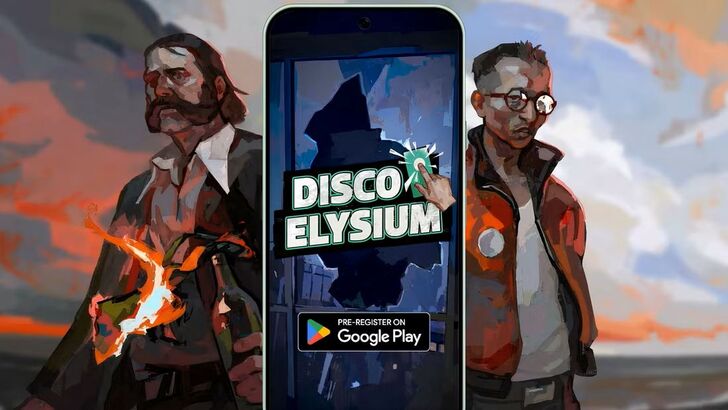
Disco Elysium Mobile is a reimagined mobile adaptation of the acclaimed 2019 narrative RPG Disco Elysium, developed by ZA/UM. It is a retelling of the original story tailored specifically for Android devices. The game offers the first four levels for free, with a one-time purchase unlocking the full experience, advert-free, for $10.
The narrative remains rooted in the city-state of Revachol, specifically the Martinaise district, where the player controls amnesiac detective Harry Du Bois who must solve a murder while reclaiming his identity and wrestling with political upheaval. Though streamlined for mobile, the story preserves the same psychological depth and political layers that defined the original version, including internal dialogue voiced by skills that argue and guide the player from within.
Mobile transforms the original’s isometric exploration into a visual-novel-style experience. Players survey 360° scenes, tap to trigger dialogue, and perform skill checks via virtual dice rolls, just as in the PC version: two six‑sided dice plus skill + attribute versus a difficulty threshold, with automatic failures on snake‑eyes and automatic successes on double sixes. Unlike traditional ports, all voiceover audio return, and scenes redrawn to suit vertical portrait mode and brief sessions aimed at short-attention smartphone players, even described internally as "what audiobooks wish they were" designed to "captivate the TikTok user."
Disco Elysium Mobile features:
⚫︎ Re-imagined for Mobile
⚫︎ Optimized for Short Play Sessions
⚫︎ Visual Novel-like Gameplay
⚫︎ New 360° Scenes
⚫︎ Full Voiceover
⚫︎ Smartphone Controls
⚫︎ First Four Levels are Free
 Google Play Google Play |
|||||
| Price | $9.99 (First Four Levels are Free) |
||||
|---|---|---|---|---|---|
Disco Elysium Mobile Pros & Cons
| Pros | Cons |
|---|---|
 Robert Kurvitz’s Writing is as Brilliant as Ever Accessible and Optimized for Mobile Fully Voiced Dialogue from the Final Cut Robert Kurvitz’s Writing is as Brilliant as Ever Accessible and Optimized for Mobile Fully Voiced Dialogue from the Final Cut |
Segmented Chapters Make it Feel Linear Exploration Feels Less Immersive Overall a Pale Imitation of the Original |
Disco Elysium Mobile Overall Score - 80/100
Disco Elysium Mobile is still the same brilliant writing and broken detective at its core, just wearing a tighter suit that doesn’t always fit. The new format trims away some of the freedom and atmosphere, but the heart of Disco Elysium—the voices, the choices—survives intact. It’s a competent, even thoughtful, adaptation, though one that I wouldn’t recommend choosing over the original, unless all else fails. If you can live with that, it’s a decent way to carry Revachol in your pocket.
Disco Elysium Mobile Story - 8/10
The murder mystery at the center is still a perfect excuse to unravel Revachol’s politics and own mangled sense of self. Every conversation feels sharp and loaded, and the inner chorus of voices remains as compelling and unhinged as ever. I will say, though, that the chapter-based structure chops the story into smaller and less organic chunks. This makes some moments feel like scenes on rails. It’s still an exceptional story, one that still hurts in my revisit, just one that breathes a little less freely on a smaller screen.
Disco Elysium Mobile Gameplay - 8/10
Skill checks and dice rolls are still the stars here in Disco Elysium Mobile, and it still has those tense and hilarious moments where fate decides if you fall face-first into failure. Despite my grievances with the medium, the touch controls here are smooth enough to make swiping through Revachol intuitive. What I'm less fond of are the compromises that come with the adaptation, most notably its linearity, which could possibly lead to a softlock.
Disco Elysium Mobile Visuals - 7/10
It’s hard not to compare the original to its adaptation. The new art direction does its job, with clean portraits and scenes tailored for the new medium, and some character designs look good. Still, it’s hard not to miss the neo-expressionist style of Aleksander Rostov’s original work, which gave Revachol its grimy soul. The mobile version looks polished and functional, but it feels more curated. It’s good, just not the kind of good that lingers in your memory the way the original art did.
Disco Elysium Mobile Audio - 10/10
Disco Elysium Mobile lifts its audio straight from The Final Cut, and that’s the best decision ZA/UM could’ve made here. Lenval Brown’s narration is still magnetic, and every character voice—yes, even Cuno and Cunoesse—hits exactly as it should. The soundtrack, too, remains haunting and hypnotic as ever. Whirling-in-Rags and the Dicemaker’s theme still live rent-free in my playlists and my heart, and hearing them here still feels amazing. It’s the one area where nothing feels compromised, and thank god for that.
Disco Elysium Mobile Value for Money - 7/10
$10 for a streamlined version of one of the best-written games ever isn’t a bad deal, especially when the first four levels are free to try. It’s an approachable entry point for players who can’t dive into the full-fat Final Cut, even if that version remains the gold standard. The value here depends on what you’re after—the convenience and portability, or the uncompromised experience. If you fall in the former camp, this is a respectable way to carry Revachol in your pocket without breaking the bank.
Disco Elysium Mobile Review: Revachol Reduced
Disco Elysium is my favorite game of all time. I stumbled into it a few months after the Final Cut launched in 2021, back when the pandemic was still in full swing and loneliness was anyone’s only friend in the confines of their home. I bought it on a whim, went in blind, not knowing the flood I was opening. What I found was a world that spoke to me in fractured ideals and the cruel hilarity of existing. At a time when days bled into one another and the world felt impossibly distant, Disco Elysium burrowed into my psyche. For weeks, I was living Revachol’s hangover, sharing its ache for meaning.
Years later, I’ve been chasing that same high like a detective with no badge and a gut full of cheap spirits. Citizen Sleeper 2: Starward Vector and Baldur’s Gate 3 came close, but nothing else really has. ZA/UM decided, though, that they could shrink Disco Elysium into your pocket. My curiosity elbowed its way past skepticism, especially when they said they’d be adapting the game in a way that would "captivate the TikTok user" instead of directly porting it. How could the crumbling grandeur of Martinaise breathe on a screen for people with small attention spans?
Disco Elysium Mobile is, in many ways, a decent adaptation. It works, mostly. It brings Revachol to your commute and lets you unspool Kim Kitsuragi’s dry wit while waiting for coffee. But it’s also a pale imitation, a facsimile of something too big, too intricate, to compress without losing something essential. The writing’s still sharp, the choices still bite, but the experience feels like looking at a mural through a keyhole. It’s a decent product, for the most part, but that’s the tragedy of it. It’s a game that shrinks an entire world in your palm, and in the process, it feels just a little less alive.
Before everything else, I want to acknowledge that, yes, I’m fully aware of ZA/UM’s messy history with Robert Kurvitz, Disco Elysium's creator, and the fallout that’s been hanging over the studio since. If you’ve followed the game at all, you probably know the discourse, and if you care about the politics baked into the game, you have every right to feel strongly about it. Those conversations matter, but this review isn’t the place for them. Whatever opinions I have on the subject, they will not be coloring what follows.
What I will say is this: I bought the game myself and blitzed through it front to back after its rather early launch—three hours ahead of schedule, apparently—just to see how it stacks up. So, when you read my thoughts on Disco Elysium Mobile, know that they’re grounded in the experience of actually playing it. As much as possible, this is about the adaptation and how well it translates one of the greatest RPGs ever made to a much smaller screen.
Look How They Massacred My Boy!
Disco Elysium Mobile begins the same way the original does: in a black ocean of nothing, with a voice in your head dragging you back toward the surface of consciousness. You wake up hungover, naked, and clueless in a rented room above the cafeteria in Revachol, a city barely holding together under the weight of history and failure. You’re a detective with no name, no memory, and a case waiting for you outside the door, a body swinging from a tree behind the building. From there, the story spirals outward into a murder investigation that is never just about the murder. It’s about politics, class, identity, love, and the very meaning of existence, filtered through your broken psyche and the voices squatting in your skull. As the game’s tagline says, you decide what kind of person you are, if that even matters anymore.
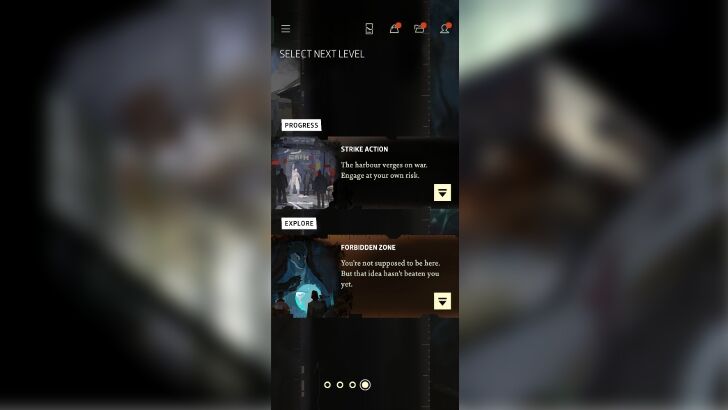
The core of Disco Elysium’s story remains intact here. The writing is all present with fully-voiced dialogue from the Final Cut. The difference is in how you experience it. Gone is the isometric sprawl of Revachol that let you wander at your own pace, to decide whether to chase leads or interrogate locals or spend two hours arguing about moralism with your Inland Empire. On Mobile, the story has been refitted into something closer to a visual novel with point-and-click elements. The open days of the original are now divided into chapters, and the areas you once roamed freely are broken into levels, which you can access at anytime during the chapter.
Do take note, however, that this still creates a more linear experience, and I've seen players get softlocked because of it. It's not hard to see why. Some levels hinge on passing a specific skill check, and if you fail it, that check gets locked. Back then, you could just exit the area and read some books or talk to other characters for EXP. Here, though, if you don’t have enough points to boost the necessary skill, you’re effectively stuck with no way forward. I didn’t hit that wall myself—RNG and I were on speaking terms, apparently—but it’s worth flagging. Hopefully, ZA/UM patches this soon because it feels like a pretty glaring oversight on their part.
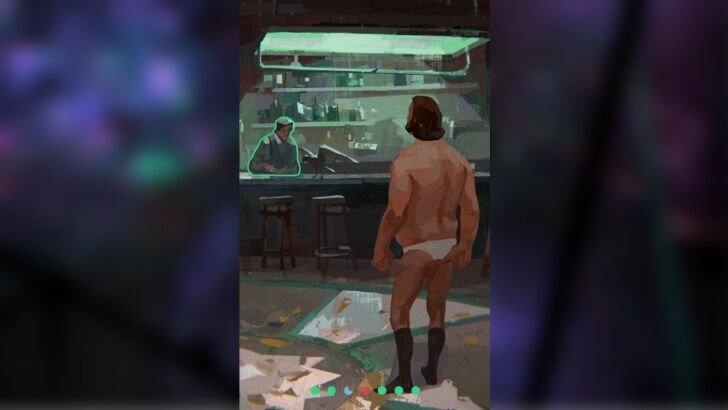
Nevertheless, these levels function as bite-sized scenes you hop between. Here, you tap into points of interests to investigate and characters to speak with. If you miss something, it sits in a menu called Loose Ends, waiting for you to circle back. It’s a safety net for players who might otherwise get lost, but it also trims away that sense of being untethered in a decaying city. The developers weren’t kidding when they said this is a sizable Disco Elysium for TikTok users, as so much of what was once discovered through meandering exploration has been sliced into self-contained scenarios.
Take the Kineema calls, for example. In the original, you could stand next to Kim’s car and make every call in one go regardless of what day it is. Here, each call becomes its own Loose End, a separate event you trigger from a menu. So after your call with Sylvie, you don’t get to return to the operator and dial the 41st precinct. You have to exit, tap the Loose End, and start a new scene. It sounds like a minor complaint, but it does break the illusion a little. The original gave you the freedom of existence; but here, it’s a series of boxes to tick.
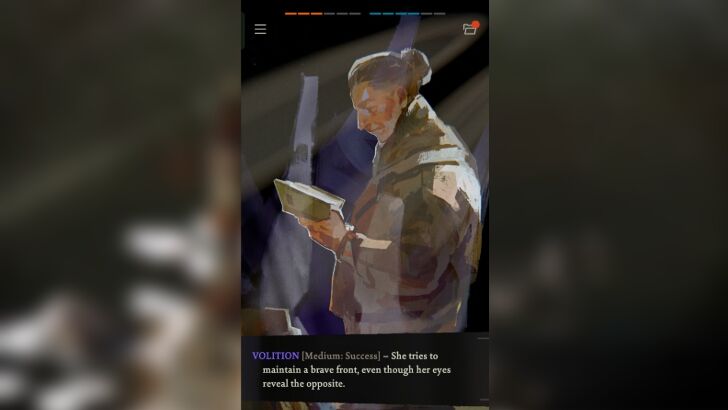
The pacing suffers as a result because of this structure. In my first hour, I accidentally jumped straight from the Whirling-in-Rags to the crime scene without ever seeing what’s directly outside of the establishment. The game allowed me to skip entire beats because the chapter-level system prioritizes progression over your presence in the game’s world. For a returning player like me, that was jarring. It felt like I was fast-forwarding through a highlight reel, which was also the reason why my playthrough only lasted 15 hours.
Granted, I blitzed through the game for this review. You could revisit certain levels to explore side segments, like searching for the Working-Class Woman's husband or investigating the curse of the doomed commercial area. But these moments feel detached from Revachol itself rather than being things you stumble upon during a regular playthrough.
Stitched Together by Stubborn Souls

Which is a shame, because the city of Revachol deserves room to breathe. In the original, it’s a corpse you keep turning over, trying to piece together the story of its death. Every street, every graffiti-scaled wall, feels like testimony to something broken yet stubbornly alive. On Mobile, that sense of space shrinks. You don’t feel the weight of crossing from the Whirling-in-Rags to the frozen boardwalk or trudging through the rain toward Martinaise’s coastline. You still visit these places, but the connective tissue of simply existing in Revachol is gone. It makes the city a series of vignettes.
That’s not to say that the soul of the place is entirely missing. Revachol is still stitched together by characters who are too stubborn, too sad, and too human to forget. Cuno, spitting obscenities at the edge of childhood. Evrart, grinning like a man who has read your obituary and still negotiating the terms. Joyce, ever so distant as she explains how the world grinds men like you into paste. Kim Kitsuragi, the best friend you never knew you had. They’re all here, unchanged, carrying their philosophies like concealed weapons. Talking to them still feels as if pushing through layers of varnish to find the raw wood beneath, only now it happens in controlled bursts.
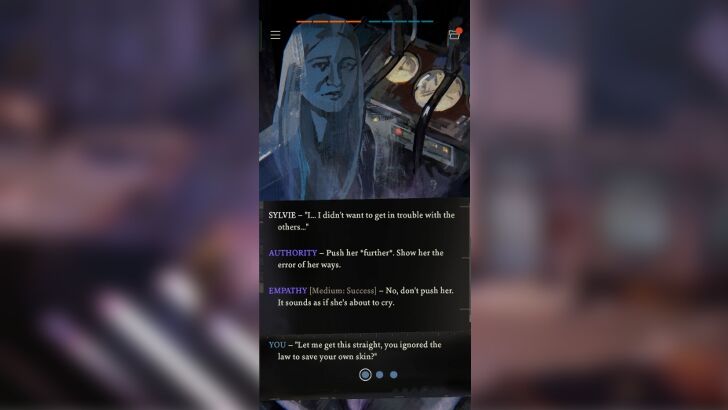
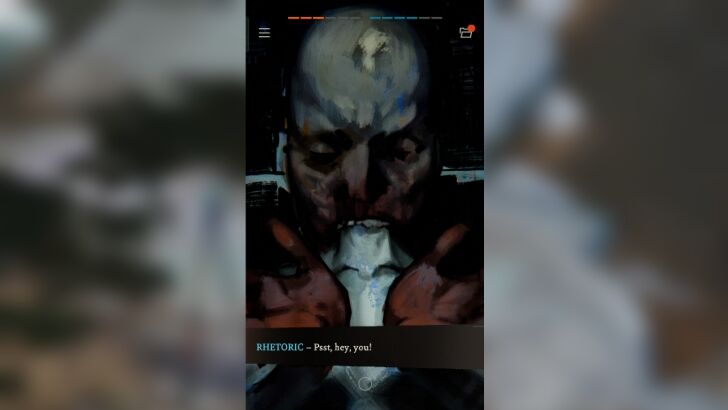
But as good as these external voices are, the real chorus is inside your own head. Your thoughts return here in full force, and it’s still one of the best systems ever put in a game. Every skill you invest in—Shivers, Volition, Drama—becomes a character, a loudmouth with an agenda, chiming in during conversations. Sometimes they’re helpful. Sometimes they’re deranged. Often they’re both in the same breath.
Take Shivers, for example, who whispers urban poetry in your ear, as it makes the wind sound like a god. Or Electrochemistry, the devil on your shoulder suggesting that the case—and life itself—might be easier with a little more speed in your bloodstream. These voices argue with each other, with you, with the world. And the mobile version keeps them intact, enveloping the portrait of the event happening on your screen.
Of Thoughts and Dice Rolls
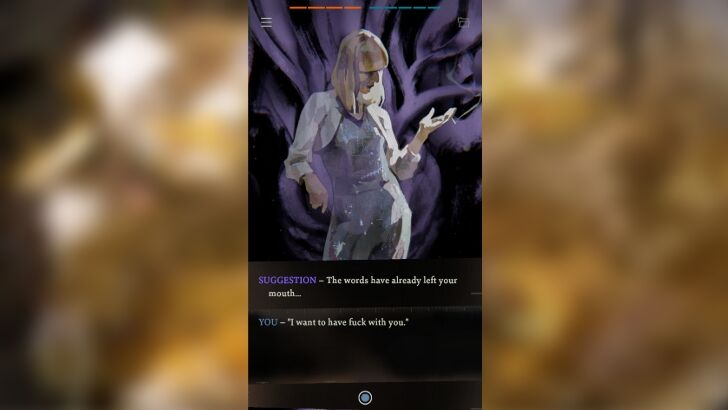
Of course, those voices in your head don’t just argue for the sake of flavor. They’re still the backbone of how Disco Elysium Mobile plays. The game’s loop revolves around skill checks, those little moments where probability decides whether you nail the perfect line or humiliate yourself in front of strangers. You’ve got four primary attributes (Intellect, Psyche, Physique, and Motorics), each broken down into six individual skills that behave like personalities in your brain. These skills determine how you see the world, but they also dictate your chances of success when you try to do anything remotely difficult.
Every significant action runs through a check against your attributes. It’s all calculated in the background. Your skill level versus the difficulty threshold, modified by the quirks you’ve accumulated and the drug or clothing bonus. Then the dice come in—two six-sided cubes clatter invisibly but just as cruel as ever. Snake eyes mean an automatic fail, no matter how good your odds are; double sixes are a success even for the lowest of odds.
Except for the fact that you can no longer assign points to your attribute at the beginning of the game, as you’re basically locked into just three choices, I didn’t notice anything mechanically different about these systems. They’re still the same coin-flip moments that have defined Disco Elysium. If anything, the stakes feel sharper now because the option to save-scum is gone. I respect the choice; just keep in mind not to do anything that would hurt Kim in your playthrough, as that would be sacrilegious.
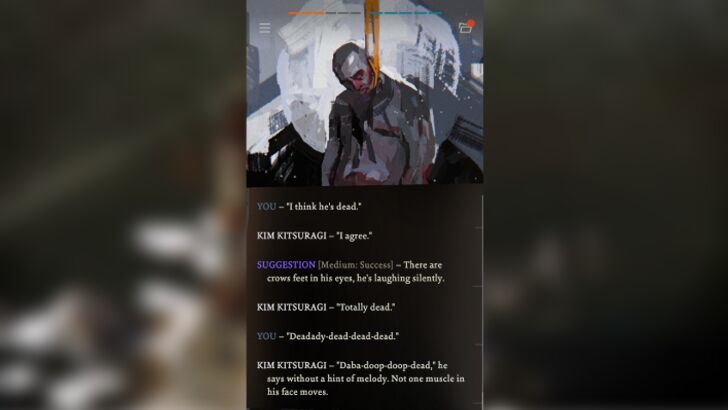
As mentioned above, what has changed is how you move through all this. The game is now a point-and-click adventure optimized for touch, so each level is a static 2D scene dotted with points of interest. Dialogue, as in the original, dominates the experience, and the controls keep it simple. You swipe up or tap to advance text, swipe down to revisit earlier lines, swipe left or right to choose responses. It’s streamlined to the point where you can play with one hand, which sounds thematically appropriate for a game about barely functioning people.
Credit where it’s due: these controls are fine for what it is. They’re smooth and polished enough that I never once fought with the interface. Even the little gimmick of swiping to clear visual debris, which could feel a bit tacked on, didn’t bother me in practice. For all my gripes about how this structure makes Revachol feel compartmentalized, the control scheme feels like the right call for mobile. It fits the format, it doesn’t get in your way, and it adapts something as complex as Disco Elysium into on-the-go play.
The Ghost of Revachol

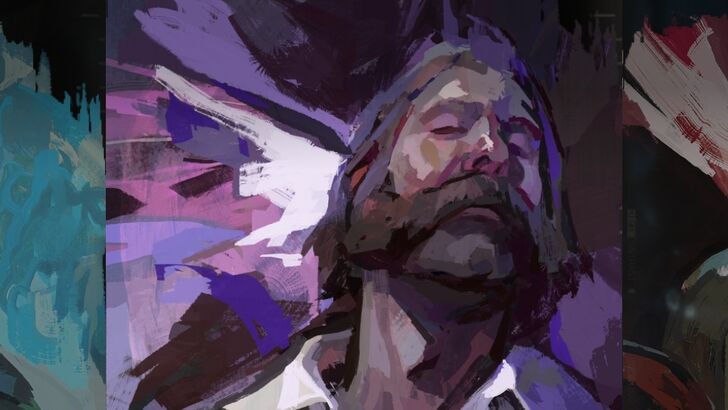
This compartmentalization is evident, too, in the game’s art. Disco Elysium was the game that made me fall in love with Aleksander Rostov’s art. His brushwork and colors decorated Revachol brick by brick. His style felt like oil paintings left out in the rain: soft-edged and carrying the weight of decay. Combined with Robert Kurvitz’s words, Disco Elysium turned into a world collapsing in slow motion. I still follow Rostov on every platform I can to occasionally scroll through his posts when I want to remember what melancholy or joy looks like when someone gives it shape. He made Disco Elysium’s aesthetic inseparable from the experience of playing it.
For the mobile adaptation, ZA/UM went in a different direction. They reworked every scene with new illustrations and portraits tailored for the condensed format. They built new art for pretty much everything. It’s an impressive amount of work, and it deserves credit for being more than a lazy crop-and-scale.
Still, for someone who fell head over heels for Aleksander Rostov’s original art, it’s hard not to feel his absence here. To be clear, the new art isn’t bad; whoever helmed the visual direction for this adaptation put real thought into making these environments and characters pop on a phone screen.
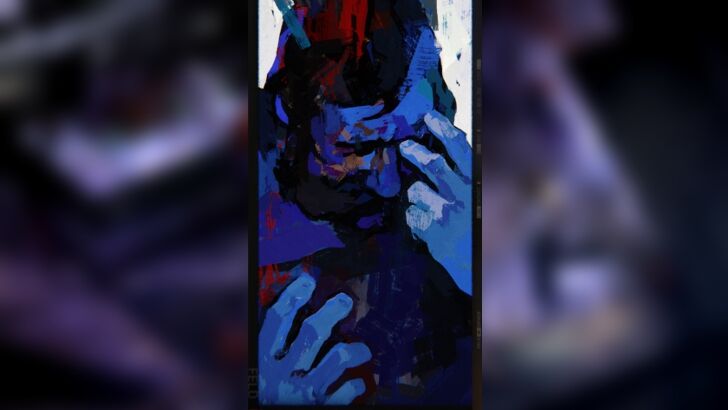
I actually like many of the redesigned portraits, which are expressive in their own way. Even the Expression—the frozen rictus the protagonist wears on his face—looks good here. It's still a mask stretched across a tired soul, which is exactly what it should be. These portraits look good, and the background art does a commendable job of giving each level some texture and atmosphere.
However, Rostov’s art is uniquely his, and anything that tries to emulate it is destined to feel like an echo. The mobile version’s art, though polished, fits the format, yes, but lacks the same neo-expressionism that made the city feel alive. It sells the mood, keeps the dialogue-heavy experience from feeling static, but it also reminds you, persistently, that this is an adaptation. A facsimile. A washed-up version of the original. You can admire it for what it is while still missing what it isn’t, and that ache never really goes away.
Is Disco Elysium Mobile Worth It?
It’s Competent; However…

Truth be told, I don’t see much reason to play Disco Elysium Mobile if you’ve already experienced The Final Cut on PC or console, unless, of course, curiosity gnaws at you the way it did me. It is very much a TikTok-era reimagining—bite-sized, segmented, optimized for quick sessions.
But I can’t fault ZA/UM for what they’ve done here. Even after everything, I still respect the attempt. They’ve succeeded in making Disco Elysium accessible to a new audience: players who don’t have the time or hardware for a 40-hour dive into Revachol’s gutter. In an age where nearly everyone owns a phone but not everyone owns a gaming PC, that actually matters. It’s a considered redesign for a different way of playing games, and I like that it sticks close on those terms.
Would I recommend it over The Final Cut? No. Not even close. If you have the means to play the original version, that’s still the best way to experience Disco Elysium. It’s worth every cent of its $40 price tag. Mobile, meanwhile, runs for $10 for the full experience, which is fair, I guess. If you’re curious, though, you can download the game and try its first four levels for free. These translate to roughly an hour of play that covers the Whirling-in-Rags opening act and a few Loose Ends like the Kineema calls. Perhaps that’s enough to decide if this streamlined version is your thing.
I’m glad I gave it a shot, if only because it let me revisit a city I’ve missed for years. Disco Elysium Mobile may not recapture the high of my first journey through Revachol, but it’s a different thing—a smaller, stranger shiver—and that shiver is enough to remind you of what was once there.
| Google Play |
|||||
| Price | $9.99 (First Four Levels are Free) |
||||
|---|---|---|---|---|---|
Disco Elysium Mobile FAQ
Is Disco Elysium Mobile Free?
You can play the first four levels of Disco Elysium Mobile's first chapter for free. To unlock the rest of the game, you'd have to pay $9.99.
Game8 Reviews

Disco Elysium Mobile Similar Games


Disco Elysium Mobile Product Information
|
|
| Title | DISCO ELYSIUM MOBILE |
|---|---|
| Release Date | August 5, 2025 |
| Developer | ZA/UM |
| Publisher | ZA/UM |
| Supported Platforms | Mobile (Android) |
| Genre | Narrative-Driven, RPG |
| Number of Players | Single-Player (1) |
| ESRB Rating | ESRB Mature 17+ |
| Official Website | Disco Elysium Mobile Website |