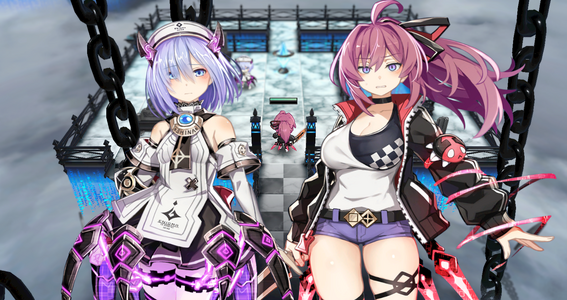

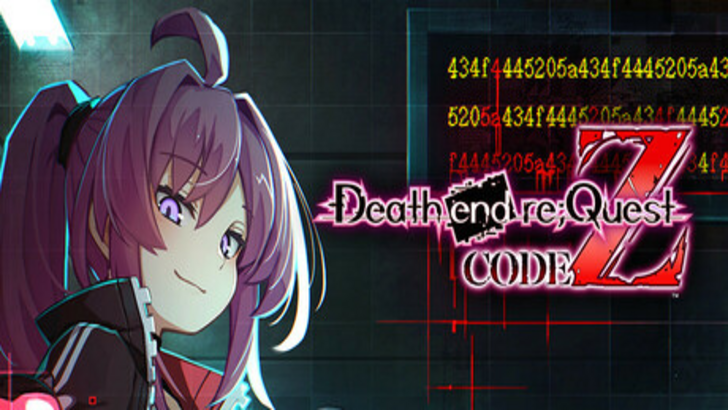
Death end re;Quest: Code Z is a dungeon-crawling RPG developed by Idea Factory and Compile Heart, and published by Idea Factory International. Read our review to see what it did well, what it didn't do well, and if it's worth buying.
Death end re;Quest: Code Z Review Overview
What is Death end re;Quest: Code Z?
Death end re;Quest: Code Z is a dungeon-crawling RPG with roguelike elements, developed by Idea Factory and Compile Heart and published by Idea Factory International for PS5, PS4, and PC. The story centers on Sayaka Hiwatari, who finds herself in a parallel universe known as World DE-1.5, a realm shaped by an AI called Iris. As she journeys through this unstable world, Sayaka encounters both familiar faces and new dangers, where the line between friend and foe grows increasingly blurred amidst the rising chaos.
Death end re;Quest: Code Z features:
⚫︎ RPG
⚫︎ Roguelike
⚫︎ Anime
⚫︎ Visual Novel Elements
⚫︎ Dungeon Crawler
| Digital Storefronts | |||||
|---|---|---|---|---|---|
 Steam Steam Wishlist Only |
 PSN PSN |
||||
| Price | $49.99 | ||||
Death end re;Quest Code Z Pros & Cons

| Pros | Cons |
|---|---|
 The Game is Almost Entirely Voice-Acted Gorgeous Character Arts and Cute Sprite Designs The Game is Almost Entirely Voice-Acted Gorgeous Character Arts and Cute Sprite Designs |
Lackluster Dungeon Design Frustrating Gameplay Really Holds it Back Narrative Starts Off Interesting but Quickly Loses Focus |
Death end re;Quest: Code Z Overall Score - 52/100
Death end re;Quest: Code Z has some promising ideas on paper, but the overall execution ultimately falls flat. The gameplay aims to capture the charm of Pokémon Mystery Dungeon, yet clunky controls and awkward design choices strip away most of the fun. The story, despite coming from talented writers, quickly loses focus and is often dragged down by outright poor writing. In the end, even devoted fans of the series will struggle to justify the experience, as polished character art and strong voice acting simply aren’t enough to save such a disappointing package.
Death end re;Quest: Code Z Story - 5/10
Death End Re;Quest: Code Z comes with strong names attached—Makoto Kedouin, the writer of Corpse Party, and Kei Nanameda as scenario supervisor. Naturally, that sets expectations for the same kind of unsettling violence and chilling atmosphere as the previous games. And to its credit, the game does start off intriguing. Unfortunately, that promise quickly unravels. The pacing is erratic, with padded filler sequences that drag the story down, while weak character progression makes it hard to stay invested. What begins as a gripping premise loses focus far too quickly.
Death end re;Quest: Code Z Gameplay - 3/10
Death End Re;Quest: Code Z borrows its core gameplay structure from Pokémon Mystery Dungeon, and at first glance, that feels like a promising direction. Unfortunately, it’s just not fun. The controls are clunky and unintuitive, making even basic movement a chore. Systems that should complement each other instead clash, creating unnecessary difficulty. Worse, several design choices it, making the roguelike dungeon-crawling feel more tedious than rewarding. The game clearly has ideas worth exploring, but they’re buried under awkward mechanics and frustrating design, leaving little reason to push through.
Death end re;Quest: Code Z Visuals - 7/10
One of Death End Re;Quest: Code Z’s strongest points lies in its visuals. The artwork is gorgeous, and the chibi character designs give each party member a distinct personality that stands out. Unfortunately, that strength doesn’t carry over to the dungeon crawling itself. The environments and monsters feel uninspired, making progression feel repetitive and dull. The UI, while functional and easy to navigate, is bare-bones and lacks any flair.
Death end re;Quest: Code Z Audio - 7/10
If there’s one thing Code Z nails incredibly well, it’s the voice acting. Almost every line in the game is fully voiced, and the performances are genuinely great—they kept me engaged even when the story wasn’t. The music has its highlights too. The opening, “Over My Dead Copy,” is a catchy something I’d listen to outside the game. And whenever Sayaka enters her Vanquish Form, the accompanying theme is genuinely great. But beyond those moments, most of the soundtrack just kind of slipped past me, fading into the background without sticking.
Death end re;Quest: Code Z Value for Money - 4/10
At $50, Death End re;Quest: Code Z is a tough sell. Its weak gameplay and poorly written story make it hard to justify the asking price. The only elements that stand out are the strong character art direction and solid voice acting—but those alone aren’t nearly enough to warrant your purchase.
Death end re;Quest: Code Z Review: As Convoluted as Its Title

Death end re;Quest: Code Z might just take the crown for one of the most unusual video game titles out there. And that’s not entirely a diss — the name actually has some meaning tied to the story and gameplay — but it’s undeniably convoluted, much like the game itself.
For anyone unfamiliar, Death end re;Quest: Code Z is a spin-off of the Death end re;Quest series, which first launched in Japan back in 2018 on the PS4, followed by Death end re;Quest 2 in 2020. Personally, I’ll admit I’m not the most hardcore fan — I’ve only played a bit of 2, but I did dive into walkthroughs because the story always fascinated me. Unlike Compile Heart and Idea Factory’s more lighthearted titles like Hyperdimension Neptunia, this series stood out with its darker, more twisted tone.
At its core, Death end re;Quest is a brutal RPG where a group of young characters must navigate a world corrupted by bugs, where death lurks at every corner. It’s violent, gory, full of despair, and penned by the writer of Corpse Party. That combination gave the earlier entries a surprisingly strong hook, with fans praising the unique premise and the bleak but compelling storytelling.
That’s what had me interested going into Code Z. Unfortunately, though, while it does take the series in a new direction in terms of both gameplay and story, I don’t think those changes land in the right way.
It Should Have Stayed Turn-Based
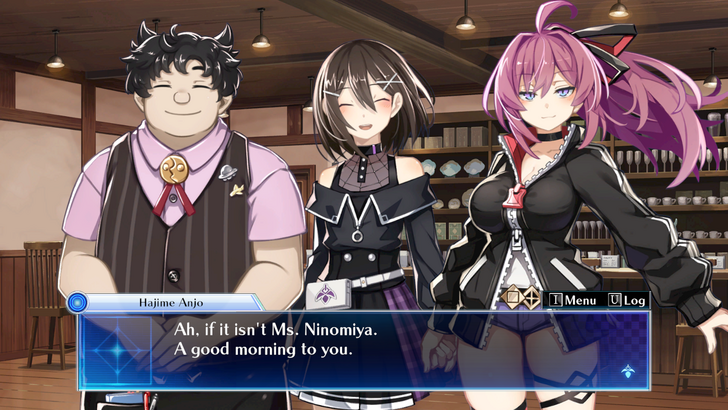
The core gameplay loop of Death end re;Quest: Code Z blends visual novel storytelling with roguelike dungeon crawling — a notable departure from the turn-based combat of previous entries. The comparison most players will draw is Pokémon Mystery Dungeon, with its grid-based, turn-by-turn structure, where each move the player makes is mirrored by enemy actions.
You play as Sayaka, balancing everyday life in town with excursions into the Strain Area. Between dungeon runs, you can stock up on supplies at home, enhance weapons at the Night Owl Café, or check in on friends to advance side stories. Once inside the dungeons, the objective is straightforward: descend floor by floor, gather items, manage resources, and ultimately defeat the boss at the bottom to rescue companions and progress the story.
The visual novel segments largely serve as narrative glue. While they don’t offer meaningful branching choices, they provide exposition and context, particularly through interactions with the Ludens adjusting to their new lives. These sequences are serviceable — not groundbreaking, but effective enough to support the plot.
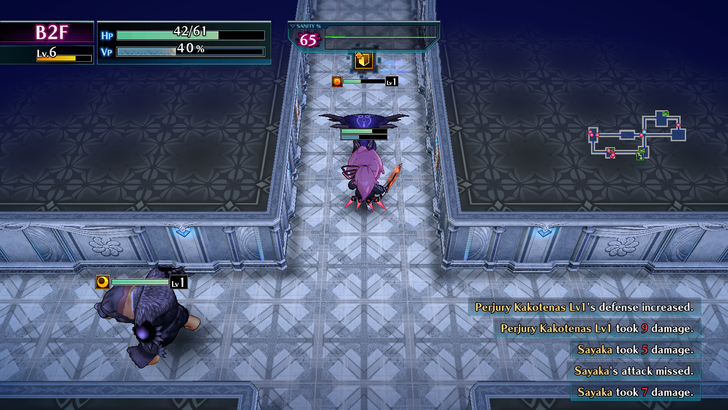
The roguelike portion, however, is where the game falters. The first issue is controls. On PC especially, inputs feel sluggish and imprecise, with noticeable delay. Keyboard play exacerbates this, as the tile-based system forces constant character rotation, and the camera doesn’t adjust controls intuitively when the angle shifts. The result is a clunky, jarring experience that undermines the rhythm of exploration and combat.
Dungeon design fares no better. Environments are repetitive, with little visual or mechanical variety across runs. While equipment and consumables can alter strategy — offering temporary buffs, debuffs, or mobility boosts — the core loop quickly becomes monotonous. Worse, the default difficulty setting undermines roguelike tension: dying doesn’t result in the loss of items, so the risk-reward balance feels neutered. Raising the difficulty restores this mechanic, but doesn’t fix the underlying lack of creativity in dungeon layouts.
The sanity system adds frustration rather than tension. As Sayaka’s sanity decreases, the screen distorts, visibility worsens, and she can inflict damage on herself. In theory, this should increase stakes; in practice, it’s heavily reliant on random item drops. Lacking a way to reliably restore sanity often results in irritation rather than strategic pressure.
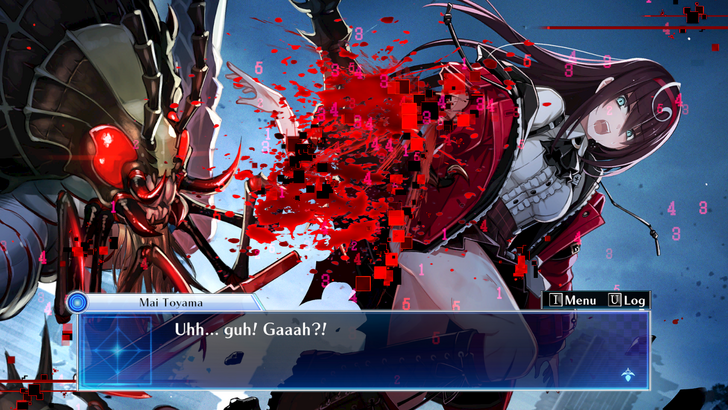
Most puzzling of all is the integration of “Death Ends.” These elaborate death scenes, complete with beautifully drawn CGs, would make sense as optional narrative flourishes. Instead, they’re tied directly to progression, requiring players to intentionally die in specific ways in order to unlock upgrades. This design choice forces needless repetition and actively encourages players to stall or sabotage their own progress.
There are occasional highlights — such as the Vanquish Form, which grants a temporary power spike and injects some excitement into combat — but these moments are fleeting. Ultimately, Death end re;Quest: Code Z struggles to reconcile its ambition with execution. The roguelike systems feel underdeveloped, the controls are cumbersome, and the progression loop is padded by frustrating mechanics rather than engaging design.
What remains is a game caught between genres, where the story presentation is adequate but the core dungeon-crawling experience is tedious, repetitive, and far from satisfying.
A Noticable and Harsh Quality Dip in Storytelling
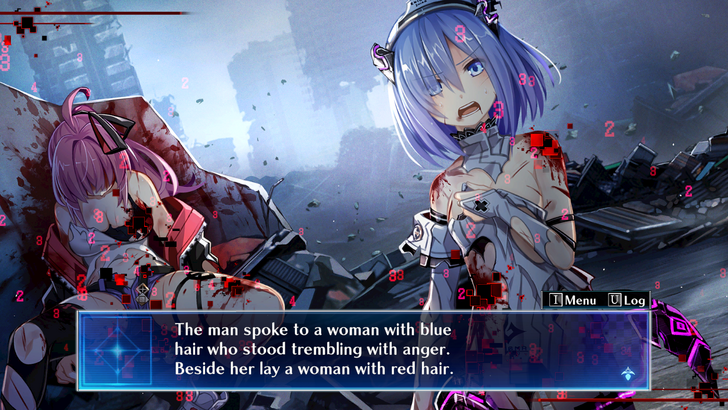
Unfortunately, the narrative of Death end re;Quest: Code Z is just as uneven as its gameplay. The opening chapters are gripping, filled with intrigue and high-stakes drama that had me fully invested. The game begins with antagonist Shina Ninomiya brutally injured, while the new protagonist, Sayaka Hiwatari, is thrust into a rewritten timeline. In this timeline, Iris is born into World DE-1, a world that mirrors Earth in the 2000s. With her goodwill restored, Iris creates a copy of this world — World DE-1.5 — a seemingly utopian reality where past conflicts have given way to peace. But stability doesn’t last: a mysterious figure emerges, leading doppelgängers of the world’s former heroes, setting the stage for Sayaka’s journey into a new phase of chaos.
Conceptually, this setup is excellent. The story teases big mysteries, blends meta-narrative twists with player involvement (at first you, the player, are directly acknowledged as a character only Sayaka can perceive), and plays with themes of identity and distorted worlds. For the first few hours, it’s genuinely compelling — constantly leaving you guessing and eager for answers.
Unfortunately, that promise quickly unravels. After the introduction and early tutorial, the pacing becomes erratic. The story rushes through major developments, like Sayaka and Shino’s decision to stay together, while simultaneously dragging on inconsequential sequences such as repetitive trips around town. The balance between character-building and narrative momentum is poorly handled, and the result is a storyline that feels both rushed and bloated in all the wrong places.
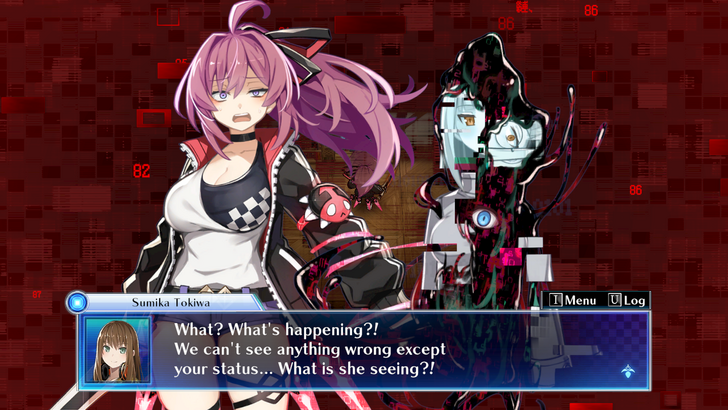
Sayaka herself also suffers from the writing. Rather than being given the time to grow into a complex protagonist, she’s overshadowed by the larger mystery. She often feels less like a character and more like a narrative vessel — someone present to move the plot forward rather than a fully realized lead. This lack of development makes it difficult to connect with her, and as the story progresses, her role feels increasingly diminished.
The uneven quality of the writing only adds to the frustration. At times, the narrative feels as though it was written by entirely different teams — the strong, suspenseful opening gives way to inconsistent dialogue, poorly paced scenes, and exposition that drags without adding much depth. While the visual novel format could have been an opportunity for rich character exploration, many conversations end up meandering rather than meaningful.
Not to mention, the worst aspect of Code Z’s writing is how convoluted it becomes. What begins as a promising, tightly framed mystery quickly spirals into overcomplication. Plot threads pile up, character motivations blur, and the narrative loses focus under the weight of its own twists. Instead of building intrigue, the confusion erodes the emotional impact, making it difficult to stay invested. By the later chapters, the story feels less like a carefully woven puzzle and more like a tangle of half-formed ideas straining to hold together.
By the time the ending arrives, the narrative has long since lost its footing. Without giving away spoilers, it’s safe to say the conclusion is disappointing and unsatisfying, leaving the impression of a rushed, messy draft rather than a carefully crafted finale. While the game clearly teases potential sequels, one can only hope that future entries take more time to refine their storytelling, because Code Z’s plot feels disjointed, underdeveloped, and ultimately wasted on what began as a fascinating premise.
The Story Isn’t Impressive, but the Character Design and Voice Acting Are
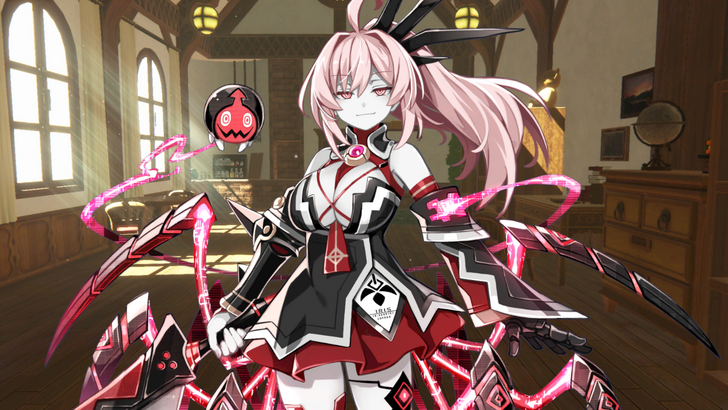
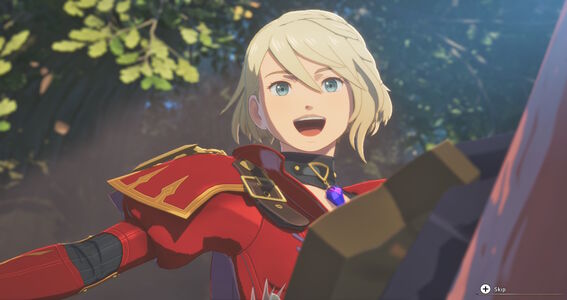
What carried me through Death end re;Quest: Code Z’s convoluted and story was its voice acting and character designs. The sprite work and CG is genuinely impressive—crisp, expressive, and consistently well-drawn—with standout designs across the cast. Sayaka’s look in particular stands out, but supporting characters like Shino Nonomiya, Celica, Kaede Hizumi, and Chloe are equally distinct and memorable.
The voice acting, however, is where the game truly shines. Sayaka is voiced by Yoshino Aoyama—best known as Bocchi from Bocchi the Rock!—and she delivers a fantastic performance. Even though Sayaka, as a character feels somewhat bland, Aoyama’s emotional range breathes life into her, especially during the gruesome “Death End” scenes, where her delivery amplifies their brutality. The rest of the cast also turns in strong performances, elevating characters who otherwise lack much development.
It’s a shame the storytelling itself isn’t good, because the acting and character art deserve a far stronger foundation. Honestly, this game feels like it would have worked better as an anime.
Is Death end re;Quest: Code Z Worth It?
Not Recommended for Both Fans and Newcomers
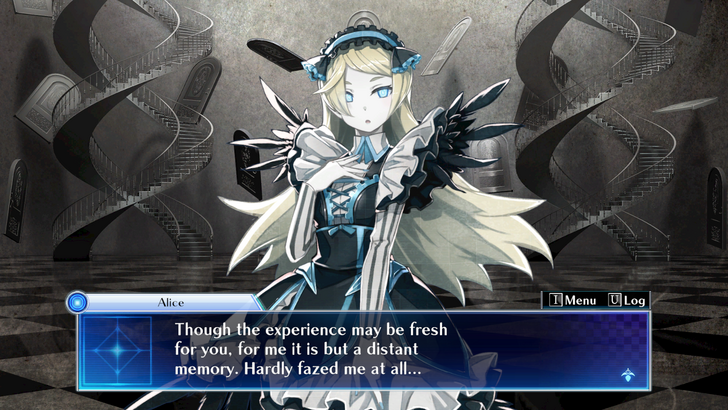
Unfortunately, I can’t recommend Death End Re;Quest: Code Z to either newcomers or long-time fans of the series. While there are a few decent elements here, they’re not enough to justify the steep $50 price tag. Especially with how the gameplay is simply too clunky and frustrating to overlook. If you’re a diehard fan, the only reason to consider it is at a deep discount—closer to $15 or less.
| Digital Storefronts | |||||
|---|---|---|---|---|---|
| Steam Wishlist Only |
PSN |
||||
| Price | $49.99 | ||||
Death end re;Quest: Code Z FAQ
Is Death end re;Quest: Code Z a Sequel?
Death end re;Quest: Code Z, is a spin-off sequel to the 2018 Death end re;Quest and its 2020 follow-up Death end re;Quest 2.
Is Death End re;quest code z Coming to Switch?
Idea Factory has officially announced that Death end re;Quest: Code Z will no longer be released on Nintendo Switch in the West. According to the publisher, the decision was made because the game did not comply with Nintendo’s guidelines.
Game8 Reviews

You may also like...




Death end re;Quest: Code Z Product Information
 |
|
| Title | Death end re;Quest: Code Z |
|---|---|
| Release Date | 2025 (PC), May 13, 2025 (PS5) |
| Developer | Idea Factory, Compile Heart |
| Publisher | Idea Factory International, Inc. |
| Supported Platforms | PS4, PS5, PC (Steam) |
| Genre | RPG, Roguelike |
| Number of Players | 1 |
| ESRB Rating | M |
| Official Website | Death end re;Quest: Code Z Website |