
| Anno 117: Pax Romana | |||
|---|---|---|---|
| Release Date | Gameplay & Story | Pre-Order & DLC | Review |
Anno 117: Pax Romana Review Overview
What is Anno 117: Pax Romana?
Anno 117: Pax Romana is the latest city-builder from Ubisoft and the newest entry in the legendary Anno series. This time set in the peaceful period of Rome's multi-generational history, Pax Romana sees players expanding the empire to reclaimed or new lands as its newest governor.
Anno 117: Pax Romana features:
⚫︎ 2 playable provinces: Latium and Albion
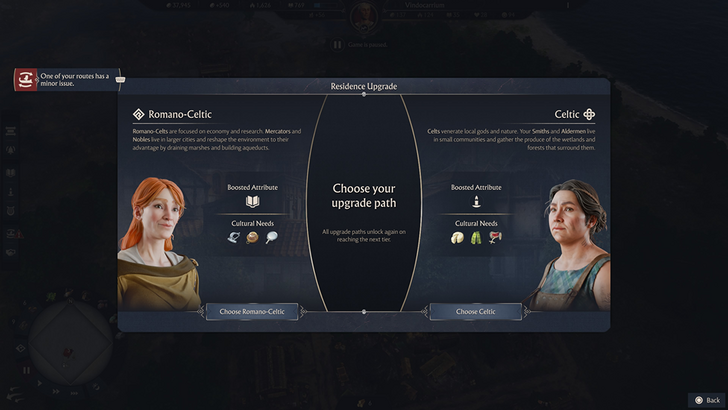
⚫︎ 3 paths for citizen upgrades: Roman, Romano-Celtic, and Celtic
⚫︎ Expanded Research Tree
⚫︎ 7 rival governors to challenge
⚫︎ Dedicated Campaign and Sandbox Modes
⚫︎ 1-4 PvP and Co-op Modes
For more gameplay details, read everything we know about Anno 117: Pax Romana's gameplay and story.
| Digital Storefronts | |||||||||
|---|---|---|---|---|---|---|---|---|---|
 Steam Steam |
 Epic Games Epic Games |
 PlayStation PlayStation |
 Xbox Xbox |
 Ubisoft Ubisoft |
|||||
| Price | $59.99 | ||||||||
Anno 117: Pax Romana Pros & Cons
| Pros | Cons |
|---|---|
 Breathtaking Frescoes, Exhilarating Roman Countryside Tight and Intuitive City-building Not Just Rome, But Albion Too Breathtaking Frescoes, Exhilarating Roman Countryside Tight and Intuitive City-building Not Just Rome, But Albion Too |
A Few Bugs to Deal With Better on the Replay |
Anno 117: Pax Romana Story - 8/10
Pax Romana’s narrative lives solely within its campaign — competent, familiar, and carried by the grandeur of its Roman setting. Having the emperor himself as your father lends the story a touch of imperial intrigue, though it never strays far from city-builder convention.
The real magic, however, lies in the sandbox. Whether you tame the wilds of Albion or surrender to them, every settlement, skirmish, and triumph feels like another verse in a history you’ve authored.
Anno 117: Pax Romana Gameplay - 9/10
Pax Romana boasts a tight, intuitive city-building system rooted in logistics, proximity, tiered citizenship, and meticulous urban planning. On paper, that may sound like every city-builder ever made — yet few truly balance all these elements at once, and fewer still do so with such clarity and historical texture. Every district, villa, and aqueduct feels deliberate, each piece clicking into the broader rhythm of Roman life across the many faces of this era. This perfect showing is marred only by the game's bug situation.
Anno 117: Pax Romana Visuals - 10/10
Pax Romana is set in Rome and its vassal states — and it absolutely looks the part. The architecture may not be historically exact, but its stylized grandeur captures the essence of Roman glory. Both authenticity and artistry shine through, from the character models to the sweeping landscapes.
Anno 117: Pax Romana Audio - 8/10
Pax Romana offers surprisingly strong voice acting for a city-builder, paired with rich ambient music and natural soundscapes that elevate its atmosphere. It’s not the highlight of its presentation, but it easily exceeds expectations for a genre that rarely invests this much in cinematic polish without dire consequences.
Anno 117: Pax Romana Value for Money - 9/10
City-builders are high-value experiences when done right, and Pax Romana stands among the genre’s best. Priced at the once-standard $60, it’s not the most accessible game for most people or their rigs, but it’s absolutely one worth saving up for.
Anno 117: Pax Romana Overall Score - 84/100
Rome wasn’t built in a day, and neither was this game. Every hour of craftsmanship shows in its design, every day of polish laid into its foundations. The result is a monument to the genre, built one ornate column at a time and topped with a golden eagle to shine in the sunlight.
Though it’s not flawless, with a few bugs acting as a memento mori to an otherwise golden game, Pax Romana still stands tall. And though neither it nor the empire could be built so quickly, you can build yours much sooner.
Anno 117: Pax Romana Review: The Golden Roman Standard Held High
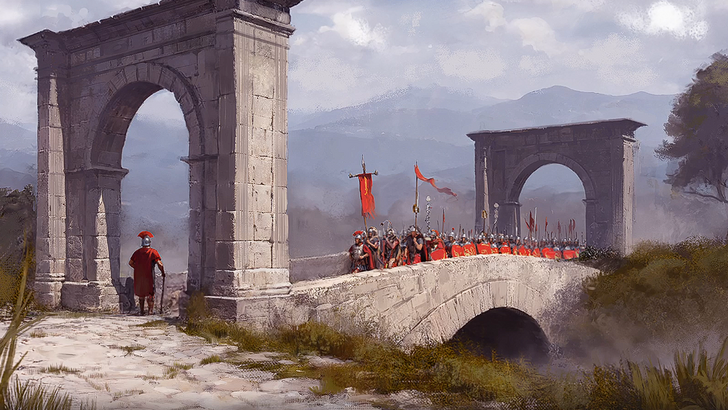
“Facta, non verba” — deeds, not words. A fitting creed for one of history’s greatest empires, and an even finer one for any game that dares to echo its glory. Rome endures not only in the scrolls of historians or the dreams of poets, but as the eternal muse for city-builders.
Yet too often, Rome’s likeness is but a mask. Certain games adorn themselves in marble and laurel, only for their pillars to crack and their promise to fade beneath the surface.
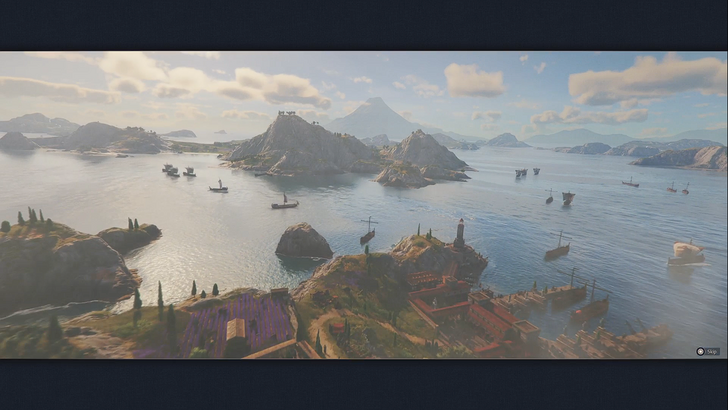
Anno 117: Pax Romana is no pretender. It honors Rome not with hollow splendor but with substance, a grand vision, and an equally grand execution. It is a city-builder that feels the weight of empire and the thrill of dominion in equal measure. You bear the burden of governance, yes—but also its triumph, gleaming and eternal, like gold leaves upon a conqueror’s brow.
There is much to unveil, ere. Shall we begin?
For the Glory of Latium! For the Civilization of Albion!
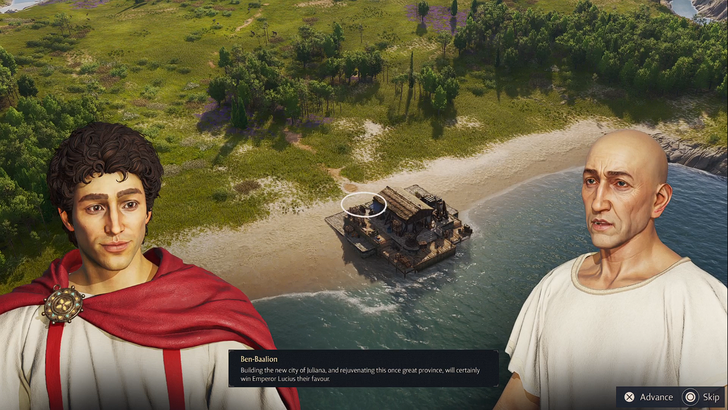
Although I’d love a game that lets us build the very heart of the empire, Rome herself, rising from the dust (and certainly not in a day), Anno 117: Pax Romana instead unfolds in an era of calm might. As its title suggests, it is the age of peace, when the empire’s legions rested, yet its ambitions reached beyond familiar shores.
And reach you shall. With the emperor’s favor filling your sails and the wisdom of the empire coursing through your mind, you take your post as a newly appointed governor, charged with birthing civilization from barren lands. Yet before the first hammer strikes or banner is raised, one great decision awaits, one that will define your rule until your next campaign begins. Will your province rise upon the scorched, fertile ashes of Latium? Or take root amid the untamed wilds of Albion?
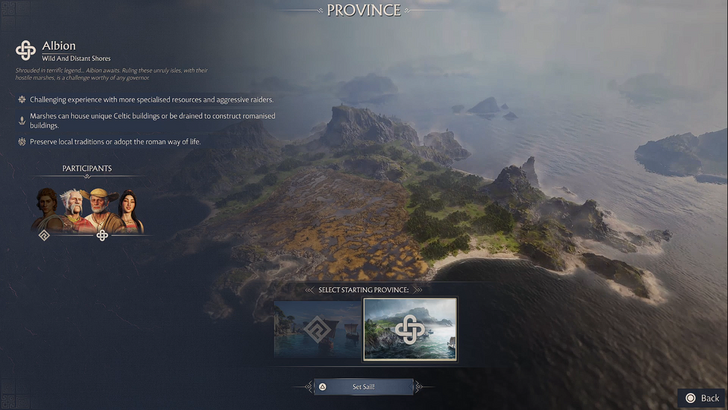
This is no choice to be made in haste, for each land bears its own trials. Establishing your province in Latium places you beneath the emperor’s very gaze, granting the comfort of imperial favor, yet binding you to the scrutiny of Rome itself. Expansion there is familiar, sanctioned, and safe… but every action carries the weight of the emperor’s scrutiny.
Albion, on the other hand, lies far from the heart of the empire. Its wild frontiers promise freedom from oversight, yet demand strength enough to tame both the land and its Celtic tribes. Independence here comes at the cost of certainty.
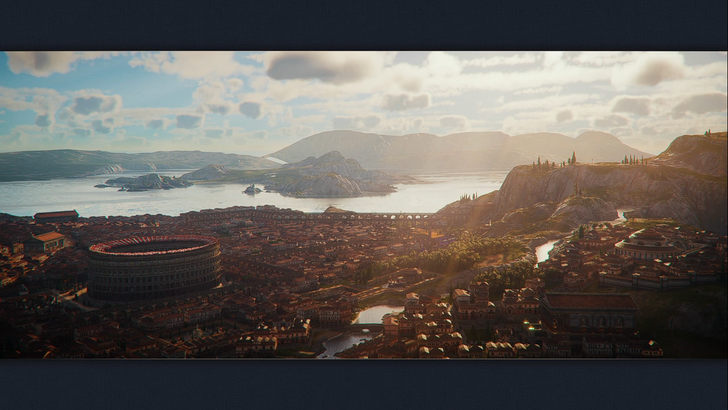
Whichever path you choose, the fate of your province rests squarely upon your shoulders. As governor, your word becomes law, and your decrees shape every road laid, every temple raised, and every alliance forged. That’s where Pax Romana shines: governance.
Building Civilization is Rough Work, But You’re Well Equipped to Do So
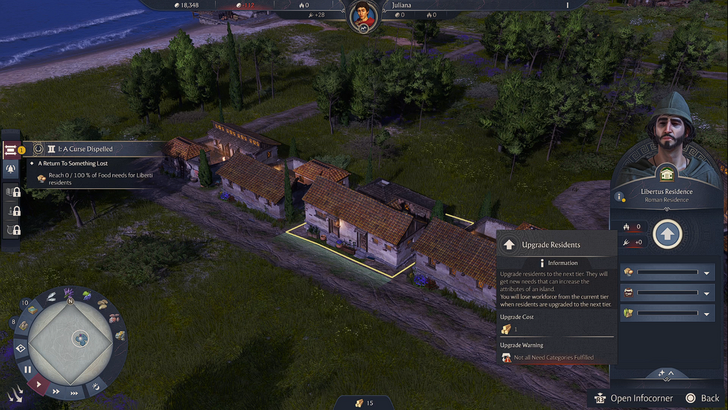
Pax Romana stands on three great pillars: Citizens, Proximity Effects, and Logistics. These are the cornerstones of countless city-builders before it, yet few have embodied them with such clarity and purpose. Perhaps that’s because this was precisely how Rome itself endured: through people, planning, and the perfect movement of goods and power.
Rome was an empire of order; its citizenry structured, its cities engineered, its supply lines flawless. Pax Romana captures that spirit with remarkable fidelity. Your citizens form the lifeblood of your province, each class with its own needs, ambitions, and role within the social machine.
If you choose to govern in Latium, your society ascends through three Roman castes: Libertes, Plebeians, and Equites, with each rung climbing closer to nobility. In Albion, however, you must choose your approach to rule: will you romanize the native Celts, or let their culture endure?
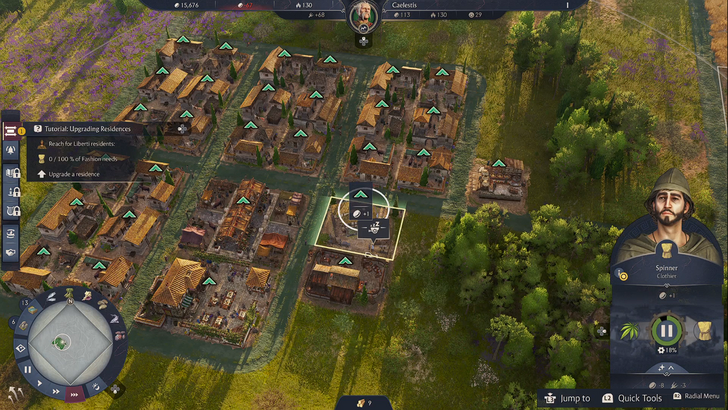
A Romanized province hosts Waders, Mercators, and Nobles, thriving through commerce and urban growth (i.e., the Roman Way); a Celtic one nurtures Waders, Smiths, and Aldermen, grounded in the earth and bound by faith.
Each citizen class carries its own demands, growing in complexity as your city prospers. To keep them fed, clothed, and content, you’ll need a pulse of production and trade flowing through a living network of roads, docks, and workshops. This is where the other pillars rise to meet the first, with Proximity Effects shaping the city’s design, and Logistics weaving land and sea into one seamless engine of empire.
All Roads Lead to Rome

When it comes to Pax Romana’s production buildings, everything revolves around proximity, or how close your structures are to one another, and how their influences ripple through your city.
This system operates in two distinct ways: some buildings project an aura of benefit, bolstering nearby citizens’ Health, Happiness, or Knowledge; others depend on a functional radius, requiring a Warehouse within reach to send and receive goods. Occasionally, a building demands both, and that’s where things get interesting.
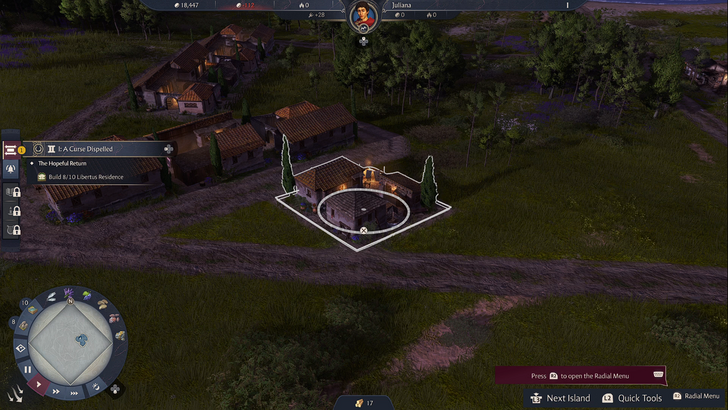
These proximity effects turn city planning into a delicate dance. Not every influence is a blessing, yet every one demands consideration. A kiln, for instance, supplies precious ceramics for your industries but raises the risk of fire in the surrounding area—hardly something your citizens would praise. Better to keep it at a safe distance. Contrast that with a Garum Works: it fills the coffers like no other, yet its pungent presence sours the air and diminishes health for blocks around.
It’s this constant tug-of-war between prosperity and peril that makes Pax Romana’s city-building so satisfying. The system is simple, yes, but deceptively deep, capturing the very essence of urban governance: that every gain comes with a cost, and every empire must eventually learn to live with the smell of its own success.
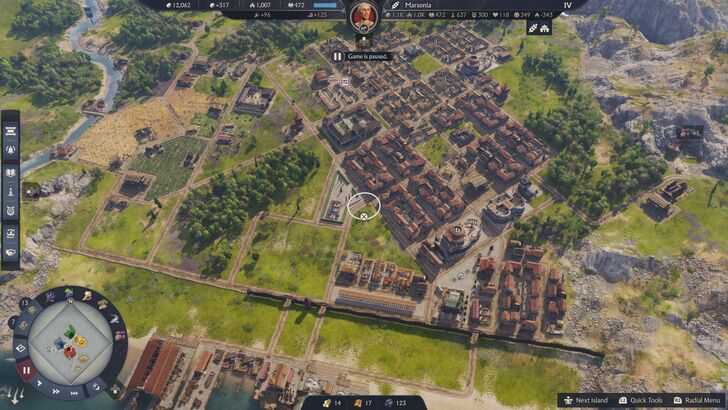
Speaking of success, Rome’s enduring legacy rides on one innovation above all: roads. Every city needs them, and Pax Romana makes their construction a joy. Here, making roads is effortless, precise, and elegantly simple. The road tool is nothing short of immaculate: snappy, intuitive, even along tricky diagonals, forming the very framework of your urban empire. People judge certain games through certain criteria, even the arbitrary ones. For me and city-builders, it’s the road tools, and this one knocks it out of the Colosseum.
And that’s a good thing, too, because everything, and I do mean everything, requires a connected road to function. Early on, with houses and production buildings, this is easy enough to manage. But as your city grows, and you lay down aqueducts or monumental structures like forums and theatres, your once-simple lattice becomes a puzzle of passages, forcing you to rethink every artery of your city.
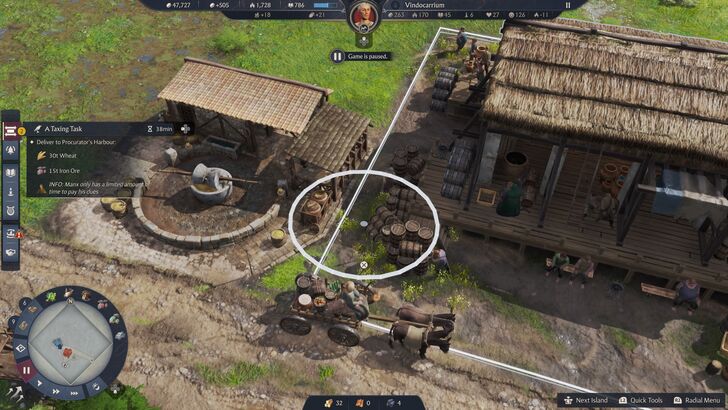
Then comes road quality. Rome didn’t settle for dirt roads; it paved its way to greatness with cobble and concrete. In the game, this is an expensive endeavor, demanding literal shiploads of concrete, but the payoff is immense, giving you longer supply chains, faster logistics, and a more efficient empire overall.
And roads, as essential as they are, are only the beginning. The game’s logistics system expands far beyond them, weaving land and sea into the lifeblood of your province.
Trading and Diplomacy Across the Empire
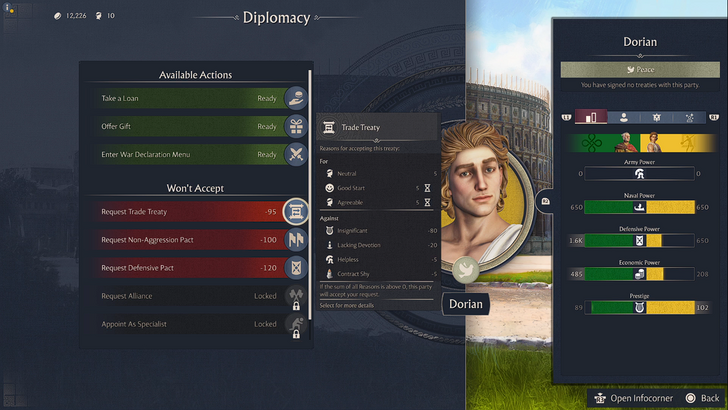
In Pax Romana, logistics and trade are two sides of the same coin—after all, trade is just the art of moving goods from one place to another for profit. The system here is deceptively deep yet remarkably clear: you can set minimum, maximum, or maintained stock levels for every good, automating the flow while keeping every transaction transparent.
You can even orchestrate purchases and sales across multiple depots on different islands in a step-by-step, nearly foolproof way, eliminating the ambiguity that plagues so many other city-builders. It’s elegant in its simplicity, but neglect it, and your markets will stagnate and your treasury will dry up.
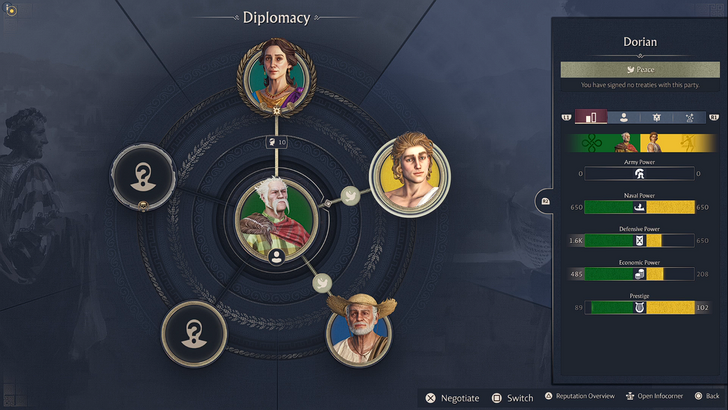
And who are your trading partners? Other governors, naturally. Each manages their own islands with personalities of their own: some cooperative, some cutthroat, but none entirely predictable. This isn’t a grand strategy of conquest like Civilization, but a subtle layer of intrigue that keeps diplomacy interesting rather than mechanically game-breaking.
Diplomacy itself relies on a straightforward notoriety system. Your actions, your choices, and even your religious devotions influence how others perceive you. Raise a governor’s favor enough, and treaties will bend to your will; falter, and your overtures will be met with rejection. Simple, clear, and effective, a perfect complement to the empire you’re building.
Bugs and Unclear Quests at the Gates!
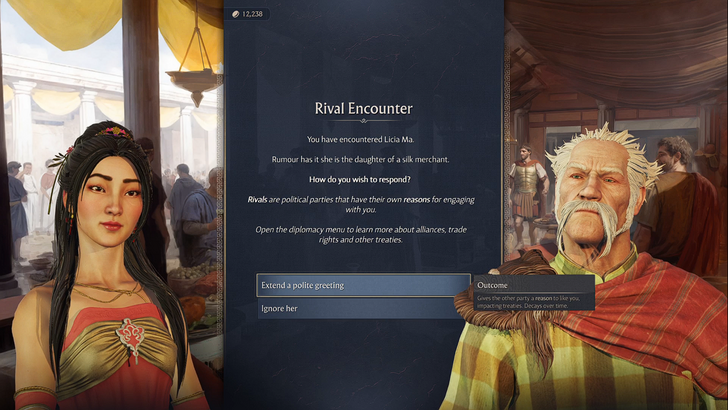
Now, having praised the mastery of Pax Romana’s city-building, it’s only fitting to acknowledge the barbarians at the empire’s gates—those unwelcome invaders we call bugs.
The game features a modest quest system meant to ease new governors into its mechanics and lend a sense of purpose to its sandbox mode. In the campaign, quests lean more toward storytelling than instruction, but alas, the bugs respect no such distinction.
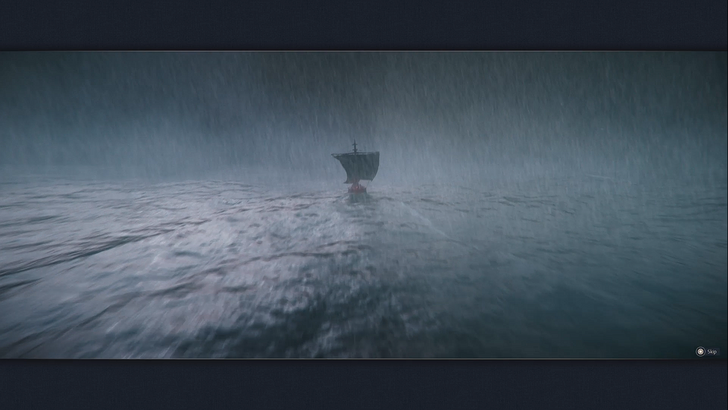
One, in particular, stands out like a dagger in the back: escort missions. Whenever a quest asks you to accompany another ship, the objective simply refuses to progress, no matter what you do. This results in a softlock that denies you the quest’s reward, which is usually the emperor’s favor.
Then there are the smaller imperfections. There’s the occasional visual hiccup when placing buildings. The game’s terrain-adaptive system sometimes misfires, producing half-finished structures or missing text in tooltips. These are minor flaws, to be sure, but when everything else shines so brilliantly, the cracks are much easier to see.
You’re Going to Need to Play This Twice
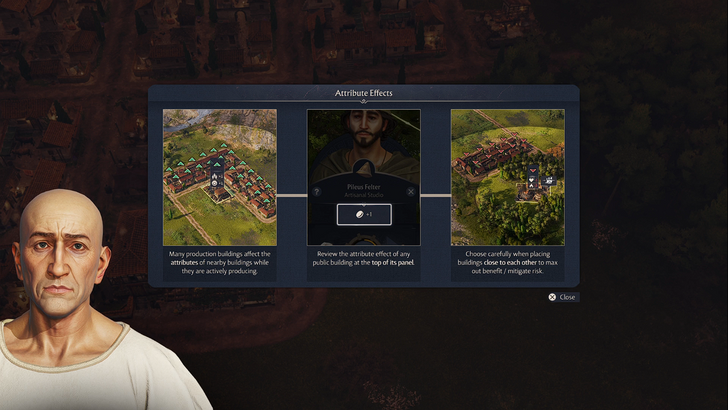
Now, that might sound like praise, and in a sense, it is. Pax Romana is a game you’ll want to replay time and again. But the real reason you’ll find yourself returning isn’t just out of love, it’s out of necessity. You’ll need a few playthroughs to truly grasp its rhythm. Not because it’s punishingly difficult (you can adjust that easily enough before starting), but because the clarity of its quests and their consequences can be… elusive.
The game makes an honest effort to guide new governors, offering gentle nudges and well-meant tutorials. Yet at times, it thrusts you into lose-lose situations only a seasoned ruler could foresee. Take, for instance, the Governor Tarragon. He asks you to safeguard his wife and child, who have transgressed against the empire. You’re given a choice: hand them over to an imperial representative who promises to spirit them away discreetly, or defy the empire’s will.
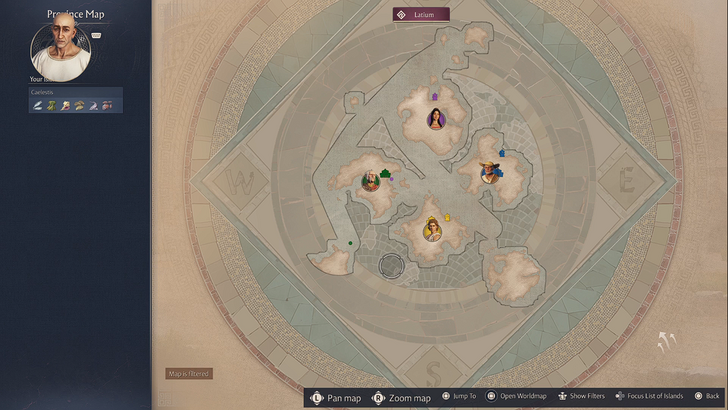
Whichever path you take, the outcome is rarely what you expect, and will most likely end with Tarragon turning his legions against you. Unless, of course, you were already prepared for war… which a new player almost certainly won’t be.
The same issue rears its head again when you take up governance in Albion, serving as the empire’s tax collector. What begins as a simple request for tribute soon twists into something far more demanding. Fail to meet the quota—perhaps expecting the mission to simply conclude—and you’re instead ordered to seize the taxes by force from a fellow governor. And just when you steel yourself for the task, the old escort bug resurfaces, grinding your progress to a halt.
There’s plenty to admire in the countless mechanisms driving this game. But these particular gears simply refuse to turn, no matter how well-oiled the rest of the machine may be.
Breath In the Sweet Air of the Roman Countryside
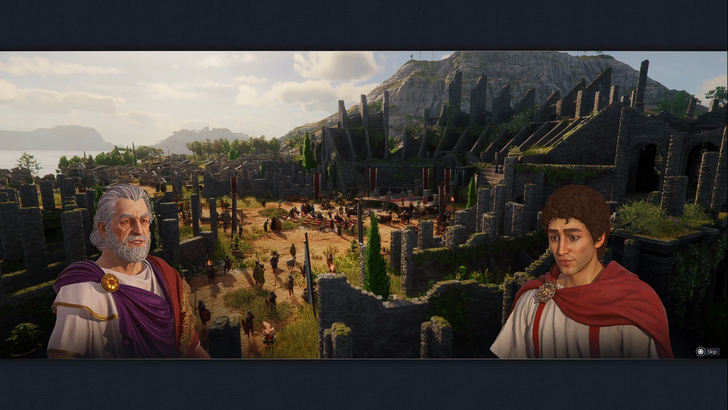
Returning to the game’s strengths, bugs and quirks aside, Anno 117: Pax Romana shines brilliantly in its visuals and audio, and it’s impossible not to be awestruck by them.
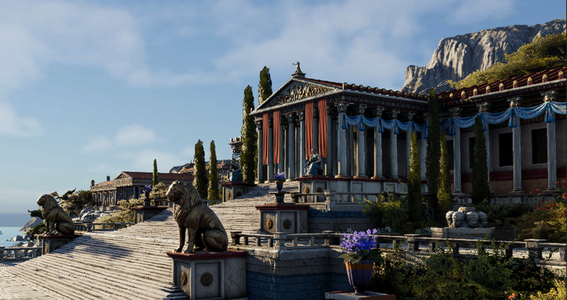
In a single word: grand. Its aesthetic presence is vast and commanding, like the frescoes that once adorned Rome’s marble halls, like the legions that marched unchallenged across continents. This game doesn’t ask for your attention; it seizes it and romanizes it.
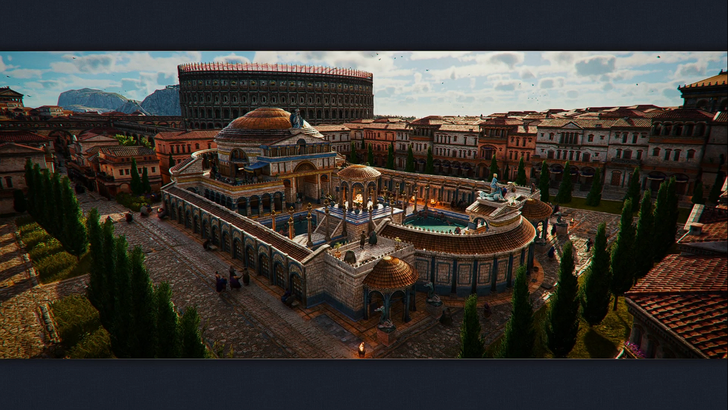
From the intricate designs and animations of individual buildings, down to the smallest details at street level, to the sweeping vistas of the countryside, every corner of the game is a feast for the senses. I often find myself marveling at the beauty of my own creation, even amid a chaotic, inefficient city layout.
And yes—voice acting, a rarity in city-builders, is present here, and executed at a level few of its kind could hope to match. The game didn’t need this lavish spectacle; its gameplay alone is already strong. Yet the developers went further, layering bread and circus atop the solid foundation, creating a world that feels alive, commanding, and utterly unforgettable.
Nothing Beats the Roman Standard for Efficiency and Design
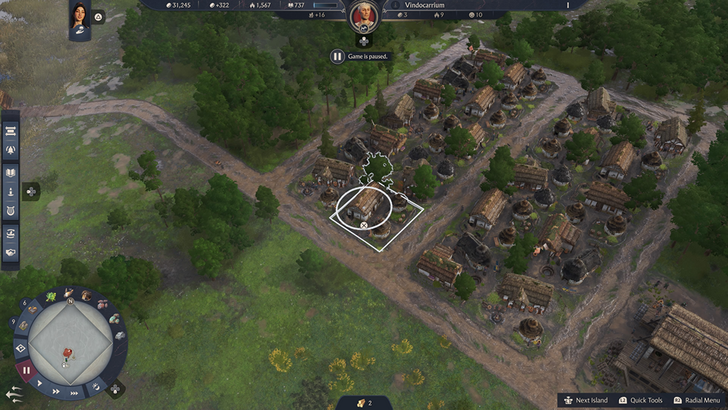
And so we come to the end of all there is to say about Anno 117: Pax Romana. It’s not a game that dazzles with spectacle or reinvents the wheel with wild new ideas. Instead, like the empire it so faithfully mirrors, it achieves greatness through discipline, efficiency, and mastery of craft.
As city-builders go, Pax Romana is deceptively simple, drawing from the genre’s most time-honored systems. Yet it wields them with such precision, such unwavering focus, that it reminds us why these foundations endure. Every mechanic feels deliberate, every system purposeful, like a brick placed exactly where it should be. And from that stability rises something truly remarkable: a city-builder as timeless and enduring as Rome itself.
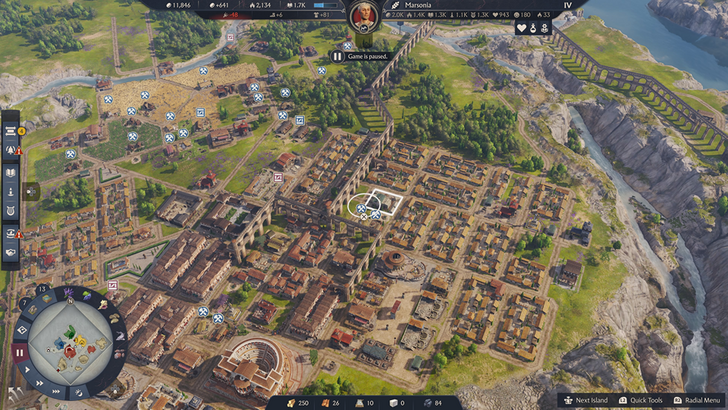
Even its flaws are modest: occasional visual hiccups, quirky quests that can be patched with ease. Small cracks in an otherwise solid edifice, demanding little more than minor attention. Leave it to Rome to achieve efficiency even in imperfection.
Rome wasn’t built in a day—and neither was Pax Romana. Its design speaks to years of mastery, the kind of careful craftsmanship that only comes from true devotion to the art of city-building. And perhaps that’s the greatest triumph of all: that within this near-perfect reflection of a once-great empire, you might find the means to build a Rome greater still.
Is Anno 117: Pax Romana Worth It?
Worth Every Denarius, If You Have Them
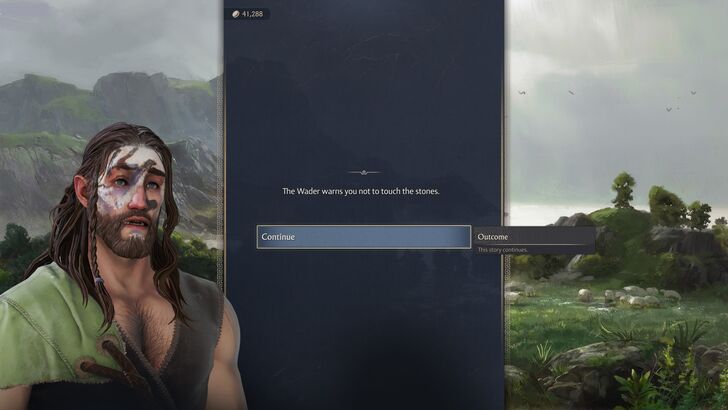
The question isn’t whether Anno 117: Pax Romana is worth playing. Undoubtedly, it is, even at the former AAA premium of $60. The real question is whether the system-dependent barrier to entry is justified, or even manageable for most players.
The answer is almost certainly yes. This is the kind of game you save for, anticipate, and savor if it wasn’t immediately within reach, and it’s bound to meet, if not exceed, your expectations. Just ensure your rig can handle its ambitions, and you’ll be aureum. That’s golden for us non-Latin-speaking folk.
| Digital Storefronts | |||||||||
|---|---|---|---|---|---|---|---|---|---|
| Steam |
Epic Games |
PlayStation |
Xbox |
Ubisoft |
|||||
| Price | $59.99 | ||||||||
Anno 117: Pax Romana FAQ
Can You Play Anno 117: Pax Romana on PlayStation 5 Using Mouse & Keyboard?
Yes. According to the game’s official FAQ blog post, the game supports mouse & keyboard controls for its PlayStation 5 edition. The inverse is also true. You can use a controller to play the game’s PC version.
Does Anno 117: Pax Romana’s Active Pause Feature Reflect Changes in Real Time?
In most cases, yes. Anno 117: Pax Romana features an active pause system to let governors make split-second decisions. Although most changes made while time is paused will reflect immediately, certain calculations require the game to be unpaused in order to reflect.
Will Anno 117: Pax Romana Have New Lands in the Future?
Yes. According to the game’s post-release roadmap, Anno 117: Pax Romana will receive additional content down the line, including a new volcanic map for Latium, and a whole new region set in Egypt to settle.
Game8 Reviews

You may also like...
 |
Cities: Skylines 2 Review | Too Ambitious For Its Own Good City-Building, Simulation |
 |
Builders of Greece Review (Early Access) | Still Under Construction City-Building, Simulation |
 |
Builders of Egypt Review | Solid Foundations, Cracked Facade City-Building, Simulation |
 |
Frostpunk 2 Review | High Praise in Low Temperatures City-Builder, Survival |
Anno 117: Pax Romana Product Information
 |
|
| Title | ANNO 117: PAX ROMANA |
|---|---|
| Release Date | November 13, 2025 (PC, PlayStation 5, Xbox Series X|S) |
| Developer | Ubisoft Mainz |
| Publisher | Ubisoft |
| Supported Platforms | PC (Steam, Epic Games) PlayStation 5 Xbox Series X|S |
| Genre | Strategy, City Builder |
| Number of Players | 1-4 |
| ESRB Rating | ESRB E |
| Official Website | Anno 117: Pax Romana Website |