


| SHUTEN ORDER | |||
|---|---|---|---|
| Release Date | Gameplay & Story | Pre-Order & DLC | Review |
SHUTEN ORDER Review Overview
What is SHUTEN ORDER?
SHUTEN ORDER is a multi-genre adventure game launching on September 5, 2025, from DMM GAMES and Tookyo Games, led by Danganronpa's Kazutaka Kodaka. It's a standalone title set in a world facing an apocalypse at the hands of the Shuten Order. The story begins when the Order's founder, Rei Shimobe, is murdered and resurrected with only four days to live.
Guided by "angels," Rei must uncover their killer to achieve true resurrection and save the world. It features multiple gameplay genres (mystery, escape, visual novel, romance, stealth horror) that change based on player choices, offering varied experiences. It will be released digitally on PC via Steam and Nintendo Switch.
SHUTEN ORDER features:
⚫︎ Murder Mystery with Five Different Game Systems
⚫︎ Five Interconnected Routes and Narrative
⚫︎ Story by Kazutaka Kodaka (Danganronpa), Takumi Nakazawa (Ever 17 - The Out of Infinity), and Takekumi Kitayama (Master Detective Archives: RAIN CODE)
⚫︎ Illustrated by simadoriru (The Hundred Line -Last Defense Academy-)
For more gameplay details, read everything we know about SHUTEN ORDER's gameplay and story.
 Steam Steam |
 Switch Switch |
||||||
| Price | $49.99 | ||||||
|---|---|---|---|---|---|---|---|
SHUTEN ORDER Pros & Cons

| Pros | Cons |
|---|---|
 Strong Cast of Characters Multi-Genres Keep Things Fresh Stylish Visuals and Distinct Character Art Strong Cast of Characters Multi-Genres Keep Things Fresh Stylish Visuals and Distinct Character Art |
Some Gameplay Concepts Aren’t Fleshed Out Enough Story Pacing Can Drag Exploration Segments Can Sometimes Feel Pointless |
SHUTEN ORDER Story - 9/10
Shuten Order’s story thrives on its ensemble cast, where even the side characters in each route feel distinct enough to leave an impression rather than fade into archetype. The Ministers, in particular, stand out as sharp reflections of the game’s themes, their clashing ideals fueling both the drama and the humor. However, even as a fan of his works, Kodaka’s trademark love of piling words on top of words sometimes bogs the pacing down, with certain stretches dragging longer than they need to.
SHUTEN ORDER Gameplay - 8/10
Each of the five routes spice up the usual visual novel framework with its own gameplay twist, which gives you something fresh to latch onto beyond dialogue choices. The variety keeps things from feeling monotonous, and those genre-bending detours often end up being highlights in their own right. The catch is that none of these mechanics are fleshed out enough to stand on their own, leaving you wishing they pushed just a little further. It doesn't help the game’s case that its linearity during exploration segments prevent you from actually exploring, especially when so-called points of interest just tell you to hurry up and interact with the one correct answer.
SHUTEN ORDER Visuals - 10/10
The illustrations here are nothing short of amazing, with Simadoriru’s character work rivaling even Komatsuzaki's Danganronpa designs. Every face, from main cast to minor side players, feels distinct and memorable, and the comic book-style panels give scenes a sense of energy that simple portraits never could. Even something as small as the speech bubbles feel carefully considered.
SHUTEN ORDER Audio - 7/10
What stood out right away is that the entire main story is fully voiced, which does a lot to carry the weight of scenes. Even without an English dub, it’s easy to follow the tone and intent of every line just by listening to the cast. The soundtrack, meanwhile, is solid. Masafumi Takada is a really good composer. However, his work here doesn’t quite reach the heights of his earlier works. None of the tracks are bad, but they mostly do their job in the moment rather than linger in your head afterward. It’s effective enough, but it’s no HEAT UP from Danganronpa; it’s not the kind of score you’ll find yourself hunting down outside the game.
SHUTEN ORDER Value for Money - 8/10
At $50, Shuten Order sits in that awkward middle ground where its niche appeal makes the price tag feel a bit steep. The 40-hour runtime is nothing to scoff at, but it does pale next to Kodaka’s more ambitious projects, making the cost harder to justify if you’re measuring strictly by hours per dollar. What tips the scale, though, is the sheer craft on display—from the layered writing to the experimental gameplay detours—which at least makes the spend feel worth it. It’s not the most generous game, but it earns enough goodwill to avoid feeling like a rip-off.
SHUTEN ORDER Overall Score - 84/100
Kodaka’s latest visual novel is clever and brimming with personality but never quite lets you escape its rails. The sheer creativity behind each path keeps you hooked even when its nonlinearity gets in the way of you just wanting to discover everything the game offers. Although the game can feel padded and Kodaka’s love for character archetypes can get in the way, the story’s synergy with the fun route-specific gameplay ideas make it hard to put down. It’s flawed, like some of his other works, but it’s a flawed game that’s still worth seeing through to the end.
SHUTEN ORDER Review: Breathing Fresh Air into the VN Formula

I didn’t expect to be talking about another Kazutaka Kodaka game so soon after The Hundred Line -Last Defense Academy-. That one already felt like the culmination of years of collaboration, with Kodaka and Kotaro Uchikoshi pooling their respective brain juices into something unreasonably dense and cohesive. Naturally, I figured the next Kodaka outing would be years off, or at least follow a similar pattern to Uchikoshi’s own No Sleep for Kaname Date, where he handed directing off to another capable director while overseeing the story as the scenario advisor. That would have made sense. But no. Instead, he doubled down and put his own name front and center again, this time in the director’s chair alongside Takumi Nakazawa, Takekumi Kitayama, and a handful of other familiar conspirators from the Danganronpa series. What makes that even wilder is that Kodaka is doing this while simultaneously wrapping up Tribe Nine’s story as a doujin project, now that the game is headed for its shutdown this November 27.
I’ve always had a soft spot for his works, mostly because he thrives on the swings that other creators would consider reckless. The Danganronpa trilogy, for all its ludicrousness, is proof that he’s never been afraid of pushing ideas past their breaking point just to see what happens. Rain Code, for better or worse, was messy but unique still. The Hundred Line, though, felt like it was Kodaka and Uchikoshi’s magnum opus.
So coming into Shuten Order, I had to recalibrate my expectations. It’s not aiming for that same scale, and it doesn’t try to be. Compared to The Hundred Line, it’s a much smaller work, almost modest in scope, but ambition is still baked in its multi-genre design. Kodaka has dabbled across genres for years, and here he seems intent on flexing just how many tricks he has up his sleeve.
A Murder Mystery with a Strong Hook and Even Stronger Characters
You, Rei Shimobe, wake up in a hotel room with no memory of who you are or how you got there. Before you can even get your bearings, there’s a knock on the door—two self-proclaimed Angels, Himeru and Mikotoru, drop the news that you are dead. Murdered, in fact. God, in an oddly bureaucratic stroke of mercy, has given you a temporary body and one mission; you have to figure out who killed you and kill them within four days, or else your body collapses for good.
It doesn’t take long before things spiral further. You learn you’re not just some random victim, but the Founder of Shuten Order, an organization that is religiously non-religious in its beliefs, devoted to ending humanity’s existence. Naturally, this makes you a target. The heretics—radical terrorists—would like nothing more than to see you wiped off the board permanently. But, they’re not actually the main threat. The ones you really need to keep your eye on are the Ministers of Shuten Order itself, the people you oversaw as the Founder, each of whom has both motive and opportunity to have orchestrated your death.
There’s Kishiru Inugami, the Minister of Justice, who conveniently was the first to find your body. Then Yugen Ushitora, the Minister of Health, whose compassion seems a little too rehearsed. Teko Ion, the Minister of Science, keeps his cards close. Honoka Kokushikan, the Minister of Education, has something up in the background. And Manji Fushicho, the Minister of Security, is so openly ruthless that you almost wonder if she’s too obvious to be guilty. They’re all suspects. They’re all potential allies. And they’re all just as likely to be feeding you half truths as they are to be telling you anything useful.
That sounds like standard Kodaka territory, a murder mystery with outsized personalities and narrative traps for the player to stumble into. Kodaka’s still working with well-known character tropes, and Shuten Order doesn’t break that tradition, for better or worse. But what makes the game stand apart from his other works is how contained it all feels. Yes, the game leaps between genres and tones depending on which path you take, but they all feed back into the same central mystery: who killed you, and why? Despite its detours, everything bends back toward the question of your own death.
The structure is what sells it. After the prologue and after asking for the Power of God (a literal deus ex machina in some use-cases), the game splits into five routes, each centered on one of the Ministers. Each route reshuffles your assumptions. One Minister might suggest another had motive, only for that thread to unravel when you spend more time with the accursed. A supposed clue might lead you to doubt the person who handed it to you in the first place. Trust becomes slippery, and with your memory gone, you’re left second-guessing not only their words but your own judgment. Even the idea of if you, as Rei Shimobe, are a boy or a girl gets murky.
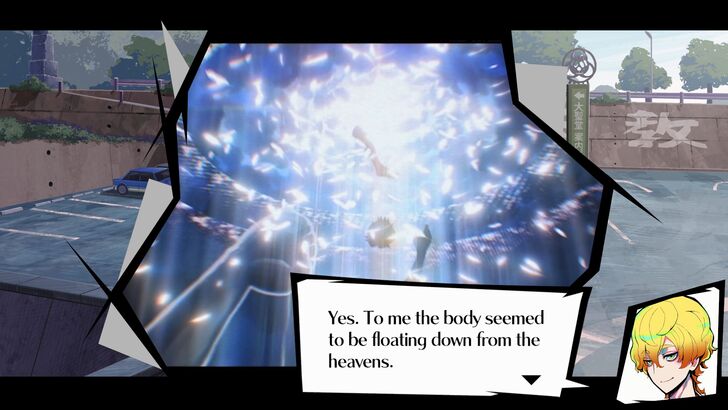
To make things more tangled, each route gives you Keywords, which are bits of context about your murder. These Keywords carry over into other routes, even if your player character can’t exactly remember them, letting you challenge contradictions or piece together events that were once opaque.
It’s a refreshing twist on the multiple-route structure of so many visual novels. Instead of every path being a standalone "what if," they’re fragments of one larger puzzle. You’re encouraged to revisit your own conclusions and test how fragile they are once you meet the other Ministers.
Many Segments Feel Too Linear
As much as I enjoyed unraveling the central mystery, I can’t help but feel frustrated by how the game handles its structure. Linearity isn’t inherently a bad thing; most visual novels, after all, are built on fairly strict rails. The issue here is that the game tries very hard to disguise itself as something more nonlinear than it really is. It teases freedom and variety, but the mask slips quickly once you realize how tightly the story controls your every move.
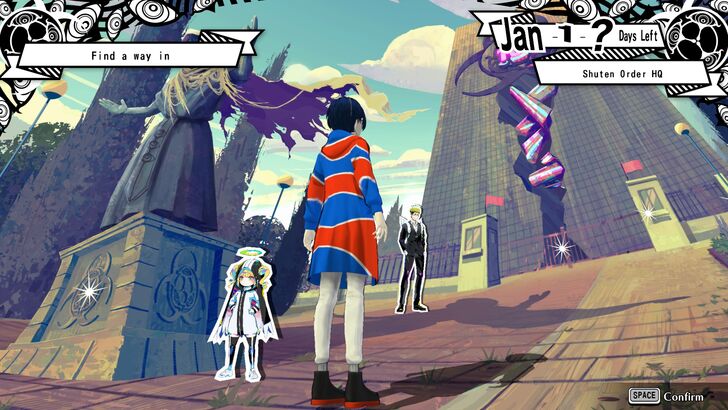
Take the exploration segments. On paper, they seem like an opportunity to wander through the game’s world, poke around environments, and maybe influence how the narrative develops. In practice, they’re smoke and mirrors. Each area has one single hotspot that actually advances the story. The other points of interaction are window dressing, short descriptions that add flavor to the setting or reveal bits of character lore, but never alter the flow of events. There’s value in worldbuilding for its own sake, of course, but when the design consistently dangles the idea of you moving the plot, only to funnel you down a preordained path, it starts to feel like busywork.
I had hoped that moving about the game’s world would allow me to at the very least discover relevant interactions that I would otherwise have not seen if I had not been curious. However, almost every hotspot just tells you to hurry up and proceed with the story already. If almost all interactions are like that, what even is the point of "exploring?"
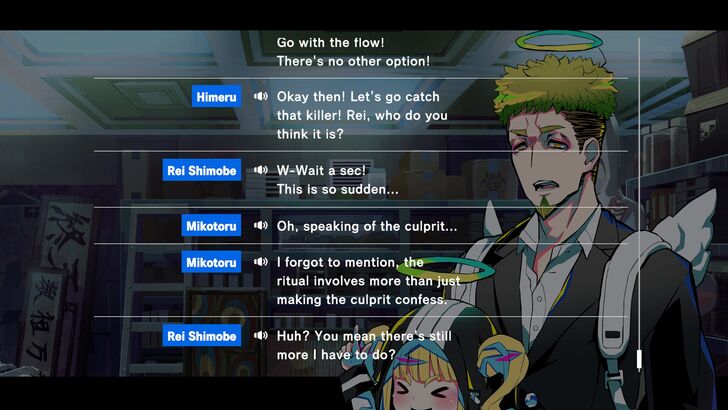
The same problem extends to the game’s choices. Kodaka has built his reputation on shocking rug-pulls, so I half-expected the dialogue options to be an avenue for at least more moral tension. Instead, most of them prove to be illusions of choice. In four of the five routes, there is almost always only one correct answer. Choose it, and the story continues as intended. Pick anything else, and you’re funneled into a game over. It doesn’t matter if your reasoning made sense or if the choice seemed plausible in context; the game simply tells you no and punts you back to try again.
This structure inflates the runtime in a way that feels cheap. Your choices being negligible punishes your curiosity. The design ends up encouraging players to brute-force their way through dialogues, not because the story is pushing them toward a deeper revelation, but because the wrong answers are just there to maybe see if you’re still paying attention.
Inflating the runtime becomes even more of a problem when your character Rei simply parrots back what another character has just said moments prior, in a tone of wide-eyed disbelief. It’s a tic that quickly loses its charm when it happens for the tenth, twentieth, thirtieth time. Instead of heightening tension or giving the player an anchor in the story, it becomes padding; scenes drag because the game insists on rephrasing the same information in slightly different words after it already said it. As a result, the pacing starts to sag under the weight of its own excess.
Five Ministers, Five Routes, Five Genres
What impressed me, though, about Shuten Order isn’t just the story itself, but how the game constantly reshapes its mechanics to match the shifting tones of each route. Kodaka and his team could have easily settled for a straightforward visual novel, but instead they stitch five varying games together: Danganronpa-style murder mystery, a VTuber-controlled escape room, a fractured sci-fi narrative, a tongue-in-cheek dating sim, and even a stealth horror game. None of these genres feel like throwaway gimmicks, either. They’re each built to reflect the personality of the Minister they center around, and for better or worse, they all run with that tone until the end of that route.
My favorite of the bunch is Kishiru Inugami’s path, the murder-mystery adventure. It’s Kodaka returning to what he knows best: corpses on the floor, survivors pointing fingers, and you forced to figure out who among them is lying. The formula is familiar. You investigate an estate area by area, gathering scraps of evidence, and then everyone convenes for a trial, where logic and rhetoric fly until someone gets cornered.
It works because, like in Danganronpa, the tension doesn’t come from knowing whodunit, but in being constantly undermined. Your half-formed theories shredded before you can find the words to defend them. More than once, I had the right suspicion but no clue how to prove it.
The wildest swings are Yugen Ushitora’s VTuber escape game and Honoka Kokushikan’s so-called romance adventure. They both sound absurd. Without spoiling much, Ushitora’s route literally has a VTuber model planted on the side of the screen, cheerfully reacting as you solve logic puzzles in a death game; the other takes the trappings of a dating sim and filters them through Honoka’s (possibly) many personalities.
They end up being some of the funniest parts of the game, because they lean into the ridiculousness, even with all the deaths going on. All of them, though, have heart, and there is almost always a reason why you are doing what you are doing in the said route in the first place.
Not everything is as good as the said three, however. Teko Ion’s multi-perspective sci-fi narrative is the most ambitious on paper, weaving viewpoints across different characters, but it gets bogged down in the constant perspective swapping that blunts its emotional weight.
Manji Fushicho’s route, meanwhile, goes full stealth horror. It’s the most different out of all five. At first, it’s effective—the lights dim, the music turns hostile, and a figure called Nephilim stalks the corridors with a jackhammer. The first hour had me so rattled I roped in a friend to sit through it with me. But the fear fades once you realize how mechanical the whole thing is.
Nephilim doesn’t hunt you. He follows a patrol pattern, his movements carved into code, and the only "challenge" is memorizing his routes and staying out of his cone of vision. Once the trick is revealed, the tension dies. What was at first a game of cat and mouse becomes theater, and Nephilim is the actor waiting for its cue to move.
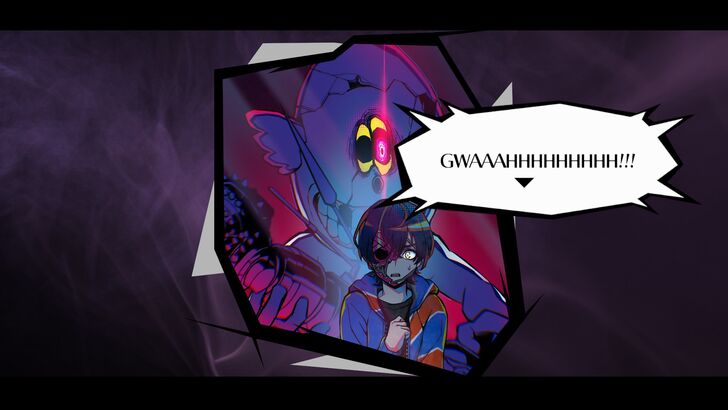
That’s not to say that the latter two routes are bad; quite the contrary. I appreciate how Kodaka and his team tested out different genres. They’re not bad; they’re just not up to the same level as the first three. Even then, though, it’s hard not to admire the audacity.
Stylish Comic Book Art Style is The Game’s Strongest Aspect
One of Shuten Order’s strongest assets, maybe even its secret weapon, is its visual presentation. Credit here goes to illustrator Simaroriru, who manages to carve out an identity that can stand shoulder-to-shoulder with Rui Komatsuzaki’s iconic Danganronpa designs. Every character—the Ministers, Angels, Heretics, and even the assorted side players who pop up in each route—feels stylistically distinct. Save for the literal no-faced NPCs, nobody looks visually the same. You see a silhouette and you know exactly who it is, and more importantly, you get a sense of their role and personality just from their design.
The game also leans into a comic book aesthetic, not just as a stylistic flourish but as a way of framing the entire narrative. Dialogue is done through stylized speech bubbles, positioned and shaped in ways that match the tone. Character reactions are punctuated by comic panels that pop out onto the screen, showing a gesture, an expression, or a shift in body language. It feels dynamic, as if you’re not just playing a visual novel but actively flipping through a graphic novel that animates itself while you read. Even minor beats, like someone stepping into frame, are amplified through this style.
Admittedly, the presentation was so polished that I caught myself considering buying the digital deluxe edition just for the art book, even after receiving a review key.
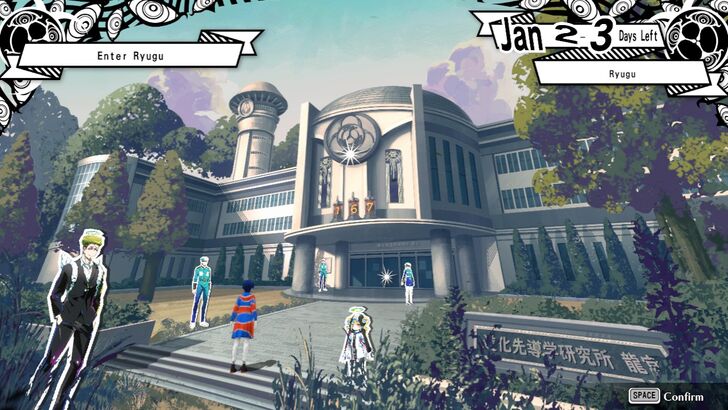
The one small nitpick I have is, again, with the exploration segments. During those sequences, Rei is rendered in 3D while the environments and NPCs remain in 2D comic-cutout style. The clash is noticeable. It’s not immersion-breaking, but it does stick out. I understand the difficulty of animating a 2D cutout sprinting around multiple environments, but the inconsistency is still somewhat jarring.
The good news is that you’ll get used to it fairly quickly, and the rest of the game more than makes up for it with visual flair that rarely misses.
Is SHUTEN ORDER Worth It?
Yes; Kodaka Rarely Misses

After playing more visual novels this year than I care to count, I’ve started to feel the weight of it. Visual novel fatigue is real: the endless reading and the creeping sense that your eyes are glazing over even when the writing is sharp. Most of the games I’ve gone through have been good, sometimes even great, but stringing them back-to-back makes the format itself feel exhausting. Shuten Order had every chance to get lost in that blur, just another text-heavy murder mystery, like many of Kodaka’s titles. But it didn’t.
That isn’t to say it’s a breezy read. It’s wordy, sometimes excessively so, yet the game interrupts the onslaught of text with gameplay that changes drastically depending on the route. Each Minister’s storyline feels like it was stitched together with a different genre in mind, and while not every experiment succeeds, the variety kept me engaged when I might otherwise have tapped out. Even in the weaker routes, I liked the character enough to push me forward. If anything, my biggest wish is that some of these experiments were fleshed out more fully. But wishing for that just had me daydreaming about The Hundred Line again.
Shuten Order isn’t as massive as that; it’s leaner and smaller in scope with an even smaller price of $50, ten less than The Hundred Line. It still sits high for a niche game in a niche medium, but the production value is undeniable here. Kodaka and his team poured effort into every corner, and the result is 40 hours that felt fun, even when padded, and meaningful, even when messy. Even when the reading feels exhausting, Shuten Order makes you want to keep reading anyway.
| Steam |
Switch |
||||||
| Price | $49.99 | ||||||
|---|---|---|---|---|---|---|---|
SHUTEN ORDER FAQ
Who Are Shuten Order’s Ministers?
There are five Ministers, and each one corresponds to a route with varying gameplay and tone.
⚫︎ Kishiru Inugami: Mystery Adventure
⚫︎ Yugen Ushitora: Extreme Escape Adventure
⚫︎ Teko Ion: Multi-Perspective Novel
⚫︎ Honoka Kokushikan: Romance Adventure (?)
⚫︎ Manji Fushicho: Stealth Action Horror
Game8 Reviews

You may also like...



SHUTEN ORDER Product Information
|
|
| Title | SHUTEN ORDER |
|---|---|
| Release Date | September 5, 2025 |
| Developer | Neilo Inc. |
| Publisher | EXNOA LLC, Spike Chunsoft Co., Ltd. |
| Supported Platforms | PC (via Steam) Nintendo Switch |
| Genre | Visual Novel, Adventure, Anime |
| Number of Players | Single-Player (1) |
| ESRB Rating | ESRB Mature 17+ |
| Official Website | SHUTEN ORDER Website |