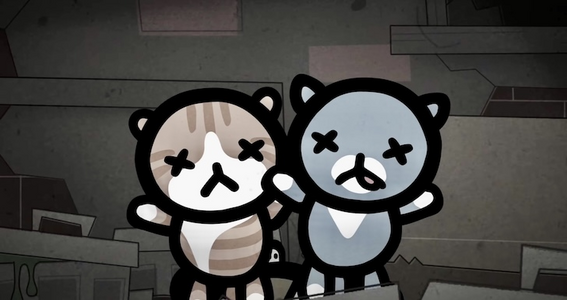

Cult of the Lamb is an action roguelite and cult simulator by Massive Monster and Devolver that was first released in 2022. Read our review to see what it did well, what it didn’t do well, and if it’s worth your money.
Overview
What is Cult of the Lamb?
Cult of the Lamb is a 2022 roguelike action management game by Massive Monster and Devolver Digital that puts players in the fleece of a sacrificial lamb leading their own cult. Saved from certain death and forced to do the bidding of The One Who Waits, players must manage their growing cult while going on holy crusades against the Four Bishops of the Old Faith who put them to the sword in the first place.
Cult of the Lamb features:
⚫︎ Cult-based management and socialization mechanics
⚫︎ Randomized roguelike runs across 4 biomes
⚫︎ Branching cult and faith trees improved through sermons
⚫︎ 2-player local co-op functionality
| Digital Storefronts | |||||||
|---|---|---|---|---|---|---|---|
 Steam Steam |
 PSN PSN |
 Xbox Xbox |
 eShop eShop |
||||
| $24.99 | |||||||
Cult of the Lamb Review: Delightfully Heretical
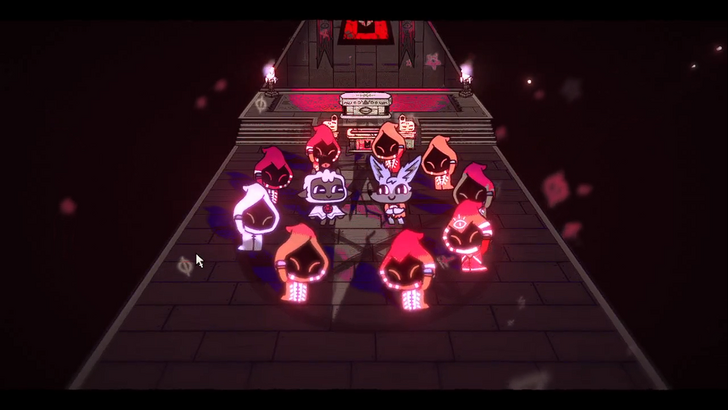
When you think of cults and bohemian revelry, the mind often wanders to hooded figures, burning pyres, and the odd government conspiracy. Images of slain sacrifices, burnt effigies, and scattered bones tug at the imagination, but I’ll tell you what doesn’t: cute animals.
Never did I think that cult activity would be considered adorable, but that was before 2022, when Cult of the Lamb burst into the scene with dagger in hand. I couldn’t believe my eyes when these plush, Cartoon Network-worthy creatures began sacrificing each other to dark, esoteric forces awash in satanic imagery. And yet, here it was, tearing up the indie scene with its unmistakable visuals.
This game is a known indie darling and has been for years now, but I’ve not scrutinized it with a critical eye until recently. Does it pass my inspection and hold up to great expectations? The short answer is yes, but the "why" might not be what you expect. Let’s dive right in.
Cult Management and Heresy for Dummies
We begin this journey where another ends. Sacrifice. This was the fate of the Lamb, last of his kind, and destined to die as decreed by the Four Bishops. Though undeniably guiltless, this was what must be done for heresy to cease its grip on the Bishops’ lands, and for the Fallen One to remain in their incarceration. With the drop of an axe, darkness overtakes all.
I lied, though, as this story does not end here. The Lamb is saved by a mysterious deity called The One Who Waits, bestowing upon them a cursed crown and an edict to spread their influence upon the Bishops’ lands. The Lamb must now start a cult, bring The One Who Waits’ power to bear, and strike down the Bishops who wronged them both.
Dramatic as that sounds, it’s nowhere near as entertaining as experiencing this firsthand. The storytelling and gameplay go from cute to harrowing and back to cute again in a span of a few minutes, and I’m all for it. This is the main meat of the game, though, and it’s time I explain it in detail.
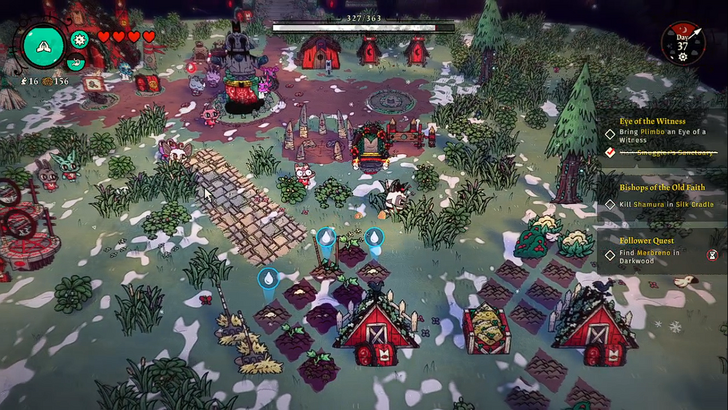
Starting a cult is no easy matter, but The One Who Waits grants you everything you need to do so. We begin with your first follower, whom you must indoctrinate like all who come after them. Once steadfastly within your cult, you can order this follower around to accomplish menial tasks such as gathering wood, collecting stone, building structures, and most importantly, worshipping you as their leader. This is the gameplay cycle of Cult of the Lamb in a nutshell, and it all revolves around your followers.
You gain followers, tell them what to do, and they accomplish the tasks to grant you resources, rinse, and repeat. Once they worship you enough, you can use this divine inspiration to think up new structures and ideas to run your cult better, and then you can use your followers to enact said ideas.
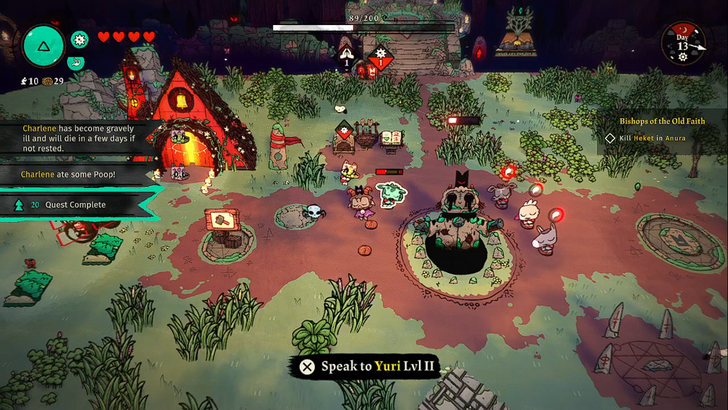
It’s quite the positive feedback loop, and would make for a great base-building game if that’s all Cult of the Lamb offered. But what if I were to tell you that this fun base-building and all its intricacies are but 50% of what the game offers? That’s right, in addition to sprucing up your base Midsommar style, you can also head out and kill some heretics on the game’s roguelike claim to fame: Crusades.
Crusading for The One Who Waits
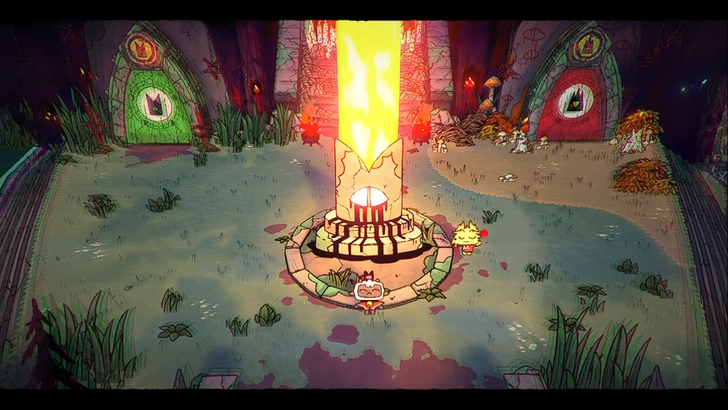
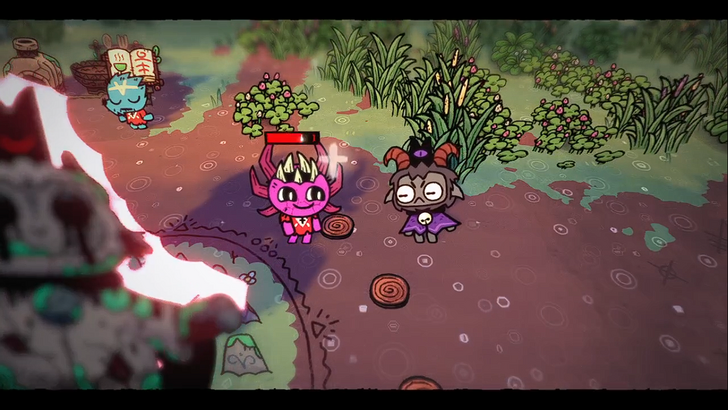
As historically derivative as that sounds, that is technically what the game calls your excursions to murder heretics and stick it to the Bishops. And it’s no picnic either, since not only must you survive the attempt, you must also get back to your cult as soon as you can, lest they starve, kill each other, or worse.
It’s like a shopping trip of sorts, with you gathering resources and running errands while leaving your children (fully-grown cultists) at home. The crusade itself is structured like your standard room-based, Zelda-style dungeon crawler with a few distinctions. Firstly, these runs are noticeably shorter, taking ten minutes at most to finish, and that’s pushing it. Each level usually has fewer than ten rooms, with only 3-4 levels per run, so it really isn’t that epic a quest overall.
Secondly, how bosses are structured is different in that you don’t really ever fight the same boss twice. It’s not like in The Binding of Isaac, where a random draft of bosses awaits you at the end of the floor. No, it’s a linear progression of bosses, with the same order of bosses awaiting each short run, progressing to the next one in line for the next run once you beat one.
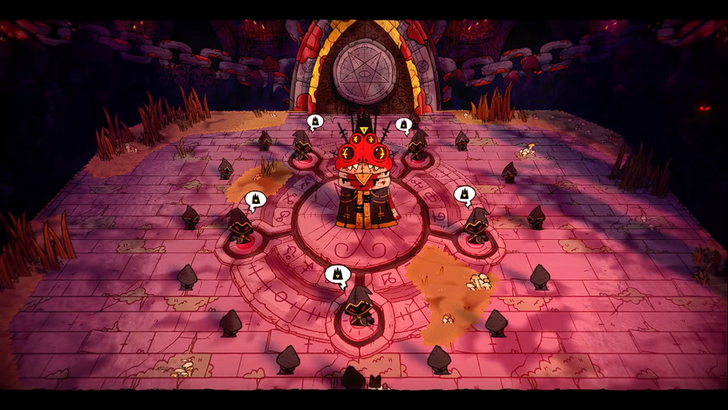
Every three bosses, you face one of the Bishops, a particularly powerful entity tied to the game’s main story and your means of unlocking the next biome and its resources. While on the topic of biomes, there are four: Darkwood, Anura, Anchordeep, and Silk Cradle. There’s one for each of the Bishops, and each comes with its own set of unique resources your cult will eventually need.
There’s no progressing very far without crusading, as you’ll eventually need a resource that your current biome simply doesn’t have. There’s no crusading for too long either, because your cult will eat itself alive if you don’t come home. This intentional balance between the game’s two halves is the main allure of its craftsmanship, because if either were off in its balancing by a millimeter, the whole thing falls apart. More on that later, though, because we have more mechanics to cover.
Rites, Rituals, and Revelry
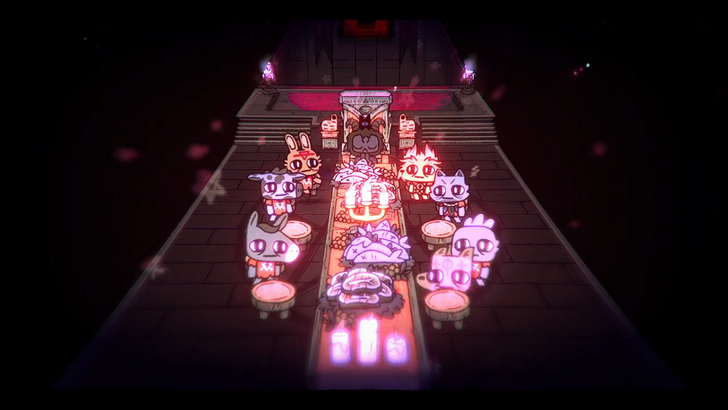
So those are the broad strokes of Cult of the Lamb. How about we get into the nitty-gritty? Surely decoration and slave labor aren’t all the cult side of the game offers? It’s fun and all, but not all too cult-y. Not to worry, if that wasn’t cult-y enough for you, then how do mortal sacrifice, ritual nudity, deific ascension, sanctified holy combat, cophrophagia (don’t look that up), and drum circles sound?
Rites, rituals, and revelry go hand in hand with this game’s aesthetic, and it has a metric ton of them for you to try out. Unsurprisingly fueled by the bones of fallen enemies, these rituals, usable from your church, grant powerful temporary or one-off effects when activated. From something as simple as the Bonfire Ritual boosting your overall Faith, to the sacrifice of one of your followers, to actual resurrection, this game has almost every pop-culture cult ritual in it, and then some.
While on the topic of church and faith, Cult of the Lamb does not shy away from using the concept of religion for more than simple cultist activities. It’s not just a gimmick, since faith is an integral part of gameplay when you use it well. There is no better example for that than the Sermons and Doctrines you can hold and cement, respectively, while on the pulpit of your church.
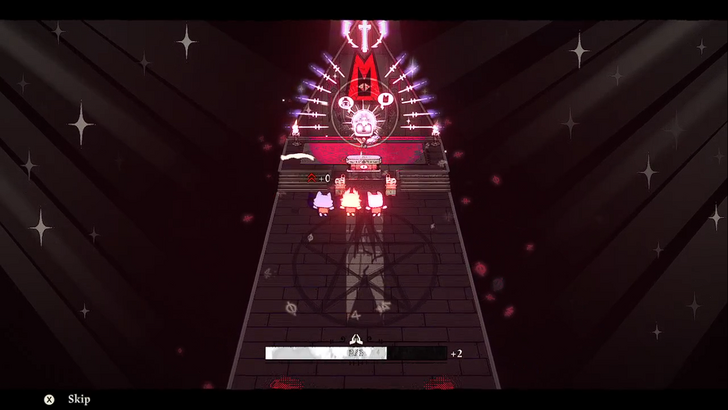
Sermons are daily gatherings you can perform to leverage the faith of your followers into something useful. Their Devotion represents the level of their Faith, and the higher the Devotion, the more they contribute per sermon. What you gather in sermons can be used to upgrade your church, improving aspects of your crusades, or parts of your cult’s various facets entirely.
Doctrines, meanwhile, are more powerful and seldomly enacted edicts that require rare Commandment Stones from your crusades to activate. Doctrines can cover one of six possible aspects of your cult’s activities, each with four levels, requiring a Doctrine for each. Whenever activated, a Doctrine presents a dichotomous choice between two extremes, the consequences of which will affect your cult for the rest of the game.
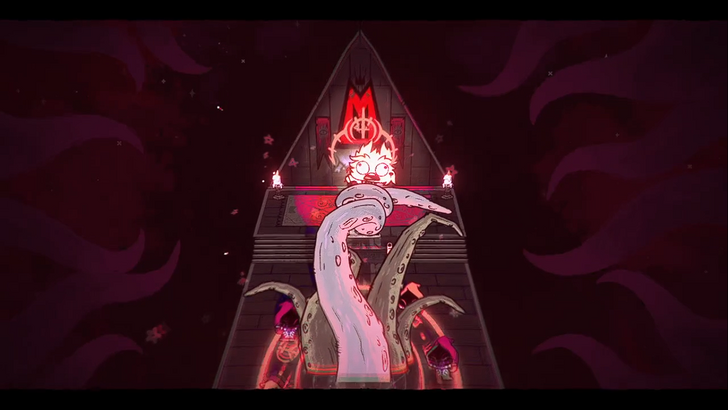
These effects can range from unlocked Rituals to permanent passives applicable to all current and future followers. For example, setting a doctrine regarding the concept of the afterlife posits a choice between honoring the elderly or understanding that the good must die young. The former increases faith for each elderly follower in your flock, and the latter punishes you for letting anyone die of natural causes.
Slowing Down the Late Game
There simply is a lot to do in this game, especially once you unlock the last facet of your cult in the midgame—the concept of Sin—and use it to upgrade your church even further. That said, despite this density of content, the late game really slows down to the point of monotony.
This reflects a larger issue that Cult of the Lamb has in that it’s exceedingly easy. The early game is forgiving, getting tougher as the midgame approaches. At this point, you’re just starting out, don’t have many cult buildings up, barely any church upgrades set, and your flock is a measly handful.
Once you’ve got a couple of Bishop hearts under your belt, though, things take a turn for the simpler. That is to say, the closer you get to the endgame, the easier the game gets. The upgrades you unlock simply outpace the game’s difficulty by a lot, so you’re left styling on enemies or the rest of the game. While that sounds fun, it gets boring really quickly, which is a shame, because boredom, up until that point, wasn’t an emotion I wanted to associate with the game.
This Game Slays (Upon the Altar)
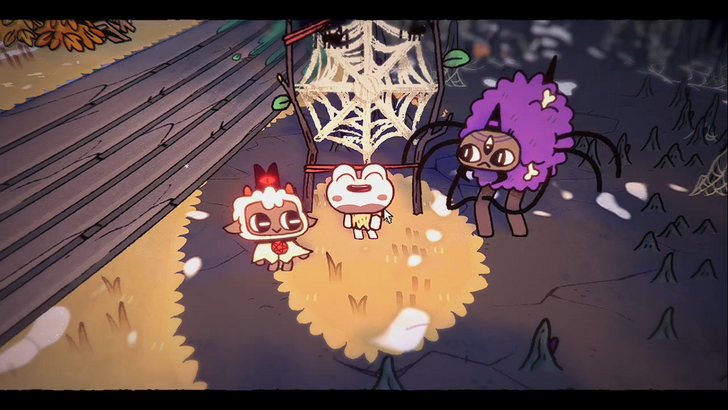
Overall, Cult of the Lamb is a tour de force in theming and game design that manages to juggle an obscene complexity in both respects. It makes cult activities not so distasteful without diluting the significance of said activities to the in-universe characters, while also managing both a decorate-a-thon and an entire roguelite dungeon crawler on top.
Few games can do this balancing act with such mastery, while both looking and sounding good, because apparently, this game needed more accolades. Sadly, it does compromise in one way, and that’s mostly with its balancing and the monotony of its late game. But hey, I heard that new Woolhaven DLC expansion is out, and it’s all late game. What we got now, though, is delightfully heretical in every way.
Is Cult of the Lamb Worth It?
Blessed Are Those Who Purchase This
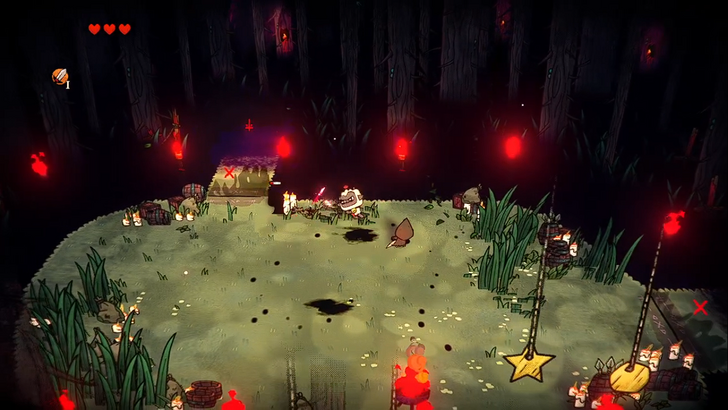
Cult of the Lamb is a must-buy for most kinds of gamers out there because there’s a little bit of something here for everyone without compromising each of its parts. If you like decorating and managing bases, it’s got you. Action roguelites? This game has that by the buckets. Dark fantasy theming, banger music, or just plain morbid fascinations? Yes, yes, and yes.
All you need to be part of the flock is a meager $24.99, which is no small chunk of change and might be inaccessible for some, but more than worth it in the long run.
Cult of the Lamb [Switch 2] FAQ
How Do I Level Up Followers in Cult of the Lamb?
Players can level up their followers’ devotion in Cult of the Lamb in various ways. The most common and repeatable way is to bless followers, which can only be done once a day per follower and moderately increases their devotion.
Players can also give their followers big and small gifts, both obtainable while crusading. Certain specific food items also have a chance to increase follower devotion, as do certain buildable structures like the Confession Booth.
How Do I Unlock Webber in Cult of the Lamb?
Players can unlock Cult of the Lamb’s collab character with Don’t Starve Together, Webber, by squashing spiders at night while at their cult’s base. The Skull Spider has a rare chance to drop from these spiders and, when buried in a body pit, will turn into a Webber follower.
Game8 Reviews